Popular JavaScript frameworks in 2026 include React, Next.js, Vue, Angular, Svelte, and SolidJS. React, Angular, and Vue.js dominate the charts as the best JavaScript frameworks. They present significant new advancements focused on performance, developer experience, and server-side functionality.
Elysia stands out as the only back-end JavaScript framework built on Bun. While relying on a new runtime is a gamble, Bun’s rising popularity suggests the experiment is paying off. However, on usage, Express is still king, and Nest grows fast.
So, with all the options available, what frameworks are the best to focus on to ease your web development process?
Stack Overflow Developer Survey proves, once again, that JavaScript continues to be the most in-demand language for the 13th year straight, with 66% of approval. Why? JavaScript has versatile frameworks that can be used for both front-end and back-end development, and is efficient when testing websites or web applications.
We created this list with the most in-demand JavaScript frameworks, evaluating the best ones based on the most recent State of JS. We carefully reviewed their features, performance, scalability, maintainability, and other factors to determine which framework is the best fit for your project.
By the end of this article, we trust you can make an informed decision on which is the best framework for you to use.
Top 5 JavaScript Frameworks You Should Have on Your Radar
We have broken down the selection of JavaScript frameworks based on usage into three categories. These are the results:
| Front-end Frameworks | Back-end Frameworks |
| React | Elysia |
| Angular | Nest.js |
| Vue | Express |
| Svelte | Fastify |
| Preact | Strapi |
5 Popular JavaScript Front-End Frameworks
In the 2025 State of JS ecosystem, React remains the undisputed heavyweight, leveraging its massive ecosystem and the maturity of the React 19 compiler to maintain the highest usage and job market demand.
Vue.js continues to thrive as the “progressive” favorite, balancing a gentle learning curve with powerful performance through its new Vapor Mode.
Angular has seen a significant resurgence in developer “happiness” scores by modernizing its core with Signals and incremental hydration, solidifying its role as the go-to for robust enterprise architecture.
Svelte maintains its status as the performance leader, with Svelte 5’s “Runes” system further refining its unique compile-time approach to eliminate virtual DOM overhead.
Finally, Preact remains the essential specialized tool for developers who need React’s declarative power within a tiny 3kB footprint, making it the top choice for performance-critical widgets and lightweight embeds.
1. React

Built by Facebook and officially hosted by the React Foundation, this framework prioritizes the simplification of building interactive UIs. React developers can build and operate the dynamic UI of web pages with high incoming traffic. The framework has functional, declarative, and component-based styles.
React now in 2026 allows components to render on the server by default. This means less JavaScript is sent to the user’s browser, making sites much faster than the traditional “Client-side only” React from years ago. Additionally, React is declarative and component-based; developers can reuse components to create complex UIs in a short amount of time.
React Latest Statistics
- 44.7% of developers are using React, which makes it the most popular front-end JS framework (Stack Overflow survey 2025 and Statista)
- 85% of JavaScript developers are using React.js, and 27% have shown an interest in learning this framework for the near future (State of JS 2025 survey)
- GitHub: 243K stars, leading for ten years straight, surpassed only by OpenClaw.
2. Vue
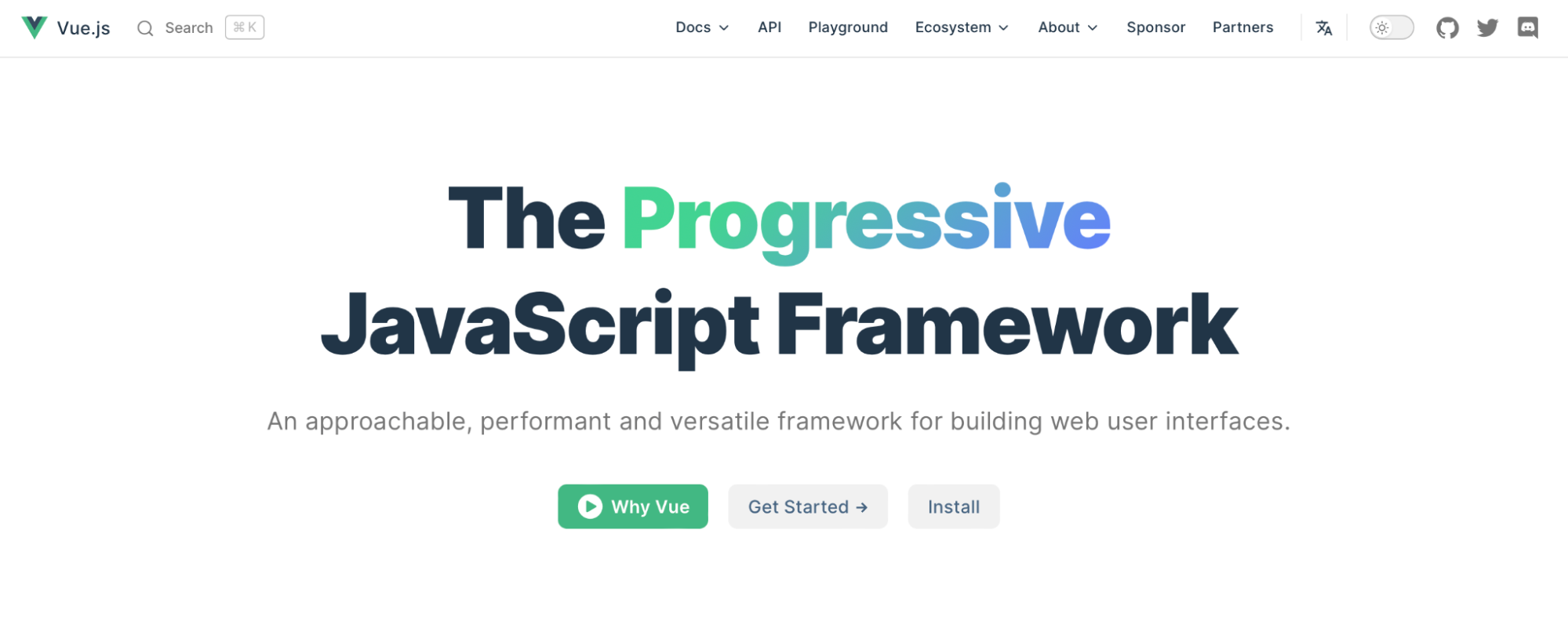
Vue calls itself “the progressive JavaScript Framework”. In this framework, the core library exclusively focuses on the view layer; any additional functionality must be adopted in increments. You can use either JavaScript (easy entry) or TypeScript (industry standard). Vue does not force you to use one over the other, which is part of its “progressive” charm.
Vue.js uses a Composition-based architecture. With the introduction of the Composition API, logic is often organized by feature rather than strictly following the ViewModel controller structure. Vue 3 handles data “under the hood” using JavaScript Proxies, making it fast and memory-efficient.
3. Angular
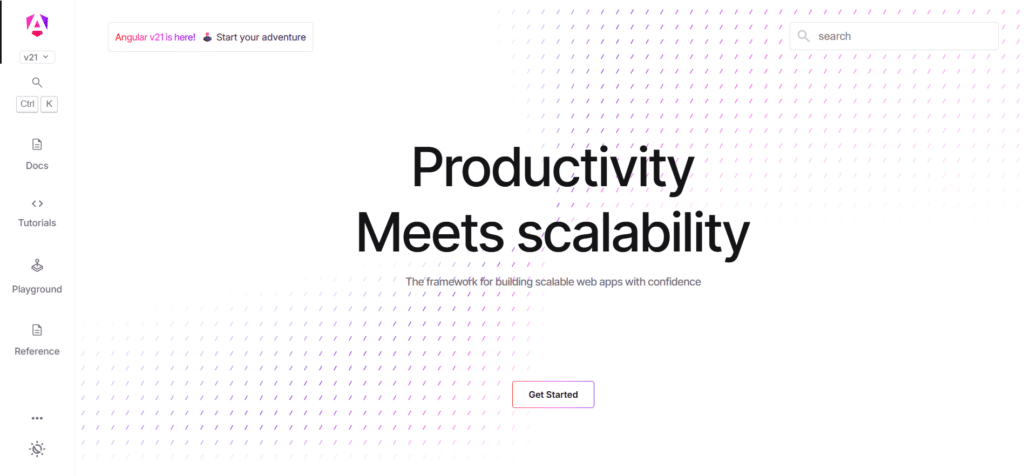
Angular is a comprehensive framework designed for building scalable, high-performance web applications. While AngularJS (1.x) revolutionized the web, modern Angular (v2 and beyond) was a complete rewrite designed to handle the demands of modern enterprise-grade software.
However, Angular requires TypeScript. Technically, you can write an Angular application using plain JavaScript (ES5 or ES6), but the framework is built from the ground up for TypeScript. Still, Angular is largely used by companies.
Angular Latest Statistics
- Angular is the third most used JS framework in 2025 (State of JS)
- Angular ranked 8th for web frameworks, with 18% positive response (Stack Overflow Developer Survey)
- Almost 1 million live websites are using Angular (BuiltWith)
- GitHub: More than 100K stars and 2,234 contributors.
4. Svelte as an Emerging Framework and Innovative Approach
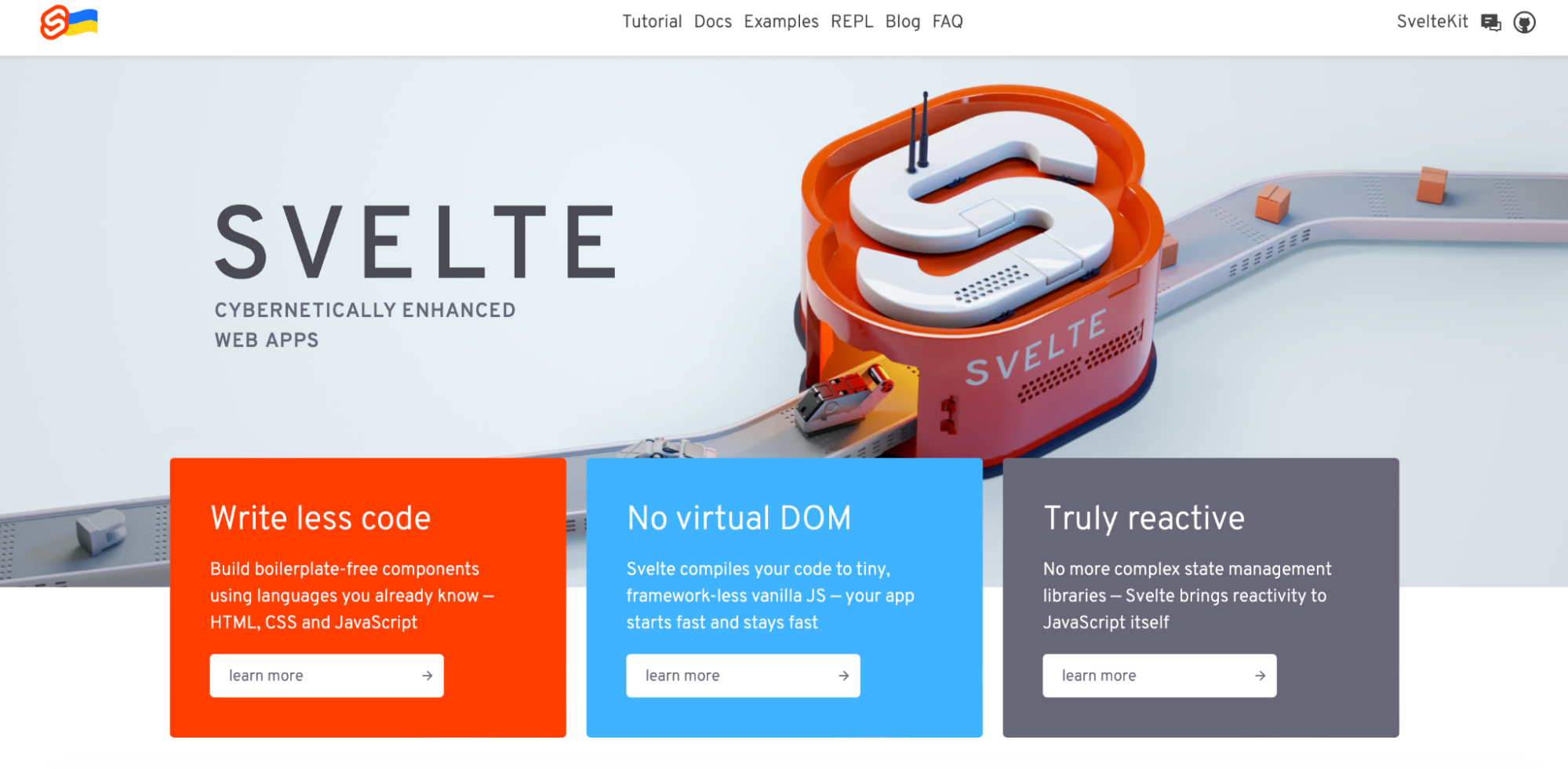
Svelte offers an innovative approach to building user interfaces by shifting the heavy lifting from the browser to the build step. Unlike traditional frameworks that rely on a Virtual DOM to manage changes, Svelte acts as a high-performance compiler. It transforms declarative components into highly optimized JavaScript that surgically updates the DOM only where necessary, resulting in exceptional runtime performance and smaller bundle sizes.
With the introduction of Runes in Svelte 5, developers can write even more concise, predictable code that works seamlessly across both components and standalone modules. It utilizes a familiar syntax based on HTML, CSS, and JavaScript (with first-class TypeScript support), enabling programmers to reduce boilerplate, minimize bugs, and significantly increase the maintainability of their applications.
Svelte Latest Statistics
- Svelte is the most appreciated framework, with 71% of developers engaged with it (State of JS 2025).
- Over 63% have shown interest in learning or using Svelte (State of JS 2025).
5. Preact
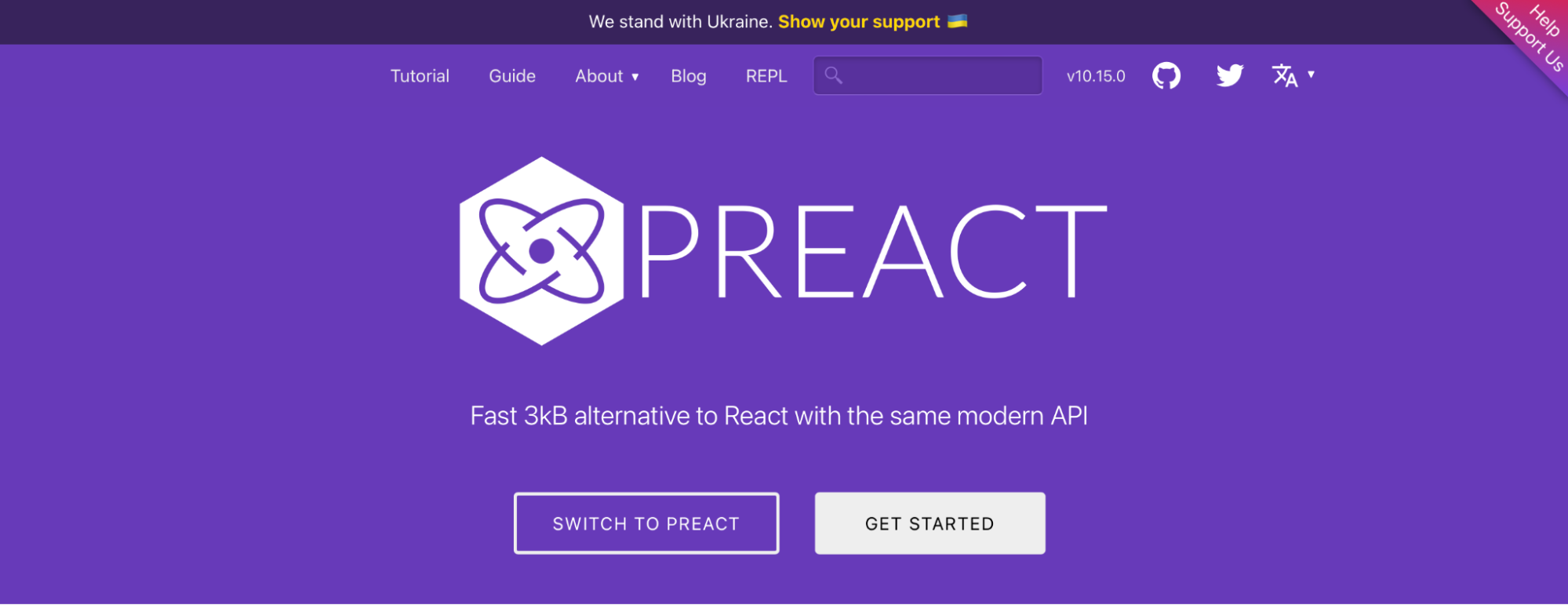
Preact is a fast and lightweight JavaScript library for building user interfaces. It is often referred to as a “react-compatible” library because it provides a similar programming model and API as React, but with a smaller footprint.
The framework is designed to be a drop-in replacement for React in most cases, offering a similar development experience with a smaller bundle size, embedded widgets, islands architecture, Strict SEO, Core Web Vitals, and improved performance.
Preact Latest Statistics
- Preact is the most appreciated (54%) JavaScript framework (State of JS 2025)
- More than 2.5 million websites are using Preact (BuiltWith)
- Preact recorded 14 million downloads per month (Snyk)
5 Best JavaScript Frameworks For Backend Development
The State of JS 2025 highlights a fascinating split between the “old guard” and high-performance newcomers. Express maintains its massive lead in total usage despite growing developer fatigue regarding its lack of modern TypeScript features.
Nest.js continues to dominate the enterprise sector, prized for its Angular-inspired architecture and robust dependency injection, while Fastify remains the go-to for performance-critical applications due to its low overhead and superior JSON schema validation.
The most significant shift this year is the meteoric rise of Elysia, which has captured developer attention by leveraging the Bun runtime to provide end-to-end type safety and speed that outclasses traditional Node.js frameworks.
Meanwhile, Strapi continues to lead the headless CMS niche, evolving from a simple backend tool into a comprehensive content infrastructure that developers value for its framework-agnostic flexibility.
1. Express
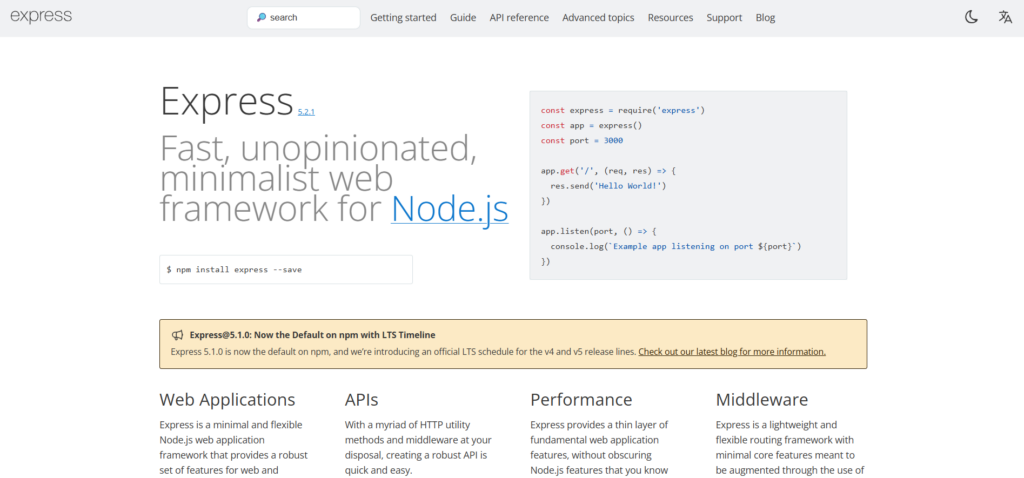
Express.js is a fast and minimalist web application framework for Node.js. It provides a simple and flexible approach to web application development and APIs. The framework is designed to be unopinionated, so developers have the freedom to structure and organize their code as they want.
Express is one of the top JavaScript frameworks due to its ability to accelerate server-side development. It significantly reduces the time required for complex tasks that would otherwise take hours when using pure Node.js. With Express, developers can resolve these tasks in just a matter of minutes.
ExpressJS Latest Statistics
- Express was ranked as the 3rd best web framework overall (Stack Overflow Survey 2022)
- It has over 29 million downloads (NPM)
2. Nest.JS

Nest.js is a progressive JavaScript framework used by developers to build scalable server-side applications. It’s built on top of Node.js and leverages Typescript to provide a strongly-typed and object-oriented development experience.
This backend framework boasts the architectural principles of Angular, such as modularity, dependency injection, and decorators. And while it leverages TypeScript, in 2026, we see more developers using it with SWC (Speedy Web Compiler) instead of the standard tsc for significantly faster build times.
3. Elysia
Elysia is the breakout star of 2026. It’s a JavaScript framework built from the ground up to maximize the Bun runtime. Elysia is designed with a “human-first” philosophy, focusing on extreme performance without sacrificing developer ergonomics. In fact, Elysia amassed 91% of developer satisfaction in the State of JS 2025.
Elysia’s standout feature is its static code analysis (Sucrose), which allows it to pre-optimize routes and generate code on the fly. Surprisingly, it often rivals the speed of frameworks written in Go or Rust.
In 2026, Elysia is the go-to for developers who want end-to-end type safety. Through its “Eden” connector, types are shared between the server and the client (like a high-performance version of tRPC) without a separate compilation step. While it was born on Bun, its 2026 version is fully WinterTC compliant, meaning it now runs seamlessly on Node.js, Deno, and Edge environments like Cloudflare Workers.
Elysia Latest Statistics
- 2.3M+ requests per second in plain-text benchmarks, outperforming Fastify by nearly 6x and Express by 21x.
- Elsyia captured the highest interest among backend developers in the State of JS 2025, with a satisfaction rating consistently above 90%.
- GitHub: Rapidly climbed to 17K+ stars, becoming the fastest-growing backend repository in the last 24 months.
4. Fastify
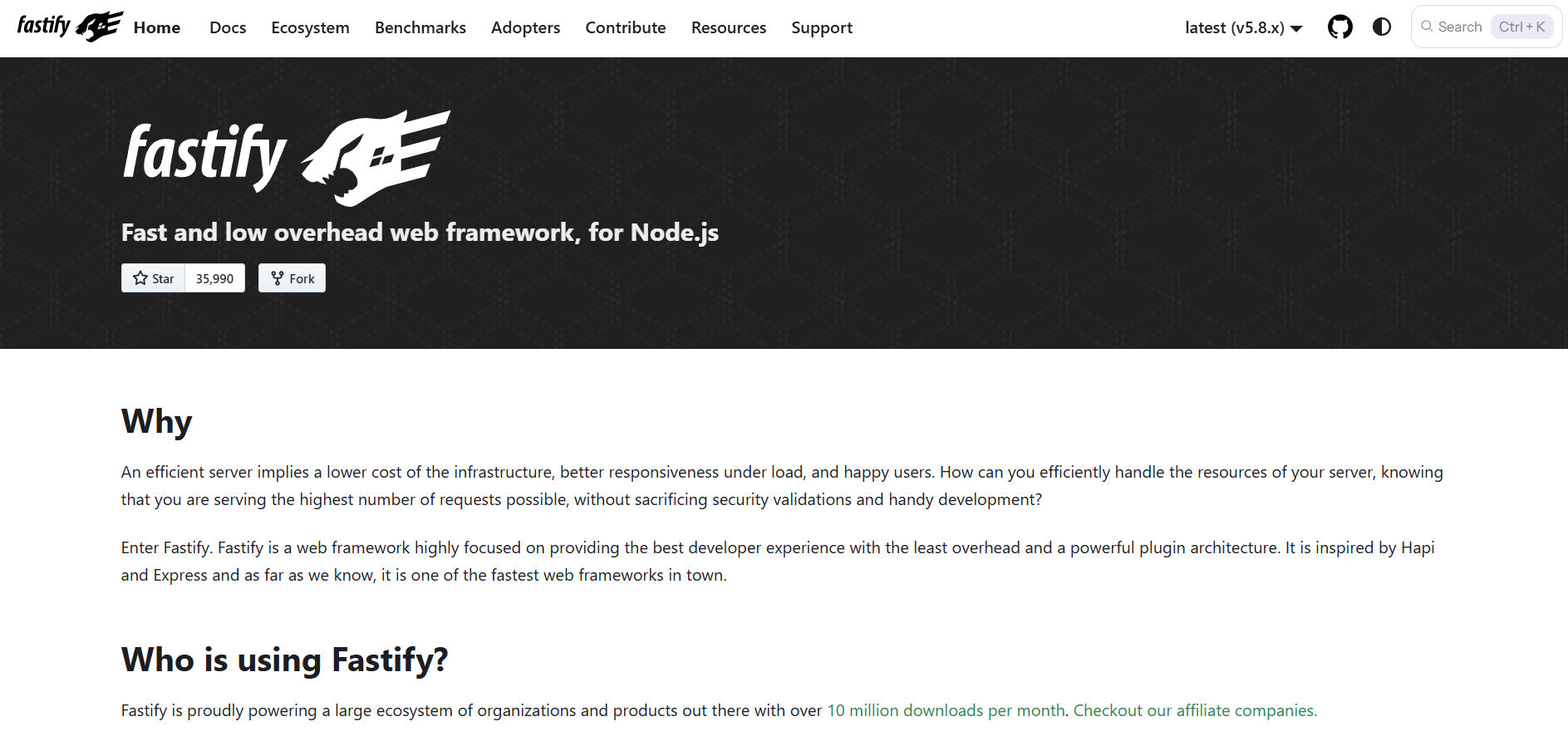
Fastify is a JavaScript framework focused on providing the best developer experience with a powerful plugin architecture. Hapi and Express inspire Fastify; however, it’s built to be one of the fastest frameworks in the Node.js ecosystem. In 2026, it remains a favorite for developers who prioritize performance without sacrificing the convenience of a rich feature set.
One of Fastify’s standout features is its focus on JSON Schema validation. By using schemas to compile functions, Fastify can speed up serialization and provide automatic validation for routes. It also boasts a completely encapsulated plugin system, allowing you to modularize your application without worrying about cross-contamination of dependencies.
Fastify Latest Statistics
- Fastify serves up to 70,000-80,000 requests per second, making it significantly faster than Express.
- Over 290+ community-maintained plugins and 60 core plugins.
- GitHub: Over 36K stars with a reputation for high code quality and security.
- Downloads: Consistently records over 10 million downloads per month (NPM).
5. Strapi
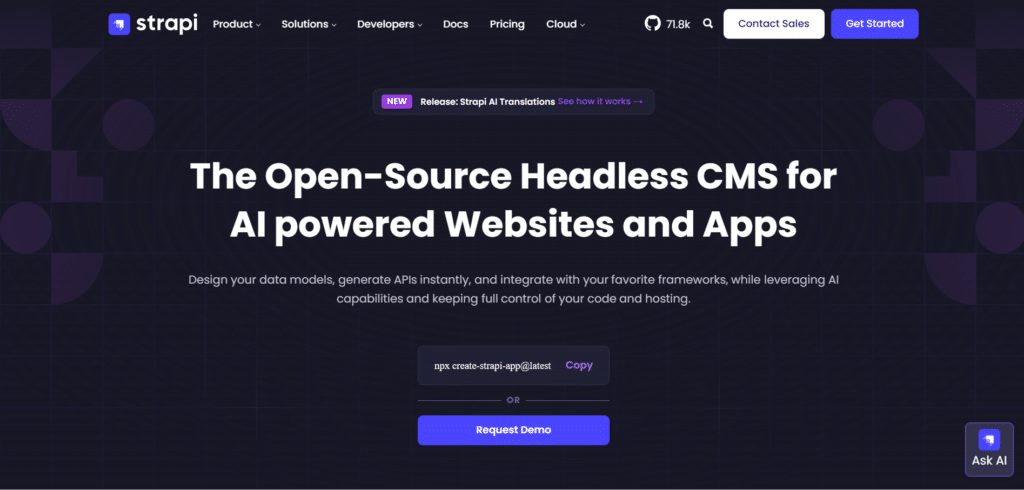
Strapi is a comprehensive content infrastructure. As the leading open-source headless CMS, it appeals to developers who demand maximum control over their content and infrastructure. Strapi 5 earned its place in the enterprise market by completing a full migration to TypeScript and introducing the “Document Service API.” It replaces the older Entity Service for a more streamlined developer experience.
With the 2026 updates, Strapi now features native AI-powered content workflows, including retroactive metadata generation for media libraries and an “AI Content Type Builder” that can infer data structures from Figma files or images. Its architecture remains framework-agnostic, though it is frequently paired with Next.js for high-performance, full-stack applications.
Strapi Latest Statistics
- 70K+ stars on GitHub, maintaining its position as the most popular open-source headless CMS.
- 50 million+ downloads on NPM, reflecting its massive footprint in the Node.js ecosystem.
- 100% TypeScript coverage in the core codebase as of the 2026 stable releases.
A Framework to Choose Between JavaScript Frameworks in 2026
Here is a new, structured framework for decision-making called the V.A.L.U.E. Matrix. It moves away from what is popular and towards what is appropriate for the lifecycle of your product.
Here is the rule of thumb: Don’t switch frameworks for performance; switch for architecture. With the advent of the React Compiler and Vue’s Vapor Mode, the “speed gap” between major frameworks has shrunk.
In 2026, you should choose based on Developer Happiness and Ease of Maintenance rather than raw millisecond benchmarks.
1. Volume & Velocity (Project Scope)
Determine the scale of the application and how fast you need to ship.
High Volume/Enterprise
If you are building a “forever” app for a bank or insurance company, Angular is the choice. Its “Signals” and “Zoneless” updates in v21+ provide the guardrails needed for 50+ developer teams.
High Velocity/Startup
If you need an MVP by next Tuesday, Vue.js or Svelte trumps. Their gentle learning curves and “Vapor Mode” (Vue) or “Runes” (Svelte 5) allow for rapid iteration without the boilerplate of React hooks.
2. Architecture Preference (Rendering Strategy)
In 2026, the way of rendering matters as much as the what.
Server-First (SEO/Content)
If SEO and Core Web Vitals are your KPIs, choose Astro or Next.js. They prioritize React Server Components (RSC) to ship zero-to-minimal JS to the client.
Client-Heavy (Interactivity)
For complex dashboards or SaaS tools where the user stays on one page for hours, React (with the new Compiler) or SolidJS provides the best fine-grained reactivity.
3. Longevity & Labor (Ecosystem & Hiring)
A framework is only as good as the people you can hire to fix it.
The “Safe” Choice
React remains the industry standard of 2026. You will never struggle to find a developer or a third-party library.
The “Specialist” Choice
Preact or Svelte. These attract high-performing “performance nerds.” Choose these if your brand identity is built on being the “fastest web app on the market.”
4. Underlying Runtime (The “Bun” Factor)
2026 is the year the runtime (Node vs. Bun vs. Deno) finally dictates the framework.
Bleeding Edge (Bun)
If you are starting fresh and want faster performance, Elysia on Bun is the move. It is the first framework that treats the runtime as a feature, not just a host.
Legacy/Stable (Node)
If you are tied to AWS Lambda or established CI/CD pipelines, Nest.js or Fastify remain the kings of the Node.js ecosystem.
5. Efficiency of DX (Developer Experience)
How much “magic” do you want the framework to do for you?
Automated
React 19+ (with the Compiler) handles memoization for you. It’s for teams who want to “just write code” and let the build tool optimize it.
Explicit
Angular or Nest.js. These are for teams who find “magic” dangerous and prefer explicit structures, dependency injection, and strict TypeScript.
Quick Selection Guide
| If your priority is… | Choose (Front-end) | Choose (Back-end) |
| Hiring Speed | React | Express |
| Runtime Speed | Svelte / SolidJS | Elysia (on Bun) |
| Project Rigidity | Angular | Nest.js |
| Lightweight/Embeds | Preact | Fastify |
| Content/SEO | Astro | Strapi |
Conclusion
When talking about JavaScript frameworks in 2026, there is a convergence of performance and DX, where tools like the React Compiler and Svelte Runes automate optimizations. A bifurcation exists between the “Old Guard” (Express/Angular) and the bleeding-edge (Elysia), alongside a shift toward runtime-specific frameworks like Elysia on Bun for specialized, high-velocity rendering.
React and Angular lead the enterprise stability, while Svelte 5 and Vue’s Vapor Mode push the bleeding edge of performance. For the backend, Nest.js remains the scalable standard, but Elysia on Bun offers runtime-specific speed. Choosing depends on balancing ecosystem maturity with modern developer experience.
However, if you still struggle with choosing the right one, feel free to reach out. DistantJob can help you find JavaScript experts who can oversee your entire project and become part of your team. In less than two weeks, we can help you hire certified developers who will match all your expectations.
Conclusion
When it comes to finding the best JavaScript framework, you can’t go wrong with any of the frameworks mentioned. Each of these has its own set of advantages and disadvantages, so it’s important to choose one that will fit the specific needs of your project.
If you’re looking for a cutting-edge JavaScript framework to build user interfaces easily, Svelte is a good choice. If you’re looking for a JavaScript framework that is easy to use and has a small footprint, then Vue.js is a good option. And if you want to create real-time web applications, then Meteor is the right choice for you. It all depends on your needs.
However, if you still struggle with choosing the right one, feel free to reach out. DistantJob can help you find JavaScript experts who can oversee your entire project and become part of your team. In less than two weeks, we can help you hire certified developers who will match all your expectations.
FAQs
A JavaScript framework is a collection of ready-made components and solutions customized to speed up the development process. These frameworks provide benefits that JavaScript itself doesn’t offer. JavaScript frameworks include support programs, compilers, code libraries, toolsets, and APIs to develop software and create systems.
Frameworks and libraries are not the same thing. Libraries are collections of code designed for specific use cases. When developers use them, they call specific functions from the parent code. Frameworks are a more holistic approach. These don’t just offer one solution or one specific function but a complete template for development.
Vue.js is considered the easiest JavaScript framework to learn due to its simplicity and gradual learning curve, which makes it a great option for new JavaScript developers.
Use the V.A.L.U.E. Matrix to align your choice with project goals. Evaluate Volume (enterprise scale vs. startup speed), Architecture (server-first SEO vs. client-heavy interactivity), and Runtime (stable Node.js vs. bleeding-edge Bun). Prioritize Developer Experience and Architecture over raw benchmarks, as modern compilers have significantly narrowed the performance gap.