I’ve watched companies lose more money fixing a bad IT hire than they would have spent doing the search properly the first time. A 2024 EMA Research and Big Panda study put downtime costs as high as $14,056 per minute. That number gets people’s attention, but here’s the part most hiring guides skip: the damage isn’t just the outage. It’s the six months you spend untangling decisions a weak hire made before anyone noticed they were in over their head.
To hire an IT specialist, first define the specific role you need: security, sysadmin, database, network, or IT manager, since each requires different hard skills. Screen for relevant certifications, test problem-solving with live coding or take-home challenges, and budget realistically: junior IT specialists earn roughly $50K-$70K, mid-level $70K-$95K, and senior specialists $95K-$130K+ in the US, with lower ranges common for skilled remote hires.
“IT Specialist” Is Not One Job. Stop Hiring It Like It Is.
Here’s a mistake I see constantly: a company posts a job for “an IT specialist” with a generic list of responsibilities, then gets confused when the candidates who apply can’t agree on what the role even is. That’s because “IT specialist” isn’t a job title, it’s a category. A network engineer and a database architect have almost nothing in common day to day.
Pick the actual role before you write the job post.
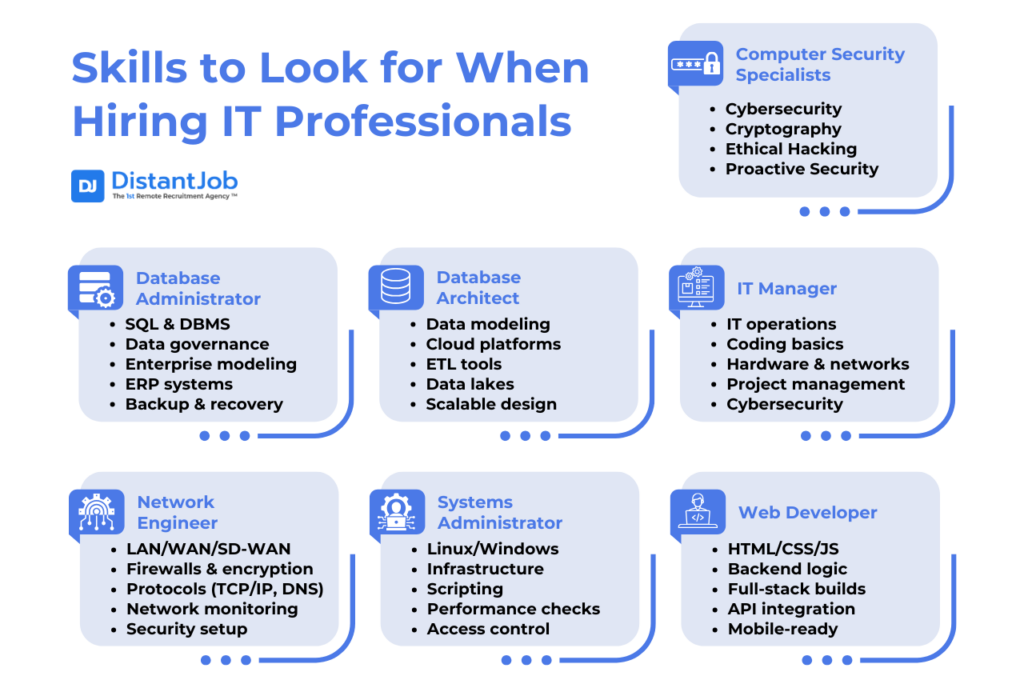
| Role | What they do | Core hard skills |
|---|---|---|
| Computer security specialist | Protects systems from breaches and malware | Cryptography, ethical hacking, threat detection |
| Database administrator | Maintains and operates company databases | SQL, DBMS, ERP systems |
| Database architect | Designs database systems and data architecture | Data modeling, cloud platforms, ETL tools |
| IT manager | Oversees all IT operations and infrastructure | Coding, networking, security, team leadership |
| Network engineer | Builds and maintains company networks | LAN/WAN/SD-WAN, firewalls, encryption |
| Systems administrator | Keeps infrastructure stable and supports users | Linux/Windows, scripting, network protocols |
Everything below, skills, certifications, salary, depends on which row you’re actually hiring for.
What to Screen For: Skills and Certifications
Hard skills get the headline, but I’ve placed candidates with perfect resumes who fell apart the first time a server went down at 2 a.m., and they had to explain the problem to a non-technical CEO calmly. Both halves matter.
Certifications worth checking
I won’t pretend a certification proves someone’s good. It proves they passed a test. But it’s a fast filter that saves you from taking someone’s self-reported skills on faith.
- CompTIA A+ — baseline hardware/software troubleshooting, common for support and sysadmin roles
- CompTIA Network+ — networking fundamentals for network engineers and sysadmins
- CompTIA Security+ or CISSP — for security specialists, CISSP signals senior-level expertise
- MCSE (Microsoft Certified: Solutions Expert) — relevant for Windows-heavy infrastructure
- AWS or Azure certifications — increasingly important as more IT infrastructure moves to the cloud
Must-have vs. nice-to-have
| Must-have | Nice-to-have |
|---|---|
| Role-specific hard skill (e.g., networking for a network engineer) | A second specialization (e.g., a sysadmin who also scripts) |
| Clear, calm communication under pressure | Experience at a recognizable company |
| Problem-solving demonstrated through real examples | Public contributions (technical blog, open-source, forums) |
| Relevant certification or equivalent hands-on experience | Multiple cloud platform certifications |
Don’t let “nice-to-have” items disqualify a candidate who nails the must-haves. I’ve seen hiring managers pass on a strong network engineer because they didn’t have a GitHub profile. A network engineer doesn’t need a GitHub profile.
The soft skills that actually separate a good IT hire from a frustrating one:
| Soft skill | Why it matters |
|---|---|
| Communication | Translates technical problems into plain language for non-technical stakeholders |
| Problem-solving | Diagnoses and resolves issues through reasoning, not guesswork |
| Teamwork | Collaborates with other departments during incidents and projects |
| Emotional intelligence | Stays steady under the pressure of outages and deadlines |
| Asynchronous communication | Critical for remote or distributed teams working across time zones |
| Conflict resolution | Resolves disagreements without stalling a project |
How to Interview an IT Specialist
Split the interview into three parts: technical (what they know), behavioral (what they’ve actually done), and culture fit (how they work with your team). My advice: ask them to walk you through a real incident they handled, not a hypothetical. Anyone can recite the “correct” answer to a textbook scenario. The way someone describes an actual failure, what they missed, what they’d do differently, tells you far more.
For a deeper walkthrough of doing this remotely, see our guide to remote technical interviews.
How to Test an IT Specialist’s Skills
Live coding and take-home challenges are the two formats I see work. Go live if soft skills and real-time collaboration matter most to you. Go take-home if you care more about raw technical depth and want to see independent work.
One warning, because I’ve watched this backfire: experienced IT specialists, especially passive candidates who already have a job, won’t burn a weekend on a test that doesn’t respect their time. Keep it short, keep it relevant to the actual role, and tell them why you’re asking. Skip this and you’ll lose strong candidates before they ever reach an interview.
What to Actually Pay an IT Specialist in 2026
| Seniority | US salary range | Typical experience |
|---|---|---|
| Junior | $50,000 – $70,000 | 0-2 years |
| Mid-level | $70,000 – $95,000 | 2-5 years |
| Senior | $95,000 – $130,000+ | 5+ years, often specialized (security, cloud architecture) |
These move with location, certifications, and specialization. Security and cloud roles trend higher across the board. This is also exactly why so many companies I work with hire remote IT specialists out of Eastern Europe and Latin America: the same certification level and the same seniority, at a fraction of the North American price, because the cost difference is about geography and overhead, not skill.
Salary isn’t the whole offer either. I’ve seen candidates turn down a higher number for a role with more ownership, real mentorship, or remote flexibility. Don’t assume the biggest paycheck always wins. It usually doesn’t, once you’re past entry-level.
The IT Job Market Right Now
Tech hiring in 2026 is uneven. Some sectors are growing, others are cutting, often in the same news cycle. The specializations still in real demand: software development, cybersecurity, cloud computing, and data/AI infrastructure.
Here’s my actual advice, not the market commentary: a specific, well-scoped role beats a vague “IT specialist” posting every time. Strong IT professionals have options right now. They gravitate toward postings where the expectations are obvious, not toward companies that can’t articulate what they need.
Freelancer or Full-Time?
| Choose a freelancer if… | Choose full-time if… |
|---|---|
| The work is short-term with limited ongoing support needs | The role requires long-term infrastructure ownership |
| You need to fill a gap until a permanent hire starts | You expect the person to grow into broader responsibilities |
| The need is project-based and intermittent | You need someone invested in the company’s long-term success |
IT Specialist’s Soft Skills
While IT specialists widely vary in their technical abilities, the soft skills they all need are similar.
| Soft Skill | Description |
| Team-Work | Ability to work and collaborate with a team. |
| Emotional Intelligence | Mental resilience and maturity to cope with frustration. |
| Asynchronous Mindset | Capability to communicate with others asynchronously. |
| Communication | It allows us to transmit and understand important information. |
| Conflict Resolution | Solve misunderstandings without hindering work. |
| Problem-Solving | Solve problems through reasoning and testing solutions. |
Where Can You Recruit IT Professionals?
- Freelance platforms
- Job listing sites like Indeed or ThinkRemote
- Look internally for current employees who have relevant IT skills
- Headhunting from your competitors
- Post the job on your website or social media channels
- Remote IT recruitment agencies like DistantJob 😉
Need Help?
Hiring IT professionals has no tried and true method: it all depends on what you’re looking for and the resources you have available to do so.
If you’re struggling to find professionals to help you with your projects, then our expert recruiters can be your valued partner. We have more than a decade of experience finding the best remote developers and IT specialists out there to work for our clients, and we can do it for you too. We conduct rigorous vetting processes that will guarantee a professional, culture-fit employee for your company in as little as 2 weeks. Just book a discovery call today and learn more!
FAQ about how to hire an IT Specialist
Start by defining which type of IT specialist you actually need, security, network, database, sysadmin, or IT manager, since the title covers several distinct skill sets. Screen for role-specific certifications and hard skills first, then evaluate communication and problem-solving through real scenarios rather than hypotheticals.
Yes, if onsite presence isn’t a hard requirement. Remote hiring opens access to a larger talent pool, often at a lower cost than local hiring for the same seniority and certification level, without sacrificing technical quality when the vetting process is rigorous.
Look for IT consultants with experience in the areas you need assistance with, good customer service/communication/technical skills, references from past clients, a background/certifications check, and flexibility to create the best solution for your needs.