Hiring a Ruby on Rails developer is not as simple as it used to be. There is a narrower pool of talent than in the case of Python or JavaScript developers. The greatest Rails engineers have already been hired (and probably didn’t even fill out a traditional resume in the first place). And there are a ton of other companies, especially startups and fintech companies, that use Rails and are competing for the same staff.
But here’s what many hiring managers get wrong: they treat Rails hiring like any other developer search. Post a job, filter resumes, run a coding test. That approach worked in 2015. In 2026, with a tighter talent market and a framework that’s evolved significantly (Rails 8 shipped with major architectural changes), you need a more deliberate strategy.
So, how do you find and recruit the best Rails talent despite these challenges? This article walks you through the full process. We’ll talk about the main issues smaller teams face when hiring RoR talent and give you tips on how to overcome them.
Is Ruby on Rails Still Worth Hiring For in 2026?
This is the first question you need to answer honestly before investing in a Rails hire — and the answer is a clear yes, with some important context.
The “is Rails dead?” narrative has been circulating since at least 2018, and it’s wrong every year. As of 2026, Ruby on Rails holds a 19.95% market share in the web framework space. Over 22,130 companies worldwide use Rails in production, with 9,468 of them in the United States alone. Shopify, processing billions of dollars in commerce annually, runs one of the largest Rails monoliths in existence. GitHub, Airbnb, Basecamp, Hulu, and Kickstarter all continue to run on Rails.
What’s more, Rails isn’t standing still. Rails 8.0 shipped in November 2024 with transformative changes:
- The Solid Stack — Solid Cable, Solid Cache, and Solid Queue replace Redis and external job processors with built-in alternatives. This dramatically simplifies deployment and reduces infrastructure costs.
- Built-in authentication — A native authentication generator that handles sessions, password resets, and database-backed auth without external gems like Devise.
- Kamal 2 for deployment — Rails now ships preconfigured for zero-downtime deployment. One command takes a fresh Linux box to a running application server.
- Propshaft — A modernized asset pipeline replacing Sprockets, with better compatibility with modern JavaScript tooling like Vite, esbuild, and Bun.
- SQLite in production — Rails 8 makes SQLite a genuinely viable production database for many applications, further reducing infrastructure complexity.
Rails 8.1 followed in October 2025, adding job continuations (resumable background jobs after server restarts) and further reliability improvements.
The bottom line: Rails in 2026 is a leaner, more self-contained framework than it’s ever been. It’s not the right choice for every project (more on that later), but for web applications, SaaS products, marketplaces, and MVPs, it remains one of the most productive frameworks available, and the companies built on it aren’t going anywhere.
What Skills Should You Look For When Hiring Ruby on Rails Developers?
When hiring a Ruby on Rails developer today, you need someone who’s more than just a coder. Here are the key skills you should look for:
- Ruby Language Proficiency: Understanding Ruby syntax, conventions, and best practices.
- Rails Framework Knowledge: Familiarity with MVC architecture, ActiveRecord, routing, migrations, and RESTful design.
- Frontend Basics: Working knowledge of HTML, CSS, JavaScript, and frameworks like React or Vue.
- Database Management: Experience with relational databases such as PostgreSQL or MySQL.
- Version Control: Strong experience with Git and collaborative development workflows.
- Testing and Debugging: Proficiency with testing frameworks like RSpec or MiniTest and debugging techniques.
- Cloud and Deployment: Basic familiarity with cloud services (AWS, Heroku) and CI/CD pipelines.
Pro tip: Look beyond theoretical knowledge and prioritize real-world project experience and problem-solving capabilities.
8 Steps to Hire Ruby on Rails Developers
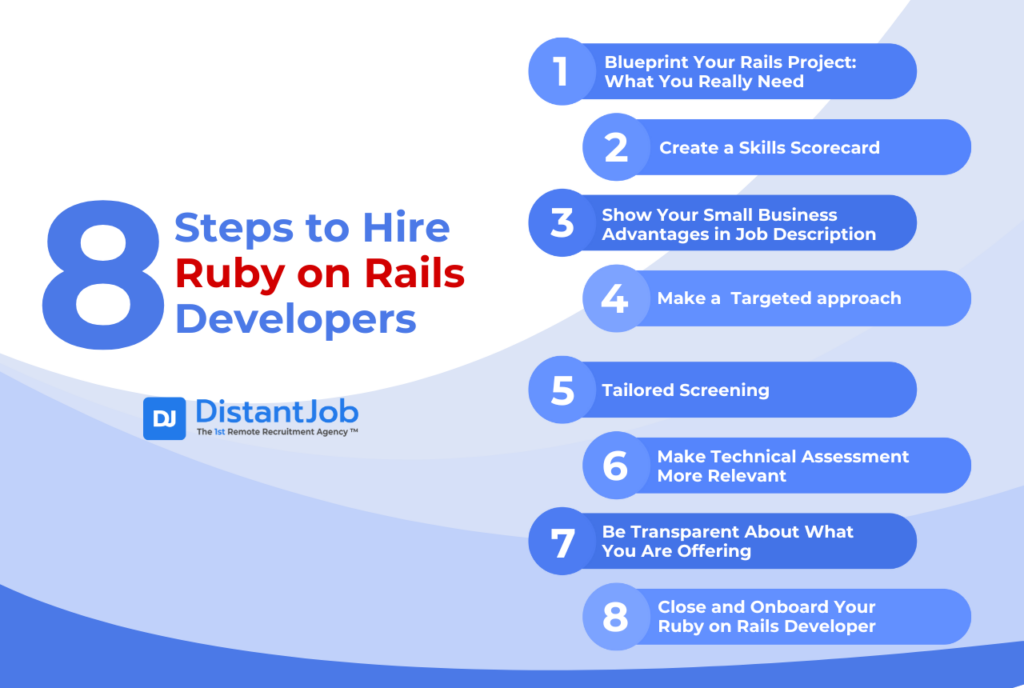
As with any web developer position, hiring a Ruby on Rails developer starts with understanding your needs. Once you have done that, create your recruitment strategy, hire the developer, and onboard them.
Here is a breakdown of each step:
1. Blueprint Your Rails Project: What You Really Need
Hiring the right Ruby on Rails developer starts with understanding not just your technical needs but also your company culture. You need to map out your Rails requirements in a way that reflects both the technical challenges and the unique values of their team.
Small businesses often fall into the trap of creating a wishlist of every possible Rails feature they might need. Instead, take a step back and consider your “Rails footprint” – the specific ways your business will leverage the framework. Are you building a customer-facing marketplace that needs real-time features? Or perhaps an internal tool that requires complex data processing?
Here’s what makes small business Rails projects different: you’re not just looking for someone to write code. You need a developer who can make strategic technical decisions that align with your budget constraints. They should know when to use existing gems versus building custom solutions and understand the trade-offs between quick wins and long-term maintainability.
Remember, you’re not just documenting requirements—you’re creating a narrative about your project that will help attract the right kind of Rails talent.
Be specific about the problems you’re trying to solve, not just the features you want to build. This approach will help you stand out to developers who are looking for meaningful challenges, not just another Rails project.
2. Create a Skills Scorecard (Must-have vs. Nice-to-haves in RoR Expertise)
Developing a skills scorecard is a crucial hiring best practice. It enables you to evaluate candidates’ skills and experiences based on key competencies and objectives. Focusing on these critical factors ensures you make more informed hiring decisions.
So, be ruthlessly specific with your skills scorecard. Instead of listing ‘Ruby and Rails framework experience,’ break it down. For instance: ‘Experience with Rails 8.1, API development using GraphQL, and AWS deployment.’
From my experience, I have noticed that precise requirements attract more qualified candidates—not fewer.
3. Write Compelling Job Descriptions Emphasizing Your Small Business Advantages
There is serious competition for top Ruby on Rails experts. As a result, companies are finding creative ways to attract them. Your job description is where you can stand out as a small business.
Avoid writing formulaic job descriptions that fail to highlight the unique aspects of your company culture and technical environment.
Instead, include your actual tech challenges. Another small business benefit you can highlight is direct collaboration with the CTO’ or ‘shape our entire Rails architecture.’ These perks can attract senior developers who are tired of big tech bureaucracy.
Additionally, write Ruby on Rails developer job descriptions that are simple to understand. Avoid cliches like ‘Rockstar ” or any other cringe-worthy job titles that oversell the role.
4. Targeted approach
You need to have the mindset of a recruiter and take a targeted approach when sourcing for Ruby on Rails developers.
If you want the best, you need to go where they are. The Ruby Weekly Newsletter is one such place. It is sent to over 41,000 Ruby developers, who will see your job listing after you pay a fee.
When used strategically, RubyNow and Rails Jobs are good channels for finding candidates. Ruby-focused Discord communities are also gems.
And if you want a done-for-you solution, partner with a headhunting service like DistantJob. Through our extensive networks, we’ll help you find experienced developers who meet your specific needs.
The best Ruby on Rails developers for hire are usually not actively looking for a new job. But a service like ours can help you find them and pique their interest.
5. Tailored Screening
Recently, I have looked beyond traditional degrees and experience when reviewing candidate applications. It’s not that experience doesn’t matter —because it does. But it doesn’t necessarily give you the complete picture of a candidate’s skills.
Now, I scan for contributions to any gems, even small ones. This tells me more about a candidate’s Rail expertise than experience.
For the initial call, avoid the standard ‘tell me about yourself’ format. Instead, start with ‘Walk me through the most complex Rails upgrade you have handled.’ This one question reveals their experience with dependency management, debugging skills, and problem-solving approach. If they haven’t done an upgrade, that’s valuable information, too.
A red flag I’ve learned to watch for: If a candidate can’t explain the difference between Active Record callbacks and service objects in practical terms—they likely haven’t dealt with complex Rails applications—regardless of their experience.
6. Make Technical Assessment More Relevant
Over the years, we have had to change our technical assessment approach. For the coding challenges, we have eliminated the generic ‘build a basic CRUD app’ assignments.
Why? They tell you nothing valuable, and frankly, the best candidates will question your competence if you propose such. Instead, we give candidates a small section of actual legacy code from the client’s application (with sensitive details removed, of course).
For the technical interview, I ask them to walk me through their coding challenge solution. But here’s the twist—I specifically ask them what they would do differently if the application had 10x the current traffic. This way, we get their understanding of Rails performance optimization.
Then, I dive into Ruby metaprogramming, not with theoretical questions, but by discussing real-life scenarios, such as, ‘How would you dynamically generate methods for different user roles?’Their approach tells me volumes about their Ruby expertise.
Finally, I have them review a piece of Rails code with several anti-patterns. Their insights during this review are often more valuable than their answers to direct questions.
7. Be Transparent About What You Are Offering
Explain your company’s vision, how the role fits within your team, and the growth opportunities available—even if your budget is tight. Small businesses often hesitate to be fully transparent about compensation and limitations, fearing it might deter candidates. However, experienced Rails developers appreciate honesty about what you can and cannot offer.
If you can’t match market rates, highlight your unique advantages. Maybe your Rails developer will have direct input into architecture decisions or the opportunity to mentor junior developers as you grow. Perhaps they’ll get to shape your development processes from the ground up or work directly with founders to translate business strategy into technical solutions.
Be specific about learning opportunities, too. Will they get to experiment with new Rails features? Can they attend conferences or participate in open-source projects? Many Rails developers value the chance to contribute to the community, so consider supporting such initiatives even on a limited budget.
Don’t downplay the challenges, either. If your codebase needs modernization, say so. If you’re dealing with tight deadlines or complex legacy integrations, be upfront. Experienced Rails developers often see such challenges as opportunities to make a meaningful impact—but only if they know about them beforehand.
8. Close and Onboard Your Ruby on Rails Developer
Once you find a candidate that ticks all (or most) of your boxes, don’t waste time presenting an offer. Remember, top Ruby on Rails developers are in high demand.
In terms of onboarding, we adopt a counterintuitive approach: we don’t have the dev environment setup 100% ready on day one. When new hires participate in setting up their environment, it leads to a better understanding of your infrastructure.
Now to the 30-60-90 day plan. In the first 30 days, have them fix N+1 queries or add missing indexes—tasks that build familiarity with the codebase. By day 60, they should own a small feature implementation. And in 90 days, they should be refactoring a complex part of the application.
Another good onboarding best practice is to assign your new hire a buddy. This person should be a ‘Rails buddy’ who isn’t their supervisor and available for quick questions about your specific Rails practices.
Lastly, avoid introducing new hires to critical features too early. Instead, start with smaller, self-contained features that touch different parts of the codebase. This will gradually build confidence and context.
What Is the Salary Range for Ruby on Rails Developers in 2025?
In the U.S. market in 2025, Ruby on Rails developers typically earn between:
- Junior developers: $75,000 – $95,000/year
- Mid-level developers: $95,000 – $125,000/year
- Senior developers: $125,000 – $165,000+/year
Factors influencing salaries include location, seniority, and specific industry experience.
What Are Good Interview Questions for Ruby on Rails Developers?
The best approach when interviewing Rails talent is to use practical and scenario-based questions to gauge real-world problem-solving skills.
Consider using these interview questions to assess candidate skills effectively:
- Technical Knowledge: “Explain MVC architecture in Rails and provide a practical example.”
- Problem-solving: “How do you approach debugging a slow Rails application?”
- Database Skills: “Describe your process for designing efficient database schemas in Rails.”
- Testing: “Which Rails testing frameworks do you prefer and why?”
- Collaboration: “Explain your Git workflow when collaborating with a remote team.”
Conclusion
One of the main benefits of the Rails ecosystem is its extensive collection of open-source gems. These gems enable developers to build features quickly without reinventing the wheel, reducing development time. When the development process is streamlined, businesses can focus on delivering value to their customers more rapidly and efficiently.
To enjoy this benefit, you need to hire the right Ruby on Rails developer. The steps above will help you do that.
However, if you still need guidance, don’t hesitate to contact DistantJob. For more than 15 years, we have helped many small businesses hire Ruby on Rails developers. Our innovative approach ensures we not only find developers who can support your web or application development needs but also fit your company culture.
FAQ
According to online job platforms, a Ruby on Rails developer typically charges between $15.00 and $100.00 per hour. The cost can vary depending on the type of contract and the scale of the project.
A freelancer junior RoR developer earns $35-50 +, a senior developer $40-100 +, and a senior between $45-150 +. However, this price range considers different wages based on the country where the developer is based.
RoR became popular among startups because of its development speed. Building the Minimum Viable Product (MVP), this framework allows to ship a product, onboard the first users quickly, and start iterating. In addition, thanks to its library, the framework is suitable for large projects with complex backends and vast databases.
Ruby developers are responsible for writing server-side web application logic with Ruby programming language and web framework Ruby on Rails. Usually, they work on back-end components to support the front-end developers by integrating their web services with the application.
Generally speaking, the most skilled Ruby on Rails developers are usually based in countries like South America (Chile, Columbia, Brazil) and Japan. But truth to be told, you can find your ideal candidate everywhere in the world – at least, with the right tools to set up the hiring process.