If you are searching for a remote IT staffing agency, you are probably under delivery pressure, struggling to hire locally, or scaling faster than your recruiting pipeline can keep up. You need a framework.
This guide gives you exactly that. We provide a high-level roadmap to navigate the global talent market. It ensures you will find your developer who aligns with your technical standards and company culture.
What is a Remote IT Staffing Agency?
Remote IT Staffing is the “sweet spot” for companies that want the quality of a full-time hire without the legal and administrative headache of international hiring.
Think of it as “Recruitment-as-a-Service.” Unlike traditional recruiters who disappear once a contract is signed, a remote staffing agency acts as a long-term partner. They handle the heavy lifting (sourcing, vetting, and compliance) while you retain 100% management over the developer’s day-to-day work.
It is the most scalable way to build a borderless engineering team without opening legal entities in five different countries.
Staffing Agency vs. Other Hiring Models
Don’t confuse a staffing agency with other common hiring models. They serve very different strategic purposes. Each model has its place, but few people discuss “hidden costs” (such as your time or reduced team integration).
Here is a comparison sheet designed to help you see where each model excels and where it might leave you hanging.
| Feature | Job Boards (LinkedIn) | Freelance Platforms | Outsourcing Firms | Staffing Agencies |
| Primary Goal | High volume of applicants | Quick, short-term tasks | Hands-off delivery | Long-term scaling |
| Vetting | You filter the noise | You. Quality varies | The Firm owns it | Agency pre-screens |
| Time Investment | Heavy (40+ hours) | Moderate | Low (Manage “what”) | Low (Interview best) |
| Integration | Full (Internal) | Minimal | None (External) | High (Your tools) |
| Loyalty | High | Low (Multi-client) | Loyal to their firm, not you | 100% Dedicated |
| Hidden Cost You Don’t See | 40+ hours of screening per hire; compliance risk in cross-border hiring | Hourly markups add up; turnover means re-hiring every 3–6 months | Zero control over who writes your code; IP ownership can get murky | Placement fee upfront (but lowest total cost of ownership over 12+ months) |
| Overhead | High (HR/Payroll) | Low (Via platform) | Low (Monthly invoice) | Zero (Agency handled) |
Job Boards (LinkedIn/Indeed)
You post a job, receive tons of resumes, but you own the vetting. You filter, interview, and manage everything. You carry compliance risk. You absorb time-to-hire delays. Expect to spend 40+ hours filtering through noise. Job boards are tools, not recruitment partners.
Freelance Platforms (Upwork/Toptal)
Great for short-term tasks, non-critical features, or gigs. These platforms offer you large open talent pools, self-reported experience, and project-based engagements. However, long-term loyalty is rare, and you often pay a heavy hourly rate.
Not to mention high turnover and variable quality. There is also a small structural compliance support. You can ask Upwork to get your money back, but the process depends on whether the funds are still in escrow (fixed-price) or have already been released (hourly or fixed-price)
Outsourcing Firms
You hire a team, the firm manages it, and the team delivers the work. The firm owns the developer; you just rent their output. However, you usually have little control or transparency over who is actually writing the code. Great for clearly scoped projects (Waterfall), non-core systems, and limited strategic involvement. Not great for everything else.
Remote IT Staffing Agencies
They find full-time, dedicated talent who integrates into your team, uses your tools, while the agencies handle both sourcing and HR logistics (payment, compliance, etc.).
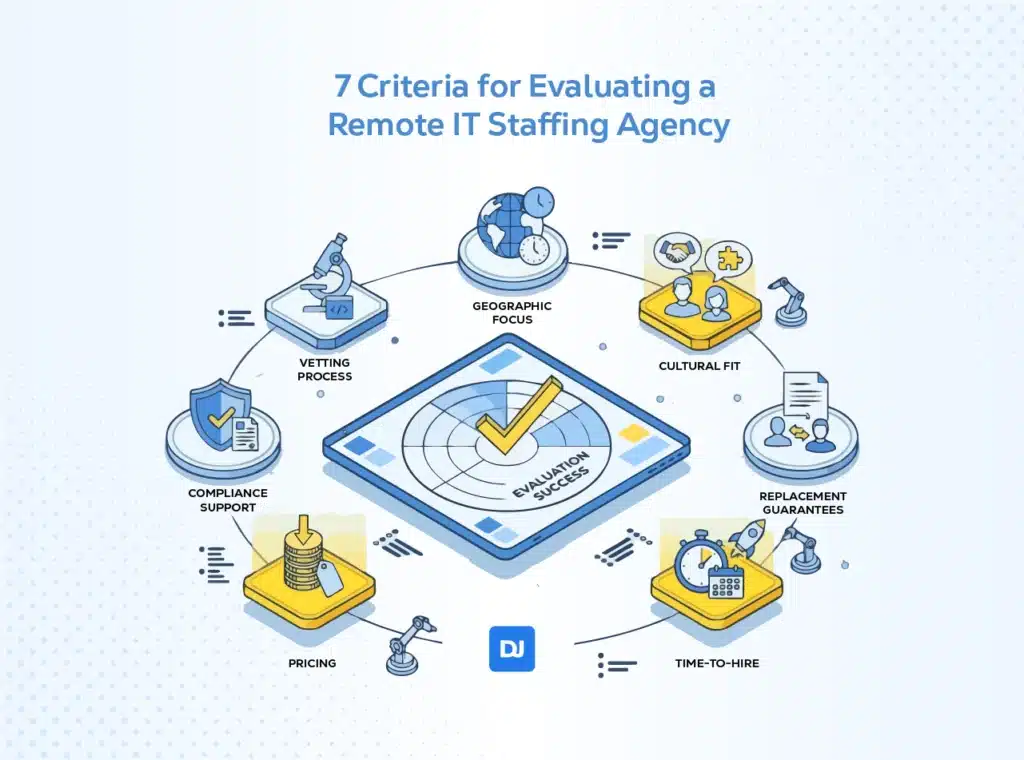
7 Criteria for Evaluating a Remote IT Staffing Agency
Not all agencies are built the same. To ensure you aren’t just buying a glorified resume-filtering service, evaluate agencies against these seven benchmarks.
| Criteria | Large Global Firms | Niche Remote Agency | Freelance Marketplaces |
| Vetting Process | Moderate | High (Specialized) | Low / Self-reported |
| Geographic Focus | Broad | Global/Targeted | Global (Unstructured) |
| Compliance | Strong | Strong | None |
| Guarantee | Often | Usually (90+ days) | Rare |
| Cultural Fit | Limited | Often Strong | Minimal |
| Pricing | Moderate | Transparent | Variable |
| Time-to-Hire | Fast | Fast (2 weeks) | Varies |
1. The Vetting Process
“We only hire the top X%” and “Pre-vetted” are marketing clichés. Ask for the specifics.
- Do they use automated coding tests? Live technical interviews?
- Do they vet for soft skills like English proficiency, cultural fit, and remote-work maturity?
- What percentage of applicants pass your screening?
- Can you outline each screening stage?
- Do you test for system design and architecture?
If an agency cannot explain its specific technical vetting stack (e.g., whether it uses HackerRank vs. live coding), it is likely just a resume-forwarding service.
2. Geographic Coverage
Does the agency specialize in specific regions (e.g., LatAm, Eastern Europe, or Southeast Asia)? Your choice should depend on your required time zone overlap.
The three major regions for remote developer talent each have distinct trade-offs:
Latin America (Mexico, Brazil, Colombia, Argentina) is the strongest fit for US and Canadian companies that need real-time collaboration. Developers in LatAm typically overlap 6–8 hours with US Eastern time. English proficiency is high among senior engineers, and cultural alignment with North American work styles is strong. Salaries for senior developers typically range from $4,000–$8,000/month, depending on the country and specialization.
Eastern Europe (Ukraine, Poland, Romania, Bulgaria) offers a deep pool of highly trained engineers, particularly strong in systems programming, backend architecture, and DevOps. Time-zone overlap with the US East Coast is limited (4–6 hours), but it works well for teams that run async-first with scheduled sync windows. Salaries range from $4,000–$9,000/month for senior talent.
Southeast Asia (Vietnam, the Philippines, and India) offers the largest talent pool at the lowest cost. However, time-zone overlap with the US is minimal (often 12+ hours offset), which makes real-time collaboration difficult. This region works best for companies that have mature async processes or need 24/7 coverage. Senior developer salaries range from $2,500–$5,500/month.
A good remote IT staffing agency should help you think through these trade-offs rather than just sourcing from wherever they happen to have a database. Ask: “Given our team’s working hours and collaboration style, which region do you recommend and why?”
3. Compliance Support
Hiring across borders is a legal minefield. A top-tier agency should act as or partner with an EOR to handle local taxes, benefits, and labor laws, protecting you from misclassification risks.
Ask specifically:
- Do you handle employment contracts compliant with the developer’s local labor law?
- Are developers classified as employees (through an EOR) or independent contractors?
- Who handles statutory benefits (health insurance, paid leave, social security contributions)?
- What happens if local labor law changes—do you update contracts proactively?
If an agency tells you they’ll handle compliance but can’t explain the specific legal structure, dig deeper. “We take care of it” is not an answer.
4. Replacement Guarantees
If a developer leaves or underperforms within the first 90 days, will the agency replace them for free? A lack of a guarantee is a sign they don’t trust their own vetting.
An agency that doesn’t offer one is either not confident in their placements or not willing to absorb the cost when things go wrong.
Ask for specifics: What triggers the guarantee? How quickly do they provide replacement candidates? Is there a limit on the number of replacements? And read the fine print—some agencies define “replacement” so narrowly that it’s functionally useless.
5. Cultural Fit Assessment
Remote work fails more often due to communication styles than technical incompetence. Your agency should understand your company’s “vibe” and DNA.
A strong remote IT staffing agency should go beyond technical vetting to assess:
- How the developer communicates in writing (clarity, tone, proactiveness)
- Their experience working across time zones and cultures
- Whether their work style matches your team’s (e.g., do you need someone who thrives independently, or someone who prefers tight collaboration?)
- Their career goals and whether your company’s trajectory aligns
Ask the agency: “How do you assess cultural fit?” If the answer is “we interview them and get a feel for it,” that’s not a process; that’s a guess.
6. Pricing Transparency
Are you paying a flat placement fee, or is there a monthly markup? Ensure there are no “hidden” costs for payroll processing or platform access.
7. Time-to-Hire
In IT, speed is a competitive advantage. A high-performing agency should present qualified candidates within 2 weeks.
Ask: What’s your average time from kickoff to first candidate presentation? And from the first candidate to the signed offer?
Be wary of agencies that promise candidates “within 48 hours”, unless they’re pulling from an existing bench (which often means they’re not headhunting for your specific role, just matching you with whoever is available).
Red Flags When Vetting a Remote Staffing Partner
If you spot these during a sales call, walk away.
- No Trial Period: You shouldn’t be locked in before you’ve seen the developer in action.
- No Direct Access: If the agency insists on being the middleman for all communication, they are an outsourcing firm, not a staffing agency.
- Opaque Pricing: “We’ll give you a quote later” usually means the markup is significantly higher than the industry standard, or it has hidden fees.
- Vague Vetting Claims: If they can’t explain their recruitment methodology, they probably aren’t doing it.
- No post-placement support. The first 90 days are the highest-risk period for remote developer turnover. If the agency’s involvement ends the moment the developer signs, you’re on your own during the most critical phase of the engagement.
4 Four Questions Checklist Before You Sign a Contract (For Your Protection)
Ask these four questions to separate the best agencies from the amateurs.
1. Can I speak directly with the developer before I hire them?
The answer must be yes. It’s good to know what kind of expertise, frameworks, and libraries your developer is familiar with.
2. How do you handle IP protection and NDAs in the developer’s local country?
If the intellectual property belongs to the agency, you will be in a vendor lock-in, whether you decide to switch agencies. Set up proper contracts, IP protection, NDAs, and data security measures before your developer writes their first line of code.
3. What is your ‘attrition rate’ for developers placed in the last 12 months?
Most agencies claim to vet for culture, but that’s easy to say and hard to do. High attrition suggests the agency is just “body shopping”, or it’s likely it isn’t vetting for the specific temperament required to succeed in a distributed team.
On the other hand, a low attrition rate proves the agency understands how to match a developer’s career goals with a company’s roadmap. It means their post-placement support is actually working.
This is exactly why we at DistantJob focus on headhunting rather than just providing a Database. A database doesn’t care if a dev leaves in three months; a headhunter’s reputation depends on that dev staying for many years.
4. Do you provide any ongoing support after the hire is made?
Even if they only handle payroll, a high-quality agency acts as a mediator. During the first 90 days (the highest risk period for turnover, according to COPC), a good agency checks in with both you and the dev. If they see a “vibe shift” or a communication breakdown, they step in to coach the developer and advise you.
DistantJob is Your Best Remote IT Staffing Agency
If this framework feels rigorous, it’s because it has to be. At DistantJob, we’ve built our model to check every box. We aren’t a “body shop”; we are a headhunting firm that specializes in the remote world.
We find developers who work as full-time members of your team, while we do the heavy lifting of global sourcing and HR. We ensure that your remote IT staffing experience is successful by focusing on culture-first recruitment and global talent reach.
Most agencies give you a choice from their ‘bench’. We headhunt for your specific role, the person you actually need.
Conclusion
Choosing a remote IT staffing agency isn’t about finding the cheapest rate. It’s about evaluating risks, processes, transparency, and long-term alignment. If an agency can clearly explain how they vet, how they protect you and your IP legally, how they replace quickly, and how they price transparently, then you’re making a good decision, not a gamble.
That’s what smart leaders do. Call us today.