Python is the most popular programming language, JavaScript and TypeScript dominate development, and Rust and Go are the fastest-rising and highest-paying mainstream options in 2026. There are more than 8,700 programming languages in the Online Historical Encyclopaedia of Programming Languages, but only a few dozen carry real career value, and the leaders moved more in the last year than in the previous five.
TypeScript just hit #1 on GitHub for the first time in over a decade, C rose to #2 on TIOBE (surpassing C++, which dropped to #3), C# was crowned TIOBE’s Language of the Year, and a U.S. government memory-safety deadline pushed Rust to an all-time high.
No single list agrees with the others, so we aggregated the six most-cited rankings, TIOBE, PYPL, IEEE Spectrum, RedMonk, the Stack Overflow 2025 Developer Survey, and GitHub’s 2025 Octoverse, and added the part most rankings skip: what these skills actually pay and how hard they are to hire for. Every figure is dated and sourced.
Programming Language Rankings 2026: Top 15 at a Glance
This table is our consensus ranking across all six indices, with each language’s primary use, where it leads, and its typical U.S. salary range.
| # | Language | Best for | Where it leads (2026) | Median US salary range |
|---|---|---|---|---|
| 1 | Python | AI/ML, data, backend, automation | #1 TIOBE, PYPL, IEEE Spectrum | $98K–$130K (AI/ML higher) |
| 2 | JavaScript | Web frontend + Node backend | #1 Stack Overflow usage (66%), #1 RedMonk | $87K–$121K |
| 3 | TypeScript | Typed full-stack web | #1 GitHub by contributors (2.6M) | $100K–$128K |
| 4 | Java | Enterprise, Android, fintech | Top-5 on TIOBE, IEEE, RedMonk | $106K–$119K |
| 5 | C# | .NET enterprise, Unity games | TIOBE Language of the Year 2025 | $92K–$129K |
| 6 | C++ | Game engines, HPC, systems | #3 TIOBE, #2 PYPL | $110K–$142K |
| 7 | C | Embedded, OS kernels, drivers | #2 TIOBE & IEEE | $98K–$132K |
| 8 | SQL | Databases, analytics | #3 Stack Overflow usage (58.6%) | $85K–$148K |
| 9 | Go | Cloud-native, microservices, DevOps | #9 IEEE; powers Docker/Kubernetes | $115K–$155K |
| 10 | Rust | Memory-safe systems | #1 most-admired SO (72%); all-time-high TIOBE | $130K–$170K |
| 11 | PHP | Server-side web, WordPress | #4 (tied) RedMonk | $72K–$109K |
| 12 | Swift | Native iOS/macOS | #6 PYPL; Apple’s language | $124K–$130K |
| 13 | Kotlin | Modern Android, JVM | Google-preferred for Android | $116K–$118K |
| 14 | R | Statistics, data analysis | #4 PYPL, #8 IEEE | (role-dependent) |
| 15 | Ruby | Web backends (Rails) | #9 RedMonk | $120K–$140K |
Salary ranges are U.S. medians compiled from Glassdoor, PayScale, Levels.fyi, and DevJobsScanner (2025–2026); global figures differ.
How We Ranked Them: 6 Indices Compared
No single ranking tells the whole story, because each measures something different. TIOBE counts search engine results, Stack Overflow surveys developers, and GitHub counts actual contributors. That’s why “the #1 language” can be Python, JavaScript, or TypeScript depending on which list you read.
Here is the top five from each index, with the date of the data:
| Index | What it measures | Date | #1 | #2 | #3 | #4 | #5 |
|---|---|---|---|---|---|---|---|
| TIOBE | Search-engine result volume | Jun 2026 | Python | C | C++ | Java | C# |
| PYPL | Google tutorial searches | 2026 | Python | C/C++ | Java | R | JavaScript |
| IEEE Spectrum | Blended (search, GitHub, jobs, papers) | 2025 | Python | C | C++ | C# | Java |
| RedMonk | GitHub + Stack Overflow signal | Jan 2026 | JavaScript | Python | Java | PHP / C# | TypeScript |
| Stack Overflow (most used) | Developer survey (49,000+ devs) | 2025 | JavaScript | SQL | Python | Bash/Shell | C# |
| GitHub Octoverse | Distinct monthly contributors | 2025 | TypeScript | Python | JavaScript | Java | C# |
For example, Python is equally popular worldwide, and C++ is the favorite in India, Pakistan, and Malaysia. When it comes to hiring remotely, it is also crucial to consider where to hire, not only which language is the most used.
Here is a comparison between three different indices to analyze the most used programming languages:
TIOBE Index
Since 2001, the TIOBE index has been an indicator of the popularity of programming languages, and it’s updated each month. In this index, ratings are the results of twenty-five popular search engines, courses, and third-party vendors—Google, Bing, Yahoo!, Wikipedia, Amazon, YouTube, and Baidu lead the way.
According to 2026’s results, the number one programming language is Python. So far, only C and Python hold the podium. For years, Python fought for first position, and now it stands with 19.98%, leagues away from C. In fact, C ratings are 11.55% at May 2026, recording a raise of +1.84 from May 2025. Java is still in the third position on the podium. But it declined from 1.37% from May 2025 to May 2026. Rust is also getting more popular, moving from position 19 to 15. Finally, Go lost 4 positions, going down from 7 to 16.
To conclude, the TIOBE index is a useful source because it analyzes the most used programming languages, rather than the best ones. If you need to make a strategic decision for a new project, this index is a starting point for an overview of programming languages’ demand and evolution.
Here is the complete list of programming languages based on TIOBE ratings:
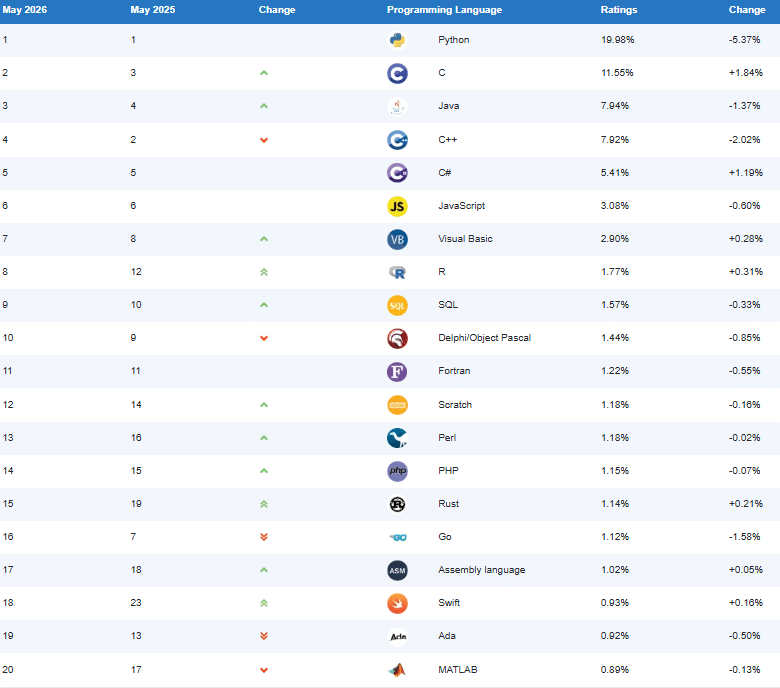
Source: TIOBE Index
PYPL Index Ranking
The PYPL Index also analyzes the popularity of programming languages. Their method takes into account which tutorials developers are searching for on Google. This index is also updated each month.
In addition to its worldwide index, PYPL publishes separate rankings for the US, India, Germany, the United Kingdom, and France. According to this index, Python is in position number 1 worldwide, followed by C/C++. To specify, Python has similar shares (around 40%) in Germany and the United Kingdom, while in France it has the highest share in France (71.79%).
PYPL also recorded a decline for Go. It dropped 7 positions from 13 to 20. In the meantime, PowerShell increased 5 positions from 19 to 14.
RedMonk’s January 2026
For its ratings, RedMonk combines GitHub data and discussions on the developer info-sharing site Stack Overflow. Based on their research, JavaScript is number 1, followed by Python and Java. Unlike the first two indices, PHP maintains a good position (number 4), and C is down the list (number 10). However, their method produces several ties. The results of their analysis determined the following list of programming languages:
| Rank | Programming Language |
| 1 | JavaScript |
| 2 | Python |
| 3 | Java |
| 4 | PHP |
| 4 | C# |
| 5 | TypeScript |
| 6 | CSS |
| 6 | C++ |
| 7 | Ruby |
| 8 | C |
| 9 | Switft |
| 10 | Go |
| 11 | R |
| 12 | Shell |
| 13 | Kotlin |
| 14 | Scala |
| 15 | PowerShell |
| 16 | Dart |
| 17 | Objective-C |
| 18 | Rust |
Here is a complete overview of the first quarter plot for 2026:
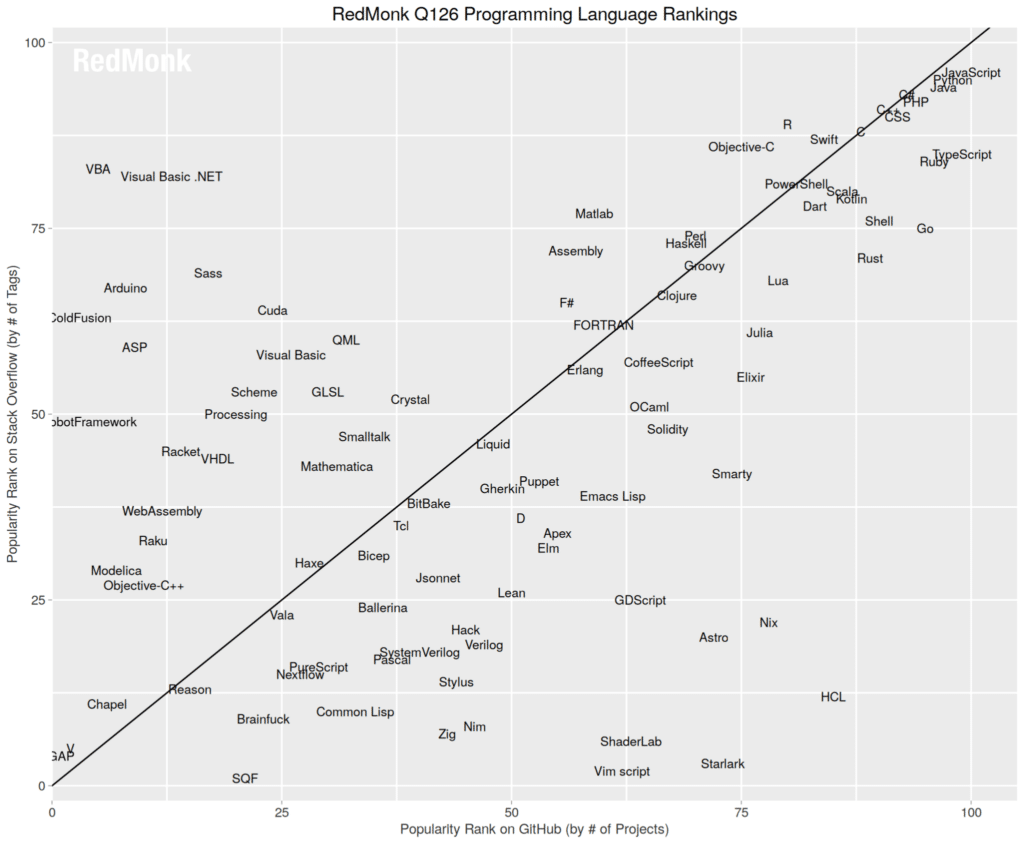
Source: RedMonk’s January 2026
The 15 Most-Used and Most Popular Programming Languages in 2026 (Ranked)
Averaging the rankings across the five indices gives a clean shortlist of the languages most worth knowing in 2026.
1. Python
Python remains the undisputed champion in 2026, due to its dominance in Artificial Intelligence and Big Data. Beyond its usual applications, this year has seen a surge in Python’s use for Explainable AI (XAI) and Edge AI, where models are deployed directly onto IoT devices and wearables. Python lowers the barrier to entry in quantum computing and automated research.
Primary Uses: AI/Machine Learning, Data Science, Intelligent Automation, Quantum Computing.
Key 2026 Apps: Advanced LLM orchestrators, real-time fraud detection systems, and autonomous drone navigation.
Salary (US): ~$98K–$130K median; AI/ML specializations reach $135K–$165K.
Learning curve: The easiest mainstream language and the most common first language in 2026 — which is also why the applicant pool skews junior unless you screen hard.
2. JavaScript
JavaScript continues to be the lifeblood of the web. In 2026, the ecosystem changed towards Framework Agnosticism. Paired with WebAssembly (Wasm) for heavy computational tasks, JavaScript now aids video editing and 3D rendering directly into the browser.
Primary Uses: Web development (Frontend & Backend), Mobile apps (React Native), IoT.
Key 2026 Apps: Interactive web-based AI tools, complex SaaS dashboards, and cross-platform mobile apps
Salary (US): ~$87K–$121K median.
Learning curve: Beginner-friendly, with instant visual results in the browser. See our guide to JavaScript frameworks.
3. TypeScript
TypeScript is the breakout story of 2026: it became the #1 language on GitHub by monthly contributors (2.636M) in August 2025 — its first time at the top in over a decade — growing +66.6% year over year. It’s JavaScript with static types, which makes large codebases safer and works better with AI code generation.
- Top use cases: Large-scale web apps, full-stack development, anything where JavaScript would get unwieldy.
- The hiring read: It’s quietly become the default for new web projects, so a strong JavaScript engineer usually ramps to TypeScript in weeks — you rarely need to hold out for it as a separate skill. Treat it as a JS hire with a typed-codebase preference, not a scarcer specialty.
- Salary (US): ~$100K–$128K median, a 5–10% premium over plain JavaScript.
- Learning curve: Quick to pick up if you already know JS — learn JavaScript first.
4. Java
Java has seen a renaissance with the release of Java 26 in early 2026. The language is faster and more expressive than ever, thanks to the maturation of Project Leyden (improved startup times) and Project Valhalla (optimized memory layout). Java remains the backbone of the enterprise world, particularly in finance and large-scale cloud-native backend services.
Primary Uses: Enterprise software, Android development (via Kotlin interoperability), FinTech.
Key 2026 Apps: High-frequency trading platforms, large-scale banking backends, and cloud-native microservices
Salary (US): ~$106K–$119K median.
Learning curve: Moderate to learn, and that verbosity cuts both ways in hiring — it’s easy to assess code quality, but mid-level Java resumes all look alike, so screen for system design. Compare Java vs. Python.
5. C#
Fuelled by .NET 10, C# is the premier language for cloud-native development and cross-platform enterprise apps. The language has introduced “Union Types” in recent updates, solving long-standing architectural hurdles. C# also integrates well with Azure, and its role as Unity’s primary language makes it a top choice for both enterprise architects and game developers.
- Top use cases: .NET enterprise software, Azure cloud, Unity game development, Windows apps.
- The hiring read: Microsoft-ecosystem enterprises, game studios, and corporate IT compete for the same pool, and it splits cleanly into web/enterprise and Unity-games tracks — a Unity gameplay engineer and an Azure backend dev are not interchangeable, so write the req for the one you actually need.
- Salary (US): ~$92K–$129K median.
- Learning curve: Moderate, and cleaner than Java for many beginners.
6. C++
C++ got a renewal after it underwent C++ 26. Static Reflection and a unified async model have made the programming language significantly more productive for developers. Furthermore, its new “memory safety” initiatives (safer code without sacrificing performance) have made it the top choice for the booming VR/AR and AAA gaming markets.
- Primary Uses: Game development, VR/AR, High-performance computing.
- Key 2026 Apps: Unreal Engine 6 projects, real-time physics simulators, and low-latency financial systems.
- Salary (US): ~$92K–$129K median.
- Learning curve: Moderate, and cleaner than Java for many beginners.
7. C
Despite the rise of modern alternatives, C is still a powerhouse. It remains the foundational language of the world. In 2026, it is still the go-to for OS kernels (Linux, Windows) and embedded systems where every byte of memory and clock cycle counts. While Rust has gained ground in safety-critical systems, C is still a walking legend, and its unmatched efficiency keeps it high in the rankings.
Primary Uses: System programming, Embedded systems, Hardware drivers.
Key 2026 Apps: Next-gen IoT sensors, automotive ECU firmware, and high-speed networking kernels.
Salary (US): ~$98K–$132K median (often overlaps with C++ roles).
Learning curve: Approachable syntax, brutal manual memory management.
8. SQL
SQL is the third most-used language in the Stack Overflow 2025 survey (58.6%) and a near-universal supporting skill. You rarely get hired as “an SQL developer,” but almost every backend, data, and analytics role requires it.
Top use cases: Querying and managing relational databases, analytics, reporting.
The hiring read: Don’t post for it standalone, screen for it inside backend, data, and BI searches. Nearly every candidate claims SQL; far fewer can actually reason about query plans and indexing, so make that the live test.
Salary (US): ~$85K–$148K median, very role-dependent.
Learning curve: Easy to start, deep to master.
9. Go
Go (Golang) is the language of cloud-native infrastructure, Docker, Kubernetes, and Terraform are all written in it. It ranks #9 on IEEE Spectrum. Notably, Go fell on TIOBE (from #7 to #13) even as real-world cloud demand stayed strong, a reminder that search-based indices and hiring demand don’t always align.
- Top use cases: Cloud-native services, microservices, DevOps tooling, high-concurrency backends.
- The hiring read: Cloud platforms, infrastructure teams, scale-ups, and fintech are all recruiting Go, and they over-index on senior infra engineers, the candidates you want often already run production Kubernetes, which makes them expensive and hard to pull.
- Salary (US): ~$115K–$155K median — Go pays like a senior specialty even at mid-level, which is part of why teams underestimate the budget.
- Learning curve: Easy-to-moderate; deliberately small and simple.
10. Rust
Rust reached an all-time high of #12 on TIOBE in 2026 and is the most-admired language in the Stack Overflow 2025 survey at 72%. Its momentum is now backed by policy: a CISA deadline (January 1, 2026) requiring critical-infrastructure manufacturers to publish memory-safety roadmaps accelerated momentum toward Rust, with CISA and the FBI urging an immediate halt to new C/C++ development. Rust is in production in the Linux kernel, Windows components, and AWS Firecracker.
- Top use cases: Memory-safe systems programming, performance-critical services, WebAssembly, blockchain.
- The hiring read: Systems, security-sensitive, and crypto teams are all fishing in the same small pond. Genuine production Rust experience is scarce enough that most teams we work with hire strong systems engineers and accept a ramp-up rather than holding out for a unicorn.
- Salary (US): ~$130K–$170K median — you pay a scarcity premium here whether you like it or not.
- Learning curve: Steep — the borrow checker humbles experienced engineers, which is exactly why production Rust on a resume is a real signal, not a buzzword. Don’t make it your first language.
11. PHP
PHP still powers a huge share of the web, most notably WordPress, and ranks in RedMonk’s top five (tied #4). Modern PHP 8 is far faster and cleaner than its reputation suggests.
- Top use cases: Server-side web, CMS platforms (WordPress, Drupal), Laravel apps.
- The hiring read: Agencies, CMS-heavy businesses, and large legacy web platforms hire PHP, and the pool is wide but uneven — separate the Laravel-modern engineers from the maintain-legacy-WordPress crowd early, because they command different rates and solve different problems.
- Salary (US): ~$72K–$109K median, the lowest of the mainstream languages.
- Learning curve: Gentle on-ramp.
12. Swift
Swift is non-negotiable for native Apple work, and that’s the hiring constraint: there’s no cross-platform shortcut, so an iOS hire is a dedicated specialist, not a generalist you reassign. Swift has climbed to #15 on TIOBE (up from #25 a year earlier).
- Top use cases: Native iOS, iPadOS, and macOS apps.
- The hiring read: Mobile teams, agencies, and any company with an iOS product compete for a finite Apple-platform pool. Because the skill doesn’t transfer from web or Android, you can’t backfill it internally — budget for a real specialist search.
- Salary (US): ~$124K–$130K median.
- Learning curve: Moderate; modern and readable.
13. Kotlin
If you’re hiring Android in 2026, you’re hiring Kotlin, Java-first Android reqs now read as legacy maintenance and quietly narrow your candidate pool. Kotlin is Google’s preferred Android language and a clean, modern alternative to Java on the JVM, interoperating fully with Java to ease enterprise adoption.
- Top use cases: Modern Android development, JVM backend services, multiplatform.
- The hiring read: Mobile teams, Android-first companies, and JVM shops modernizing off Java want it. Most strong Kotlin candidates come from a Java background, so a “Kotlin or Java + willing to switch” req widens your pool without lowering the bar.
- Salary (US): ~$116K–$118K median.
- Learning curve: Moderate, and easier than Java for many.
14. R
R hires cluster in research, pharma, and biostatistics, and they look different from a typical software search, you’re often recruiting statisticians who code, not engineers who do stats. R ranks #4 on PYPL and #8 on IEEE Spectrum; where Python is the generalist data language, R dominates heavy statistical modeling.
- Top use cases: Statistical computing, data visualization, academic and scientific research.
- The hiring read: Research, pharma/biotech, analytics, and academia hire R, and domain expertise (clinical trials, econometrics, genomics) often matters more than software polish. Screen for the science first, the engineering second.
- Salary (US): Role-dependent; strong in research and quantitative roles.
- Learning curve: Moderate — intuitive for statisticians, quirky for programmers. See Python vs. R.
15. Ruby
Ruby and Rails still ship MVPs faster than almost anything, but the talent pool is graying, you’re competing with funded startups for a finite group of experienced Rails engineers. It ranks #9 on RedMonk and stays a fixture in startups and fintech.
Top use cases: Web backends (Ruby on Rails), MVPs, fintech.
The hiring read: Startups, scale-ups, fintech, and agencies hire Ruby, but fewer juniors are learning it, so the experienced engineers know their value and move slowly. A compelling product and remote flexibility do more than raw salary to win them.
Salary (US): ~$120K–$140K median.
Learning curve: Approachable syntax, designed for developer happiness.
Programming Language Tier List 2026
A quick programming language tier list based on combined ranking strength, hiring demand, and salary in 2026. Tiers reflect career value, not code quality, a B-tier language can be the perfect tool for a specific job.
| Tier | Languages | Why |
|---|---|---|
| S | Python, JavaScript, TypeScript | Top of multiple indices, massive job markets, broad applicability |
| A | Java, C#, C++, SQL, Go | Deep enterprise/systems demand and strong, stable salaries |
| B | C, Rust, Swift, Kotlin, PHP | Essential in their domains; Rust rising fast, C entrenched |
| C | Ruby, R, Dart, Scala, Elixir | Strong in specific niches (Rails, data, Flutter, functional) |
| Watch | Mojo, Zig, Gleam, Carbon | High enthusiasm, early-stage; promising but not yet mainstream |
Highest-Paying Programming Languages in 2026
Pay tracks scarcity and specialization more than raw popularity, which is why high-demand-but-harder languages like Rust, Go, and Scala out-earn ubiquitous ones like JavaScript and PHP.
The figures below are U.S. median ranges compiled from Glassdoor, PayScale, Levels.fyi, and DevJobsScanner (2025–2026), with global medians where noted from the Stack Overflow 2024 survey (the 2025 survey reports pay by job role rather than by language).
| Language | Median US salary range | Notes |
|---|---|---|
| Solidity | $170K–$200K+ | Web3; highly volatile, inflated by outliers |
| Rust | $130K–$170K | $102K global median (SO 2024); scarce talent |
| Scala | $147K–$150K | Big-data/finance premium (Spark) |
| Go | $115K–$155K | Cloud-native demand |
| Elixir | $117K–$145K | Functional, high-concurrency niche |
| Erlang | $100K–$150K | $100,636 global median (SO 2024) |
| Ruby | $120K–$140K | Rails, fintech |
| Swift | $124K–$130K | iOS; higher total comp at big tech |
| C++ | $110K–$142K | Systems, game engines, trading |
| Kotlin | $116K–$118K | Android/JVM |
| TypeScript | $100K–$128K | 5–10% premium over JavaScript |
| Python | $98K–$130K | AI/ML roles reach $135K–$165K |
| C# | $92K–$129K | Enterprise/.NET |
| Java | $106K–$119K | Enterprise, mid-level $114K–$141K |
| C | $98K–$132K | Often overlaps with C++ roles |
| JavaScript | $87K–$121K | Ubiquitous; widest job pool |
| PHP | $72K–$109K | Lowest of the mainstream languages |
Ranges vary by region, seniority, and industry. Solidity’s top figures are skewed by a small number of high-paying Web3 roles and are not representative of typical pay. Try our salary calculator for role- and region-specific estimates.
One thing the table doesn’t show: the languages at the top of it are also the hardest to staff. The same scarcity that pushes Rust, Scala, and Go salaries up means a longer, more competitive search, budget for both the pay premium and the time-to-hire.
Biggest Movers and 2026 Trends
Four shifts defined the last year and will shape hiring through 2026:
- TypeScript dethroned everyone on GitHub. It became the #1 language by monthly contributors (2.636M, +66.6% YoY), the biggest GitHub ranking shift in over a decade, as frameworks defaulted to it and AI tools handled typed code more reliably.
- AI became structural, not a side note. Python now starts nearly half of new AI repositories, LLM SDK adoption on GitHub jumped +178% YoY, and 84% of developers use or plan to use AI tools — though trust in their accuracy fell to 33%, down from ~40% (Stack Overflow 2025).
- Memory safety became policy. A CISA deadline (January 1, 2026) requiring critical-infrastructure makers to publish memory-safety roadmaps fueled Rust’s all-time-high ranking, 72% admiration, and production adoption at Microsoft, AWS, and in the Linux kernel.
- The old guard reshuffled. C quietly passed C++ for #2 on TIOBE, C# won Language of the Year, Python’s TIOBE share diluted ~6.9 points (even while staying #1) as the market fragmented, and Go slipped on search-based indices despite dominating cloud infrastructure.
What Programming Language Should You Learn First?
For most beginners in 2026, learn Python first: readable syntax, the broadest job market, and a direct path into AI and data, the fastest-growing fields. If your specific goal is web development, learn JavaScript first instead, because you’ll see results in the browser immediately and it’s unavoidable for frontend work.
A simple rule:
- Want the most options / AI / data? Python
- Want to build websites? JavaScript (then TypeScript)
- Want enterprise or Android? Java or Kotlin
- Want the Apple ecosystem? Swift
Avoid starting with Rust, C++, or C — they’re valuable, but their steep learning curves can stall beginners. Master one approachable language first; the second is far easier.
Conclusion
The best language depends on the job. Pick the slot, match the ecosystem, check the hiring market. In 2026, the best language is not about syntax but about the ecosystem. Whether you are leveraging Python for an AI pipeline or utilizing C++ for a high-performance engine, the best programming language for your project needs to be safe, fast, and support cloud integration.
If you’re scaling a team and need specialist developers in any programming language, our IT recruitment team presents qualified candidates within two weeks. Tell us what you need for a tailored quote and timeline.
FAQ
Python is the most used programming language by combined ranking across the major indices in 2026. It holds the #1 spot in TIOBE, PYPL, and IEEE Spectrum, and second in RedMonk and GitHub. Its dominance comes from broad use across AI, data science, scripting, and back-end web work, plus the largest beginner adoption pipeline of any current language.
Neither is better. Python is the stronger pick for AI, machine learning, data work, and scripting. JavaScript is the stronger pick for anything that runs in a browser, and competitive for back-end and cross-platform mobile. Most modern web stacks use both JavaScript or TypeScript on the front-end, Python or Node.js on the back-end.
For most beginners, Python is the easiest entry point: readable syntax, a large community, broad job market. For a beginner who specifically wants web development, JavaScript is a more useful first language. Both are reasonable choices, and either one opens paths into adjacent languages later.
In 2026, the most common hiring stacks are Python (for data, ML, and back-end), JavaScript and TypeScript (for full-stack web), Java (for enterprise back-end), C# (for Microsoft-ecosystem enterprise and Unity), and Swift or Kotlin for native mobile. C and C++ hiring is concentrated in specific industries: embedded, gaming, finance, and systems software.
Rust and Go are both growing, but sit just outside the top six by combined ranking. Rust is climbing fastest, driven by adoption in systems programming and safety-critical work. Go remains popular for cloud infrastructure and back-end services. Both are reasonable picks for greenfield projects in their respective niches.
Yes. C is the foundation of operating systems, embedded firmware, drivers, and a large share of the world’s networking and database infrastructure. It’s also the most common second language for senior engineers in performance-critical work. C is rarely the right pick for new application development, but it’s not going away from the systems layer.