Ensuring cultural alignment in a remote environment is a significant challenge. Cultural fit in an office happens naturally. People see how the company operates, how others communicate. However, on remote, it needs to be intentional. Without the in-person coffee break or the water cooler, culture becomes what people do when no one is watching and how they communicate through screens.
That’s why I am a big believer that the first prerequisite to having a truly solid remote system is sharing that system with the most appropriate people.
The idea of a system is that certain processes are done behind the scenes and others are noticeable, such as communication through text. That means hiring a great developer who codes well but disappears for 24 hours without telling you what’s going on is enough of a reason for the system we rely on to break.
That’s why it’s so critical to have a guide that shares detailed vetting and vetting processes, interview questions, and red flags to look for when hiring the right person to bring into our remote engineering team.
In this article, we present some of the best practices to help align remote newcomers with your company culture.
The 4 Pillars of Remote Cultural Alignment
In a remote world, culture isn’t office snacks; it is operating system architecture. If you don’t create culture intentionally, the system crashes. This is why the vetting process requires cultural alignment, which includes documentation, paid trials, self-managing style detection, and good writing.
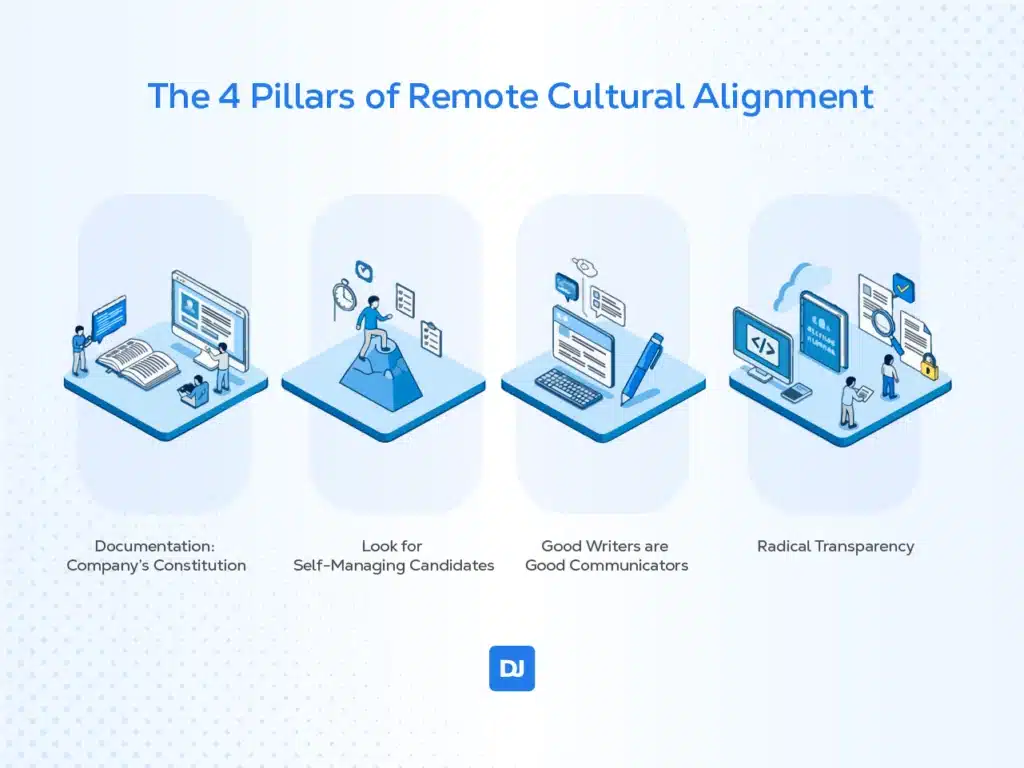
1. Documentation: Company’s Constitution
In remote teams, what isn’t written down doesn’t exist. For cultural alignment, you need a “Culture Manual” or Playbook that’s accessible to everyone. According to Glassdoor, 77% of job seekers consider company culture before even applying. And 73% don’t apply if they feel no cultural alignment. So, documentation showcases your values and ways of working, which helps attract applicants who have cultural alignment.
It’s helpful to provide documentation of team “working agreements” or a culture handbook outlining expected behaviors. For example: response times, documentation standards, and meeting etiquette in a remote environment.
Moreover, important discussions and decisions should be documented in a common space (like a project wiki or shared docs) so that everyone, regardless of location, has access to the information.
2. Look for Self-Managing Candidates
In a distributed team, if an employee needs a manager to tell them what to do next, they are a bottleneck. Look for “Self-Correction” and “High Agency” capabilities. Does the candidate set their own deadlines and audit their own work?
Ask for examples of “Self-Correction.” A great remote developer anticipates roadblocks before they happen. They don’t wait to be unblocked; they unblock themselves.
3. Good Writers are Good Communicators
In remote work, communication is mainly through writing. If you cannot communicate your ideas clearly in text, you are effectively invisible or, worse, a source of “noise.” Find people who can communicate high-context ideas with low-context words.
Pay close attention to their emails before the interview. Are they clear? Do they anticipate your questions? Good writers are usually good remote thinkers
4. Radical Transparency
Remote teams die in the dark. Candidates should be comfortable communicating bad news as early as possible.
Look for candidates who will fit well with the culture of applying a blameless post- mortem. The mindset is to document what went wrong without assigning blame to an individual or even oneself.
Ensuring Cultural Alignment Through Vetting Protocols
Cultural alignment assurance requires moving beyond “gut feelings” to a structured, data-driven vetting protocol. The goal is to identify candidates who share your core values.
1. Define “Observable Behaviors” (The Baseline)
Vetting fails when culture is defined by vague slogans like “innovation” or “integrity.” You must translate these into specific, observable behaviors.
For example, define how an employee should act during a crisis or a missed deadline.
Create a rubric that defines what a “Level 1” (misaligned) vs. “Level 5” (highly aligned) response looks like for each core value.
2. Implement Structured Behavioral Interviewing
Standardized questions ensure every candidate is measured against the same cultural yardstick, reducing unconscious bias.
| Core Value | Strategic Vetting Question | What to Look For |
| Ownership | “Tell me about a time a project failed. What was your role in that failure?” | Taking responsibility vs. blaming external factors. |
| Adaptability | “Describe a time you had to pivot your strategy based on feedback you disagreed with.” | Resiliency and openness to alternative perspectives. |
| Collaboration | “How do you handle a teammate who isn’t pulling their weight?” | Constructive conflict resolution vs. avoidance or aggression. |
3. Design Cultural Mini-Gates
Integrate small, role-specific tasks that simulate your environment. These reveal more than a polished interview ever could.
Observe how your candidates ask questions, handle feedback, and interact with the team.
Also, have the candidate sit in on a real team meeting (as long as you don’t have any NDA or confidentiality concerns). Afterwards, ask them for their observations on the team dynamic. Alternatively, you can have simulated meetings or case study discussions rather than exposing sensitive internal operations.
Finally, include future peers (not just managers) in the vetting. Peers are often more sensitive to “work style” friction.
4. Reverse the Vetting (Mutual Alignment)
Cultural alignment is a two-way street. If a candidate is “forced” into a culture that doesn’t suit them, they will burn out.
You can try to be brutally honest about the downsides of your culture (e.g., “We move incredibly fast, which can feel chaotic”).
You can also dedicate 20% of the vetting time to their questions. The types of questions they ask (e.g., about growth, work-life balance, or social impact) reveal their true priorities.
Red Flags to Watch For
- Inconsistency: The candidate’s stories in the interview don’t match the feedback from their professional references.
- The “Chameleon” Effect: A candidate who agrees with everything you say without providing specific, messy examples from their past.
- Lack of Curiosity: A candidate who has no questions about how decisions are made or how conflict is handled.
- Over-reliance on Synchronous Communication: A candidate who asks for meetings every day to discuss the basics will become unreliable. As long as you have documentation, communication should stay asynchronous as much as possible.
Conclusion
Remote culture isn’t something you have; it’s something you do. To ensure cultural alignment, a remote company must treat hiring like engineering: filter candidates for autonomy, reward documentation, and measure only what is delivered.
Most staffing agencies just match keywords on a resume. At DistantJob, we run a recruitment agency, not a job board. Our vetting process is designed to find developers who don’t just code, but who integrate into your US-based team as long-term colleagues.
Ready to hire developers who actually fit your culture? Book a Discovery Call today.