A bad hire can cost your company anywhere from $17,000 to $240,000, and that’s before you factor in the damage to your team’s morale, your client relationships, and the months of lost momentum you’ll never get back.
Do I sound a bit dramatic here? I am not. The U.S. Department of Labor estimates the cost of a bad hire at 30% of the employee’s first-year wages, and the Society for Human Resource Management (SHRM) puts the cost of replacing any employee between one-half and two times their annual salary. If you’re hiring for a senior tech role at $120,000 a year, the math gets ugly fast.
At DistantJob, we’ve spent more than 10 years recruiting remote developers for U.S. and Canadian companies. We’ve witnessed the damage that a mismatched employee can cause an organization (three out of four of our clients come to us after having gone through this difficult experience).
This article will help you evaluate the financial impact on your company by providing a formula to calculate the cost of a bad hire and relay what actually works when it comes to avoiding such situations.
How Much Does a Bad Hire Cost in 2026?
Let’s start with the numbers, because that’s probably why you’re here.
The most commonly cited benchmark comes from the U.S. Department of Labor: a bad hire costs at least 30% of the employee’s first-year earnings. So for someone earning $80,000 a year, that’s a minimum of $24,000 gone. For a $60,000 hire, you’re looking at $18,000, best case.
But that’s the conservative estimate. Here’s what the broader research shows:
A survey run by CareerBuilder found that almost three-quarters of companies with a bad hire reported an average of $14,900 in lost income. Between these employers, 74% simply state they hired the wrong person for the job.
On the higher end, recruiter Jörgen Sundberg, CEO of Link Humans, has estimated total hiring and onboarding costs at up to $240,000 per employee, which means a bad hire at that level is a quarter-million-dollar mistake.
The Toggl Hire 2025 Report, based on a survey of over 100 HR professionals in the U.S., found that while direct costs typically fall between $5,000 and $10,000, indirect costs balloon to $30,000–$150,000+ per bad hire when you include training waste, reduced productivity, delayed projects, and the ripple effects on your team.
And the problem isn’t rare. According to the same report, 23% of companies report up to five bad hires a year. At even the conservative $17,000 per incident, that’s $85,000 in annual loss, just from hiring mistakes.
The global picture is even more staggering. Gallup’s 2025 State of the Global Workplace report revealed that global employee engagement fell to just 21% in 2024, matching the lowest levels seen during the pandemic. That decline alone cost the global economy an estimated $438 billion in lost productivity. The broader disengagement crisis? $8.8 trillion annually, according to Gallup’s 2023 figures. That’s 9% of global GDP being drained by people who aren’t engaged in their work.
These are not just some random statistics. This is the reason you missed your product deadline last quarter, the reason your top developer is quietly searching for another job, and the reason your client is all of a sudden shopping for other options.
How to Calculate the Cost of YOUR Bad Hire
While these are helpful statistics, averages won’t provide you with a clearer picture of what a bad hire means for your company. For that, you need a formula.
According to SHRM’s latest benchmarking data, the average cost-per-hire (CPH) in the U.S. is now approximately $4,700–$4,800. That covers recruitment expenses — job ads, recruiter time, screening, and the hiring process itself. For specialized tech roles, it can easily exceed $6,000.
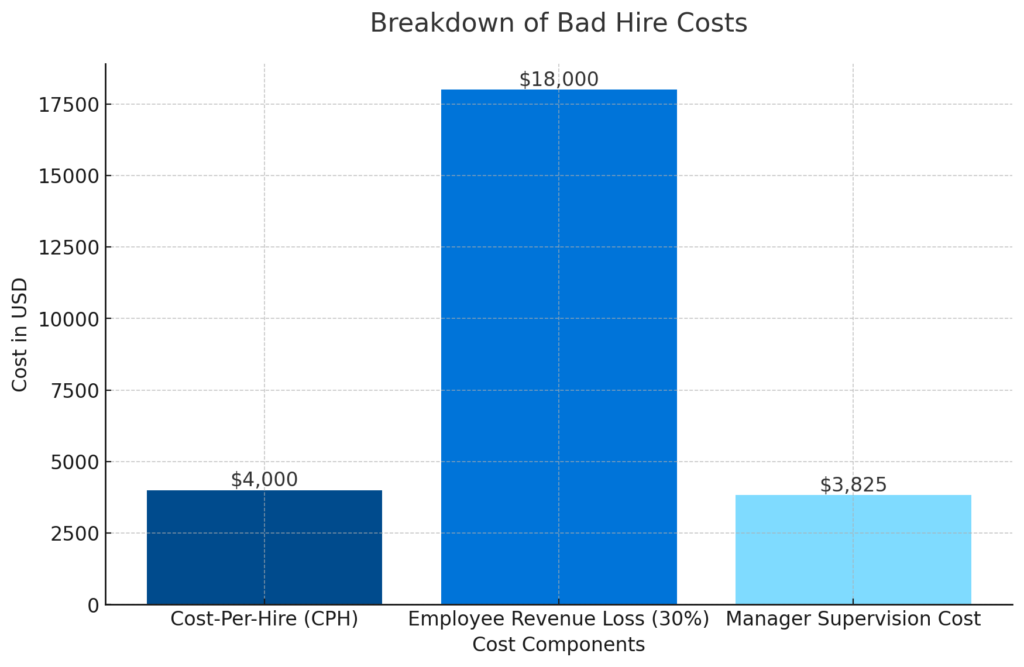
We’ve already established the baseline revenue loss at 30% of the bad hire’s salary (U.S. Department of Labor), and we know from a CareerBuilder survey of CFOs that managers spend roughly 17% of their time supervising a bad hire. Let’s put it all together:
CBH = CPH + (Employee Annual Salary × 0.3) + (Manager Monthly Salary × Months Employed × 0.17) + (Vacancy Cost × Days to Backfill)
Let’s run through two scenarios.
Scenario 1: Mid-level developer ($60,000/year) Assume average cost-per-hire of $4,700, manager earning $90,000/year ($7,500/month), the bad hire lasts 3 months, and it takes 44 days to backfill at $500/day in lost output.
CBH = $4,700 + ($60,000 × 0.3) + ($7,500 × 3 × 0.17) + ($500 × 44)
CBH = $4,700 + $18,000 + $3,825 + $22,000 = $48,525
Scenario 2: Senior engineer ($120,000/year) Same cost-per-hire, manager earning $130,000/year ($10,833/month), bad hire stays 4 months, 60 days to backfill.
CBH = $4,700 + ($120,000 × 0.3) + ($10,833 × 4 × 0.17) + ($500 × 60)
CBH = $4,700 + $36,000 + $7,366 + $30,000 = $78,066
That senior engineering hire? Almost $80,000 down the drain. And this formula doesn’t even capture the full picture — it doesn’t account for lost clients, damaged reputation, or the top performer on your team who decides they’ve had enough and starts interviewing elsewhere.
As you can see, one of the biggest levers you can pull is identifying and acting on the bad hire quickly. Every extra month you wait, the cost compounds. Keep that in mind when we get to the warning signs section.
The Hidden Costs Nobody Puts on a Spreadsheet
The formula above captures the measurable costs. But some of the most destructive damage doesn’t show up in any financial model.
1. Team Morale and the Contagion Effect
A bad hire doesn’t just underperform; they drag everyone around them down. Research shows that 54% of employees have left a job because of poor workplace culture, and a single toxic team member can be the tipping point.
When your A-players are spending their time compensating for someone who can’t or won’t pull their weight, burnout follows. Deadlines slip. Resentment builds. And the people you most want to keep start wondering whether leadership actually has things under control.
We have a simple principle at DistantJob, the “No Asshole Rule.” No matter how skilled someone is, if they poison the team dynamic, the net impact is always negative. In the long run, no technical ability justifies the damage a bad hire does to the people around them. Your team is the one doing the work. Protect them.
2. Manager Burnout
Gallup’s 2025 report surfaced a critical finding that most articles about bad hires completely ignore: manager engagement dropped from 30% to 27% in 2024. Managers under 35 saw a five-percentage-point decline; female managers dropped by seven points.
Why does this matter? Because managers account for 70% of the variance in employee engagement. When your managers are exhausted from babysitting a bad hire, their entire team suffers. The bad hire isn’t just consuming their own salary, they’re neutralizing the effectiveness of the person above them, which cascades to every other team member.
3. Client Relationships and Reputation
If your bad hire touches client-facing work, and in a small or mid-sized company, most people do, the exposure multiplies. Late deliveries. Quality issues. Communication breakdowns. Your clients don’t care that you had a staffing problem; they care about results.
It takes years to build a reputation and one bad project to start losing it. Once a client starts looking at competitors, winning them back costs exponentially more than retaining them in the first place.
4. The Remote Work Factor
For remote and distributed teams, bad hires are harder to detect and harder to manage. You can’t walk past someone’s desk and notice they’re disengaged. The signals are subtler: cameras off during meetings, delayed responses, work that always needs revision.
At DistantJob, this is exactly what we specialize in. We don’t just evaluate technical skills, we evaluate whether someone is built for remote work. Because a developer who’s excellent in an office environment can completely fall apart without the structure and accountability that comes with a physical workplace. Screening for remote readiness is non-negotiable in 2026.
5. The Cost of the Empty Seat
While you’re going through the painful process of terminating a bad hire and searching for a replacement, the role sits empty. Industry surveys suggest an unfilled position can cost a business approximately $500 per day in lost output, lost project momentum, overloaded teammates, and delayed revenue.
With the average time-to-hire now at 42 to 44 days (and often longer for specialized tech roles), that vacancy tax adds $22,000+ to your total loss. And that’s assuming you start looking immediately, which most companies don’t, because most companies wait too long to pull the trigger.
Why Bad Hires Happen: The Root Causes
After working with hundreds of clients for more than a decade, I’ve spoken with many people about why they hired poorly. Most of the reasons are always the same:
1. Rushing the Process
This is by far the number one reason. No one wants to wait to fill the empty role inside the company. The longer a position stays empty, the more projects get delayed. So managers become desperate to hire someone right away, and that’s when they cut corners like checking references or doing a second and third interview, or when they might decide to hire a “good enough” candidate.
But a rushed process might be a false economy, because hiring the wrong person for three months costs way more than waiting two more weeks to find the right candidate. I highly recommend you look at the calculations again. A couple of weeks of lost productivity (let’s say $500 a day for argument’s sake) is a drop in the bucket compared to a bad hire costing $48,000 or more.
2. Hiring a Skilled Individual Over a Culturally Aligned Individual
Skill is the one parameter that’s quite easy to verify. You can create an effective test and confirm within a day whether someone knows what he says he knows. It’s much more difficult to figure out if that person is the right fit for your company. Yet that’s what most companies overlook or are ineffective at doing.
The first thing you should check when hiring an individual is what I call the “untrainable” aspect: does the candidate culturally fit with your organization? A person can become better at his skills, but it’s very hard to change his personality to fit with your team. When I say culturally misaligned, I don’t mean someone of a different gender, race, or religion. I mean an individual who is not compatible with the processes of your company and the people surrounding you. A developer who doesn’t value constant online communication and accountability won’t fit in very well at DistantJob. A culturally-misaligned individual can disrupt your organization from the moment he starts working, even if he’s a skilled developer.
3. The Lack of a Test and Trial
It’s tough to get to know someone strictly through an interview process. That’s why tests and trial periods provide vital information. Too many decisions are being made just based on resumes and interviews, instead of a real “getting to know” period, through assessments, test projects, or candidates working as contractors. According to SHRM, an organization that does not utilize a consistent interview process is five times more likely to make a bad hire.
4. The New Obstacle of 2026
The AI-Generated CV Many candidates today are using AI tools to write a perfect-looking CV and cover letter, which then look very similar to every other CV. We didn’t have this problem two years ago.
If you haven’t adapted your process to catch up to this reality, you will be more exposed to making a bad hire.
How To Avoid Bad Hires
Knowing the causes is step one. Here’s how to actually fix your hiring process.
a. Don’t Settle for the First Batch
Unless you’re working with an IT staffing agency such as DistantJob, where clients routinely hire from the first batch of candidates because we do all the heavy lifting in the background, it’s doubtful that the best people will be among the first to show up.
Take a page from Marie Kondo’s book, and don’t jump on a candidate who doesn’t spark joy! Yes, you are in a rush to hire; your projects are being delayed, and you have deadlines to keep. That’s why we’ve done the math in the previous paragraphs. How does that cost stack up with some delays?
b. Lead with Culture, Not Just Technical Screens
During the first stage of the interview process, spend time discussing the person, not the programmer. Inform him about how you work, your values, how you communicate, what makes your day productive, and observe his reaction. Also, make sure to find out why this person wants your job. If the main reason is, “I want to work remotely,” be wary.
You want to employ people who are excited about the work and your company, not just the benefit of working remotely.
c. Use Skills-Based Assessments
The Toggl Hire 2025 data makes a compelling case: companies using skills-focused hiring reduce their time-to-hire by up to 86%, with 93% predictive confidence in assessment results. A practical coding challenge or a paid test project will tell you more about a candidate in four hours than three rounds of behavioral interviews ever will.
d. Implement a Trial Period
Once you’re reasonably confident about a candidate, negotiate a one-month trial period or a paid test project. This protects both sides, the candidate gets to see if the company is genuinely a place where they’ll thrive, and you get real performance data before committing.
At DistantJob, we find people who will love working for you. We filter and pre-interview dozens of candidates so you only see the top 3%, meaning you get the right fit faster and without the legwork. But even with the best process, a trial period adds an extra safety net.
Watch for Red Flags During Interviews
Pay attention to the signals that most hiring managers dismiss too quickly:
- Joining a remote interview from a phone in a noisy location
- Consistently poor connection with bad audio/video (this is their best foot forward — it only gets worse)
- Sloppy written communication during the pre-hire phase
- Fixating on perks and benefits rather than the actual work
- Inability to discuss past work in meaningful detail
- Bad-mouthing previous employers or colleagues
None of these are definitive on their own, but patterns matter.
6 Warning Signs You’ve Already Made a Bad Hire
After you hire someone new, or during the testing period. pay special attention to see if you can spot the following warning signs of bad hires during the onboarding period and also the first month:
- Consistent quality issues. Everyone makes mistakes early on. But when the same problems repeat after clear feedback, that’s not a learning curve — it’s a pattern.
- Skills that don’t match the resume. If someone claimed expertise in your tech stack and they’re struggling with basics, that’s a fundamental mismatch.
- Resistance to feedback. Good hires absorb feedback and adjust. Bad hires get defensive, make excuses, or agree in the meeting and change nothing afterward.
- Complaining about everything. Processes, tools, teammates, the work itself. A critical eye is valuable; chronic negativity is toxic.
- Inability to work autonomously. Especially critical for remote roles. If someone needs constant hand-holding after a reasonable ramp-up period, they’re draining your team’s capacity.
- Client or colleague complaints. This is the ultimate signal. When the people working alongside your new hire — or the clients depending on their output — start raising concerns, it’s time to act.
Don’t fall into the trap of “it’s only been a month” or “they just need more time.” Those are the most expensive excuses in business.
How to Deal with a Bad Hire (Once It’s Too Late)
There is never an easy way to do this. You can set up a couple of evaluation meetings to explain what is missing, although change is rare.
It could be a case that the hire is a good professional but simply not a fit for their current department. It could be worth a shot to move your bad hire to another department where their skills could be more appreciated and/or are a better cultural fit.
If this doesn’t work, taking action is better sooner than later. As a team leader, you can’t waste time hoping someone will have a night epiphany, turning them into the perfect employee. Waiting to make these hard decisions will also impact how your team sees you—and keep upping the multiplier of our “cost of bad hire” equation.
If you know nothing else can be done, you can only be honest and fire your bad hire. We have some tips on how to fire someone right, too.
Stop Paying the Bad Hire Tax
Here’s the bottom line: bad hires are expensive, disruptive, and, for the most part, preventable.
The formula doesn’t lie. For every week that the wrong person works in your company, there will be an additional loss of thousands of dollars, and a bad employee will exhaust your managers and potentially push other employees to quit. The more you skip when it comes to the recruiting process, the chances are you will find yourself right back where you started.
DistantJob was created to solve that problem. We learn about your culture and needs, connect to a recruiter who does all the leg work for you, reaches out to potentially hundreds of programmers, so you can meet the top 3%. We ensure that our candidates are prepared to work remotely, that they culturally fit with your team, and that they are passionate about what they do, rather than being employees who can simply pass a coding test. Our candidates will not only perform well at the beginning; they will continue to thrive over time.
You can keep absorbing the cost of bad hires, or you can shift the risk to a team that’s been getting remote hiring right for over a decade.
Schedule a discovery call and let’s find someone who will actually make your team better.