It’s said that COBOL is a dying language, but it still supports 43% of key American banking systems and 95% of all ATMs. If these systems are not maintained or migrated, it will be a strong blow against the American economy.
On the other hand, there is a skill shortage for COBOL. Therefore, COBOL is not dying, but it certainly lacks popularity in greenfield. Even so, there is so much COBOL that it’s hard to replace critical code with new languages without breaking the system. And considering how important it is for financial systems to obtain as much reliability as possible (for which COBOL really excels), it won’t die.
COBOL might not be the language of startups; however, it is the backbone of the global financial engine. Its durability is a testament to its original design goals: stability, efficiency in transaction processing, and reliability. This is a paradox: an aging language powering modern commerce.
Let’s understand its role, features, future, when to maintain COBOL systems, and when to migrate. Finally, let’s dive deep into what to look for in a COBOL developer.
What is COBOL and Where Is It Used?
COBOL (Common Business-Oriented Language) is a high-level programming language created in 1959 for business data processing. It has a syntax very similar to English, focused on dealing with batches of transactions. This language is key in legacy bank systems, insurance companies, and governments. In short, COBOL is robust and efficient in processing financial and administrative data.
Most COBOL systems run on mainframes (such as the IBM Z), which are known for their robust security architecture and for operating in highly controlled network environments isolated from the public (often air-gapped or accessible only via secure internal networks).
COBOL Key Features
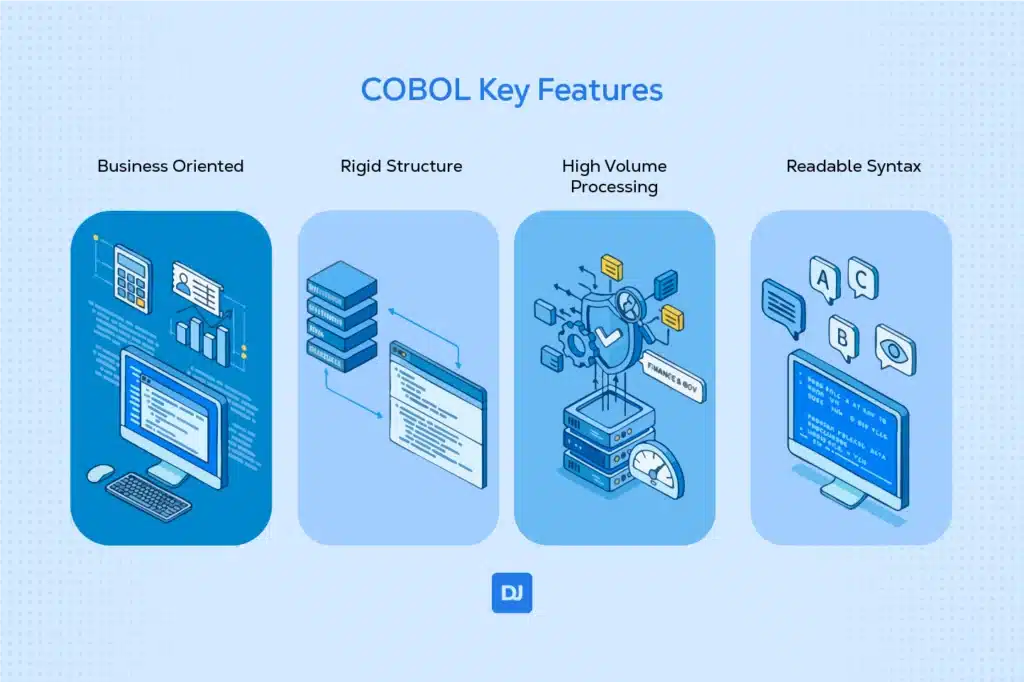
- Business-Oriented: Designed for commercial and administrative applications, making it excellent for accounting, payroll, and managing large databases.
- Rigid Structure: Divided into four sections (IDENTIFICATION, ENVIRONMENT, DATA, PROCEDURE), with sections and paragraphs that organize the code.
- High-Volume Processing: Known for its ability to efficiently manage enormous amounts of data, a fundamental requirement for sectors such as finance and government.
- Readable Syntax: Uses English words, making it relatively easy to read, although verbose.
COBOL Never Dies

There is a reason why COBOL still exists. According to an article published in the International Journal of Advanced Research in Science, Communication and Technology (IJARSCT), there are nearly 220 billion lines of COBOL code still in use today. COBOL is the foundation of 43% of all banking systems that handle $3 trillion of daily commerce. Moreover, COBOL handles 95% of all ATM card swipes and processes 80% of all in-person credit card transactions.
Few people outside the COBOL community know, but the programming language has been updated several times. COBOL’s “last update” depends on the compiler, but major ones are evolving: IBM’s Enterprise COBOL 6.4 (released May 2022) added z16 hardware support & Java interoperability, with updates through 2024, and Version 6.5 was released in June 2025.
Maintenance and Migration: Why Maintenance is Better in COBOL
Remember: there are nearly 220 billion lines of COBOL (Reuters, 2017). MicroFocus (now OpenText) brought a higher estimate in 2022, around 800 billion lines. That’s eight times more lines of COBOL than stars in our galaxy! If they are right, rewriting all of that into a new programming language can cause many bugs and even higher costs.
This is one of the most expensive and high-risk strategic IT decisions a company can face. The choice between maintaining/modernizing in-place (on-premise, without a complete rewrite) and migrating/rewriting (bringing the code to another language) depends on a complex analysis of cost, risk, agility, and business value.
When to Maintain and Modernize COBOL on the Mainframe
The in-place maintenance and modernization scenario is the most common choice for mission-critical systems. The decision focuses on reducing risk and costs without affecting the core business logic.
| Description | Reasons to Keep COBOL | |
| Risk | The risk of failure during migration is high, and service interruption is unacceptable. | COBOL is stable and has been proven over decades. If the system works perfectly, the risk of rewriting it is unacceptable. |
| Performance | The system requires high speed and massive transaction processing (e.g., overnight batch processing). | The Mainframe environment (z/OS) and the Enterprise COBOL compiler offer performance and scalability for I/O and massive data processing. |
| Costs | The estimated cost of migration is astronomical (billions of dollars), and the Return on Investment (ROI) is unclear. | Encapsulating existing COBOL (transforming COBOL logic into APIs) is much cheaper and faster than rewriting hundreds of millions of lines of code. |
| Skills | The company has a stable COBOL team and mentoring programs in place. | Investing in training and modernization tools (Mainframe DevOps, Zowe) ensures continuity without migration. |
When to Re-Write and Migrate Away from COBOL
A migration to modern languages (such as Java, Python, or C#) only makes sense when the value of the new architecture outweighs the risk and cost of rewriting.
| Description | Reasons to Migrate | |
| Agile | The company needs rapid development cycles (DevOps, Microservices) and continuous integration. | Modern languages and architectures allow faster software deployment. |
| Integration | The legacy system is isolated and can’t integrate with third-party solutions or cloud services. | Migration allows the use of native cloud frameworks and libraries. |
| Skills | Severe COBOL talent crisis and struggle to fill vacancies. | Switching to Java or C# attracts a much larger and younger talent pool, reducing hiring costs. |
| Code Quality | Only if your COBOL code is badly written, ill-documented, highly coupled, and is spaghetti code. | Migration (or tool-assisted refactoring) is the only opportunity to clean up the logic and restructure the system into a modern and sustainable architecture. |
COBOL Migration vs Maintenance Comparison
This table provides a high-level summary that compares the core dilemma of Maintenance vs. Migration, so you can learn the difference and pinpoint it instantly.
| Decision | Main Focus | Best Case Scenario |
| Keep COBOL | Minimize Risk and Maximize Transactional Performance. | Core business systems with high transaction rates and excellent performance. |
| Re-Write and Migrate | Maximize Agility and Solve the Talent Crisis | Support modern applications or when a skills crisis threatens the business. |
Why is There a Perception that COBOL is Dead?
In short, the “death” of COBOL is a long-standing prediction driven by its age and lack of mainstream popularity, but it is far from reality. The language remains stable, reliable, and a powerhouse for much of the world’s core financial and administrative infrastructure.
That being said, there is a lack of COBOL developers. In fact, there is a widely recognized shortage of new developers, particularly as the current workforce is nearing retirement age. According to Phil Teplitzky, “the average age of a COBOL programmer is 58, and 10% are retiring each year”. His study is from 2019, so it’s safe to assume that COBOL developers have gotten even older and scarcer since then.
This scarcity, combined with the continued reliance on COBOL for critical business systems, means two things.
One: the perception of COBOL being dead will persist since it’s not popular (for example, no web applications will use COBOL). Two: existing developers are in high demand.
What Skills Does a COBOL Developer Need?
COBOL is an easy programming language to learn, since it has a syntax closer to English than Python. However, a developer who merely knows COBOL won’t be able to do much. What you need to look for in a COBOL developer is not only COBOL proficiency, but an expert level in your core business (banking, insurance, aviation, etc.) and knowledge of the Mainframe Ecosystem (z/OS, CICS, DB2, JCL, utilities, and RACF/ACF2 security).
This is why COBOL developers have a wide range of average salaries across multiple sources. Generic COBOL developer job postings fail to bring this level of specialization. This is why experienced COBOL programmers can earn a lot for patching, but some basic work may pay little.
| Source | Annual Average Salary |
| GlassDoor | 93,211 |
| ZipRecruiter | 121,161 |
| PayScale | 98,000 |
In other words, COBOL developers must be unicorn developers to really impact your business.
Conclusion
COBOL isn’t dead. Instead, it’s a specialized proven technology. The challenge lies not in its functionality, which remains excellent for high-volume batch processing on mainframes. COBOL’s challenge is in the talent pipeline and developer perception.
For the foreseeable future, companies must focus on modernizing COBOL in place with tools like Mainframe DevOps and investing in upskilling new talent. Ignoring COBOL means risking the foundation of the world’s most critical financial infrastructure.
However, how to hire a COBOL developer with all the necessary hard/soft skills and cultural fit? This is when DistantJob comes in!
We are a recruitment agency that headhunts and vets the best developers in the global talent pool. You only pay when you are satisfied with the candidate; 80% of our clients accept one of the first two talents. And you have a three-month guarantee!
Contact us today, and hire the best COBOL mainframe expert available in the world!