DevOps is a culture and set of practices for getting development and operations to work together; platform engineering is the practice of building an internal developer platform (IDP) that makes those practices self-service. DevOps defines how teams should collaborate and automate. Platform engineering builds the tooling that lets them do it at scale. They are not competing approaches. Platform engineering is how mature DevOps organizations reduce the load DevOps puts on individual developers.
As your company grows, you may wonder whether to hire for Platform Engineering and DevOps roles to support your engineering teams. They are often confused by people because platform engineering is an evolution of DevOps principles.
Many companies lack clear definitions for these roles. These job roles overlap in some ways but serve different purposes, and the right choice often depends on your company’s size, stage, and goals.
In this article, we break down how startups, scale-ups, and enterprises can benefit from each role. We’re going to break down exactly what Platform Engineering and DevOps mean, how they differ, and when they work well together.
What Is DevOps?
DevOps is a software delivery approach that removes the traditional wall between development and operations teams. Instead of developers writing code and handing it to a separate ops team to deploy and maintain, DevOps brings both functions into one continuous workflow built on automation, shared ownership, and fast feedback.
The core idea is cultural before it’s technical. DevOps asks teams to break down silos, automate everything repeatable, and take collective responsibility for software from commit to production. The well-known phrase is “you build it, you run it.” The team that writes a service also operates it.
In practice, a DevOps engineer builds and maintains the pipeline that makes this possible: CI/CD automation, infrastructure as code, monitoring and observability, and the guardrails that let teams ship quickly without breaking production. They’re generalists by design, working across the whole delivery lifecycle.
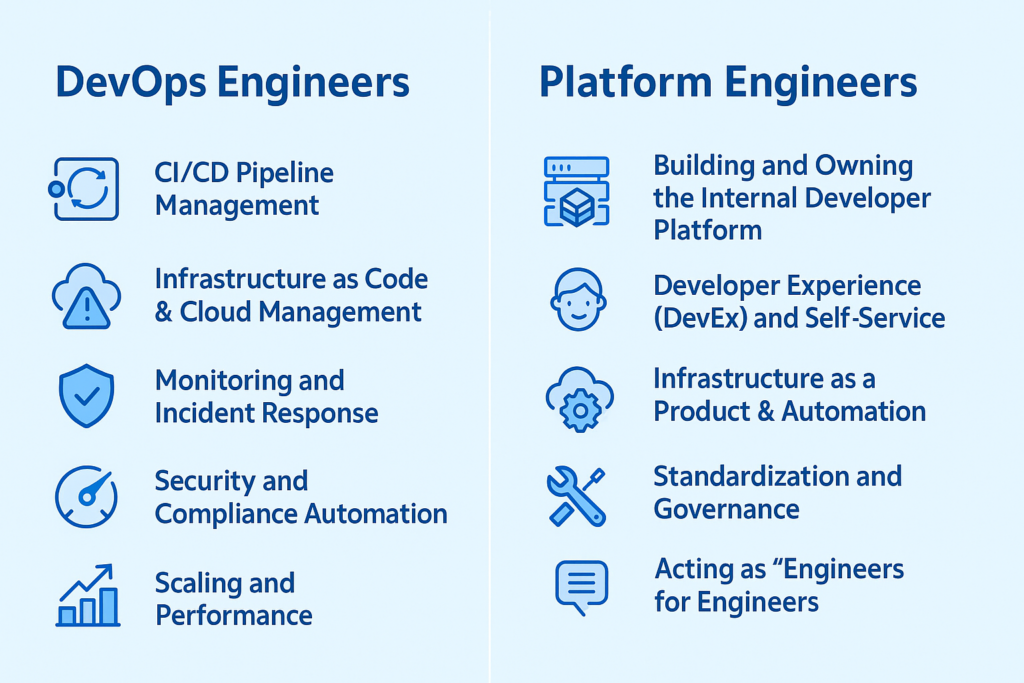
DevOps engineers are responsible for building CI/CD pipelines and necessary automations. However, DevOps engineers really are a focal point for cultural transformation. Practicing DevOps is everyone’s responsibility in the organization, including Platform Engineers.
DevOps Engineers Responsibilities
A DevOps Engineer is a role that comes from the DevOps movement; an approach that started with collaboration between Software Development and IT Ops (operations) to deliver software faster and more reliably. Their mission is to bridge the gaps on multidisciplinary teams, enable autonomy, deliver value, optimize the delivery of services and products to clients. DevOps Engineers achieve this through automation, monitoring, and CI/CD. They also apply existing market best practices such as Lean, Kanban, Agile, and ITIL. Typical responsibilities include:
CI/CD Pipeline Management
Building and maintaining Continuous Integration/Continuous Deployment pipelines. Automation allows rapid, consistent testing and deployment, so developers can ship updates with confidence.
Infrastructure as Code & Cloud Management
Managing cloud infrastructure through code and automation. A DevOps Engineer ensures the underlying infrastructure is properly set up, scalable, and resilient on cloud platforms like AWS, Azure, GCP, etc. They handle resource provisioning, container orchestration, configuration management, and so on. No wonder DevOps engineers are often confused with Cloud Engineers.
Monitoring and Incident Response
Setting up monitoring, logging, and alerting systems. DevOps Engineers watch over applications and infrastructure, responding to incidents (e.g., outages, performance issues). They also work to resolve them quickly, ensuring high uptime and reliability for the product. Finally, a DevOps Engineer often implements incident response processes and on-call rotations to manage operational issues.
Security and Compliance Automation
They implement security best practices (access control, secret management, vulnerability scanning) and ensure the infrastructure meets compliance requirements (including SOC 2, HIPAA, GDPR in regulated industries). In some companies, this role may be labeled DevSecOps, particularly when there is a heavy emphasis on security integration.
Scaling and Performance
Planning for growth by making sure systems can scale easily. A DevOps Engineer designs infrastructure and tooling that handle increasing load, whether through horizontal scaling (more instances/containers) or vertical scaling. They also optimize performance and resource usage to keep systems efficient.
What Is Platform Engineering?
Platform engineering is the practice of building and maintaining an internal developer platform: a central, self-service set of tools, workflows, and infrastructure that developers use to build, deploy, and run their software without needing to manage the underlying complexity themselves.
It emerged from a real problem with DevOps at scale. The “you build it, you run it” model works well on small teams, but as an organization grows, asking every developer to become an expert in Kubernetes, Terraform, cloud networking, and a dozen other tools creates enormous cognitive load. Developers spend more time fighting infrastructure than writing features.
Platform engineering solves this by treating the platform as a product, with developers as its customers. A platform team builds “golden paths,” which are standardized, pre-approved ways to provision a database, deploy a service, or spin up an environment, so an individual developer can self-serve in minutes instead of filing a ticket or learning a new tool. A platform engineer focuses almost exclusively on building and improving this IDP.
Platform Engineers
Platform Engineers build and maintain an internal developer platform (IDP) to make software development easier, reduce cognitive load, and enable self-service. These platforms simplify infrastructure and allow application teams to focus only on delivering business value.
Platform engineering is a DevOps best practice. According to Gartner, “Platform engineering is the discipline of building and operating self-service internal developer platforms to improve developer experience and scale agile and DevOps practices.” Therefore, platform engineers create a custom software platform with all the tools your developers will need to develop: IDEs, code templates, test environments, IaC, orchestration tools, and more.
Think about Batman and his utility belt. The Batbelt was supposed to include everything needed to enable Batman in his job. Platform engineering is to build a “utility platform” for your team.
Platform Engineer Responsibilities
Platform Engineering is a newer discipline that builds upon DevOps principles but takes a product-oriented approach to infrastructure and developer tools. In other words, Platforms are Products, and as such, must satisfy the team that will utilize them. Typical responsibilities and focus areas for a Platform Engineer include:
Establish Golden Paths
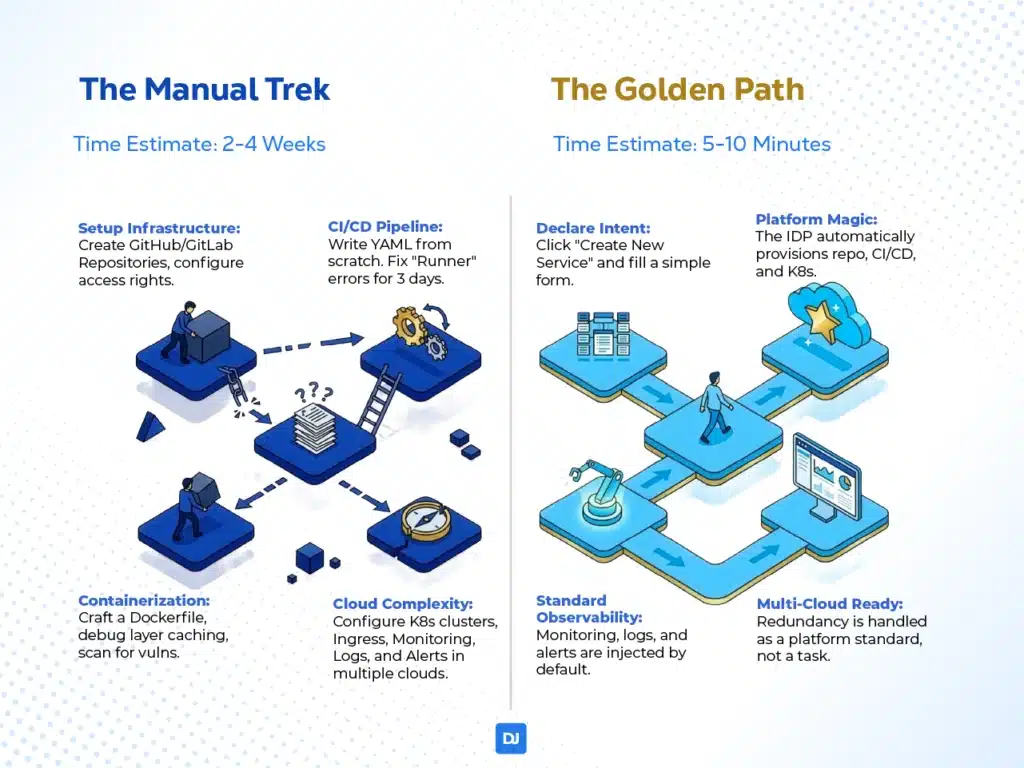
A Golden Path is the easiest and correct way to achieve a goal. It’s the essence of Platform Engineering and the reason why IDPs are Products.
For example, when a developer has no Golden Path to generate infrastructure, they have to create a GitHub/GitLab repository, then configure a CI/CD pipeline from scratch, write a Dockerfile, configure Kubernetes, set monitoring, logs, alerts, and create the same infrastructure in more than a single cloud for redundancy. It would take weeks or even a whole month.
What if the same developer just had to click on “Create New Service”, fill a three-line form, and the whole system was built in minutes? This is a Golden Path. The developer just has to declare intent in a single YAML, and the IDP does all the magic.
Building and Owning the Internal Developer Platform
Design, build, and maintain the IDP that developers use daily. It includes Developer portals, templates, custom CLIs, Kubernetes-based environment platforms, CI/CD as a service, shared tooling, and more.
Developer Experience (DevEx) and Self-Service
A core goal of platform engineering is to improve developer experience. The goal is to offer developers the “Golden Path”: a workflows that make it easy for devs to do the right thing (deploying apps, creating new services, provisioning resources) without having to think too much.
In short, Platform Engineers create templates as Lego blocks, so that developers can build everything by themselves without cognitive load, stress, or infra expertise.
Infrastructure as a Product & Automation
Platform Engineers treat internal infrastructure and tooling as a product to be managed over time. They gather requirements from developer users, build features (like new automation or a service catalog), and iterate just like an external product team would. They also implement advanced automation scripts and “everything-as-code” philosophies (Infrastructure as Code, policy as code, etc.). Therefore, they ensure that common tasks are automated and scalable.
Standardization and Governance
Platform teams centralize tools and services and enforce standards across the company. The platform provides a curated set of technologies (programming languages, deployment methods, cloud services) that are supported and integrated. Security and compliance requirements are baked into the platform (e.g., security scans or access controls are applied uniformly whenever developers use it to create resources). It also means fewer one-off solutions: multiple teams share the same platform rather than each inventing their own scripts, reducing duplication and errors.
Acting as “Engineers for Engineers”
A platform engineer develops a platform for other developers; the other dev teams are their customers. They often have a strong software engineering background, which they apply to building internal tools and APIs.
Additionally, platform engineers work closely with development teams to understand pain points and create solutions (for example, if developers struggle with setting up test data, a platform team might provide a managed test data service).
Notice that Platform Engineers do not typically handle day-to-day production; that remains the realm of DevOps/SRE. Instead, platform engineering is about minimizing problems and incidents.
Platform Engineering vs DevOps: The Key Differences
The simplest way to hold the distinction: DevOps is the philosophy, platform engineering is the implementation that makes the philosophy scale. Here’s how they compare across the dimensions that matter when you’re hiring or structuring a team.
| DevOps | Platform Engineering | |
|---|---|---|
| What it is | A culture and set of practices | A discipline that builds a product (the IDP) |
| Primary goal | Faster, more reliable software delivery through collaboration and automation | Reduce developer cognitive load with self-service tooling |
| Scope | Broad; spans the entire delivery lifecycle | Focused; building and maintaining the internal platform |
| Who the “customer” is | End users of the software | Internal developers using the platform |
| Day-to-day work | CI/CD pipelines, IaC, monitoring, incident response | Golden paths, self-service portals, platform APIs, internal tooling |
| Mindset | “You build it, you run it” | “We build the platform so you can run it easily” |
| When it fits | Almost every team shipping software | Organizations large enough that infrastructure complexity slows developers down |
| Relationship | The foundation | An evolution of DevOps, not a replacement |
A useful way to think about it comes up often in industry discussions: if DevOps is cooking a meal and needing a specific pan or ingredient, the old model makes you forge the pan and grow the ingredient yourself. Platform engineering stocks the kitchen so you can just cook. Both want the same outcome, fast and reliable delivery. Platform engineering removes the friction that stops DevOps from delivering it at scale.
Is Platform Engineering Replacing DevOps?
No. This is the most common misconception, and it leads to bad hiring decisions. Platform engineering doesn’t replace DevOps any more than a kitchen replaces cooking. It’s a response to what happens when DevOps succeeds and an organization grows past the point where every team can reasonably own its full infrastructure stack.
Platform engineering depends on DevOps principles to work. The platform a team builds exists to deliver DevOps outcomes (autonomy, automation, fast feedback) more efficiently. Take away the DevOps culture and a platform team is just building tools nobody adopts. The two reinforce each other: DevOps sets the goals, platform engineering builds the means to hit them without burning out developers.
Who Should You Hire Based on Your Company Size and Needs?
The stage of your company influences whether a DevOps or Platform Engineer is more appropriate (and when to introduce each). If your company is just starting up, your team needs a team with fewer members that can perform many roles (as DevOps). If your company is in growth mode, then you would benefit from hiring DevOps engineers to establish a DevOps culture. And when you are scaling up in an enterprise-scale environment, your teams will benefit from a team of Platform Engineers. Here is a stage-by-stage breakdown:
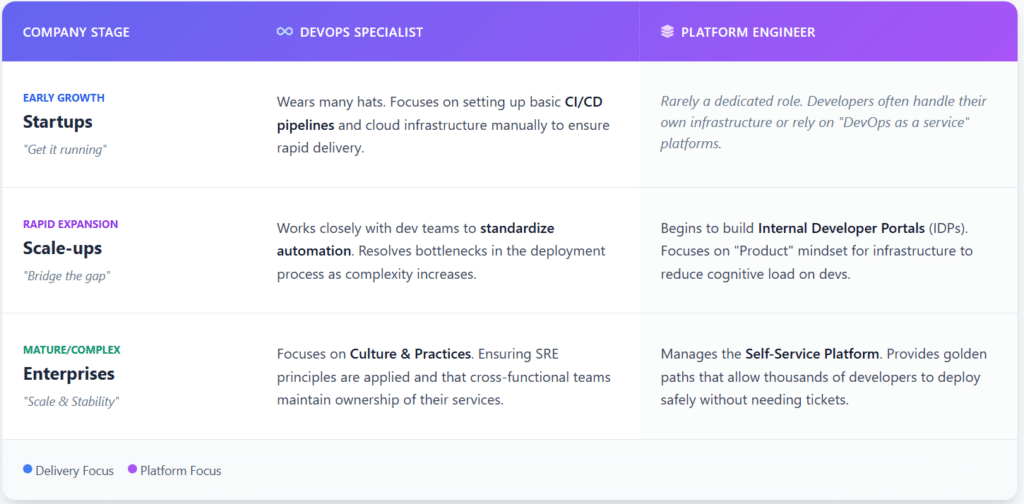
Early-Stage Startup (Small Team)
In the earliest stage (e.g., a startup with just a handful of developers), you likely do not need a full-time Platform Engineer or even a dedicated DevOps Engineer. Startups or very small teams benefit more from versatile engineers who can wear multiple hats, including basic “DevOps” tasks, rather than specialized roles. A senior software developer takes on cloud and infrastructure duties.
In a small team (around 1–5 engineers), this approach is enough for provisioning cloud resources and managing simple infrastructure needs. The focus at this stage is speed of development and time to market, so any DevOps work (setting up CI/CD, monitoring, etc.) is handled as part of general engineering work.
Hiring a full-time DevOps specialist too early can be overkill unless your product is particularly infrastructure-heavy. Platform Engineering at this stage is unnecessary; there aren’t enough developers or complex workflows to justify building an internal developer platform.
Growth Stage (Scale-Up Company)
When you have on the order of 20–30 engineers or multiple dev teams, it’s usually time to bring in a DevOps Engineer (or a full DevOps team). DevOps generalists will manage infrastructure and deployment challenges more systematically for your growth stage.
At this scale, relying on each development team to manually handle cloud changes or deployment setup becomes inefficient and error-prone. A dedicated DevOps Engineer focuses on automating deployments, improving build pipelines, and maintaining environments so that developers stay productive.
However, if you notice your DevOps team getting swamped with requests or developers waiting on infrastructure, it might be a signal to begin investing in platform capabilities. Hire a Platform Engineer or form a small platform team to create internal tooling and standards. This is why many scale-ups still get by with a strong DevOps team and maybe some infrastructure or tooling engineers.
That being said, a full-fledged Platform Engineering function typically becomes key a bit later when the company is larger. The key is to monitor pain points: if setting up new services or environments is slow and causing developer frustration, introducing platform practices (self-service tools, standardized environments) can significantly help even in this stage.
Large-Scale & Enterprise
In a large company or enterprise (with dozens of teams or 30+ developers), the needs become broad enough that both DevOps and Platform Engineering roles usually have a place. Enterprises often implement DevOps practices across teams and maintain a dedicated Platform Engineering team to provide a robust internal developer platform.
In fact, as companies scale, they require structured, consistent platforms. Here, the Platform Engineering team builds and maintains the common tooling (CI/CD systems, Kubernetes platforms, developer portals, etc.) that all dev teams use, while DevOps Engineers (or site reliability engineers) focus on operating and automating the infrastructure within those frameworks.
At the enterprise stage, it’s common to have multiple DevOps Engineers working with many product teams or infrastructure teams, plus a Platform Engineering team owning an internal platform. For example, a big company might have a Platform Product Manager guiding the platform roadmap and coordinating between platform engineers and development teams.
The Platform team’s work ensures that development teams can self-service most infrastructure needs through well-defined interfaces, reducing cognitive load and duplication. Meanwhile, DevOps (or SRE) roles continue to ensure reliability and handle any custom needs or legacy systems not covered by the platform.
Platform Engineering vs DevOps at Company Size Comparison Table
Early startups rely on developers to handle basic DevOps for speed and simplicity. As companies scale to multiple teams, hiring DevOps Engineers becomes essential to automate pipelines and manage deployments.
When growth causes infrastructure bottlenecks, Platform Engineers emerge to create self-service tools and standardize practices. In large companies, both Platform and DevOps teams coexist: Platform Engineers build shared systems like CI/CD or Kubernetes, while DevOps or SREs focus on maintaining reliability and ensuring smooth operations across all development teams.
| Company Stage/Size | Engineering Team Size (Approx.) | Primary Need/Focus | Recommended Role to Hire | Explanation |
| Early-Stage Startup | 1–5 engineers (handful of developers) | Speed of development and getting the product to market. | No dedicated role necessary; senior software developers handle basic “DevOps” tasks. | Focus is on speed; specialized roles are overkill unless the product is infra-heavy. Platform Engineering is unnecessary due to low complexity. |
| Growth Stage (Scale-Up Company) | 20–30 engineers (multiple teams) | Systematic management of increasing operational complexity and deployment challenges. | A DevOps Engineer (or full DevOps team) is usually the first hire. | Dedicated DevOps generalists improve build pipelines, automate deployments, and maintain environments for developer productivity. |
| Growth Stage (Scaling Pain Points) | 30+ engineers (multiple teams) | The DevOps team is swamped, or developers are waiting on infrastructure. | Begin investing in platform capabilities (a Platform Engineer or small team). | The pain points signal a need to codify best practices into internal tooling and standards (self-service tools) to reduce frustration and slow setups. |
| Large-Scale & Enterprise | 50+ developers (dozens of teams) | Structured, consistent platform and reliable operations across the organization. | Platform Engineering Team AND DevOps Engineers (or SREs). | Enterprises require a dedicated Platform team to build and maintain common tooling (CI/CD, Kubernetes) for all teams, while DevOps/SREs operate within those frameworks and ensure reliability. |
Platform Engineering vs Engineering for E-Commerce Platforms
Many large-scale companies across the globe use the title “Platform Engineer” to describe engineers who build the foundation of their business product. If a company hires a “Platform Engineer” to build an E-commerce catalog, that engineer will be extremely unsatisfied. There are three main reasons for this overlap in job descriptions.
First, in companies like Amazon or Shopify, the “E-commerce Platform” is so vast that the work of those who maintain the catalog engine is very similar to that of infrastructure. For example, focusing on latency, concurrency, and APIs, distancing themselves from the “frontend” or simple business logic.
Second: Many companies want their businesses on online platforms (e.g., App Store, Shopify). In these cases, the platform engineer builds APIs and SDKs for third parties, which is a middle ground between product and infrastructure.
Finally, the term Platform Engineering is trending. Recruiters may use it to attract infrastructure/SRE engineers to the Core Services teams, even if the job is not to create an IDP. Many companies have simply renamed their “Backend Core” teams to “Platform Teams” to sound more modern, which leads to candidates expecting almost $200k for roles that won’t compensate nearly as much.
This confusion makes salaries go wild across the globe, because a true platform engineer receives far more compensation than a software engineer working in a PaaS.
| Feature | True Platform Engineering | Engineering for E-Commerce Platforms |
| Primary Customer | Internal Developers (DevEx) | External Customers & Merchants |
| Primary Goal | Reduce cognitive load; Build an IDP | Enable business transactions; Scalable APIs |
| Key Metrics | Deployment frequency, Lead time for changes | Throughput (orders/sec), Latency, Cart conversion |
| Tooling Focus | Kubernetes, Crossplane, Terraform, Argo CD, Backstage | Distributed databases, Search engines, GraphQL |
Platform Engineering vs DevOps Salaries
According to the State of Platform Engineering 2025, the annual salary difference between Platform Engineers and DevOps Engineers in North America is huge. Platform Engineers earn an average of $160,767, while DevOps Engineers earn an average of $118,500.
European Salary Comparison
According to the State of Platform Engineering 2025, the salary trend favoring platform engineers is consistent in Europe, although the overall figures are significantly lower:
2024
- European Platform Engineers earn an average of $118,028.
- European DevOps roles earn an average of $96,132.
2025
- European Platform Engineers earn an average of $104,629.
- European DevOps roles earn an average of $65,882.
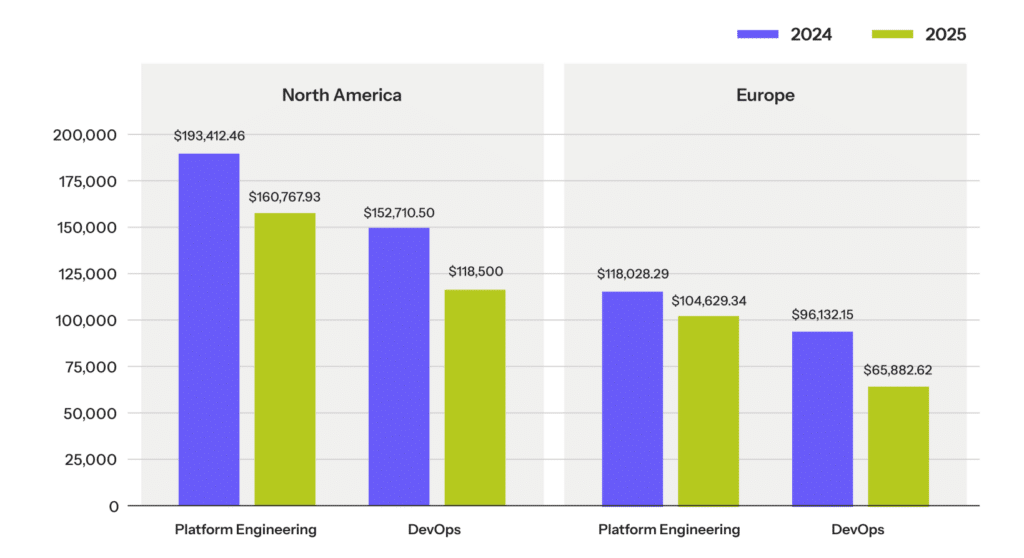
Although both salaries are lowering, the gap between them is approximately 60% higher in favor of Platform Engineers in Europe. However, anecdotal evidence from Reddit points to much lower pay in certain European regions; for example, a Cloud DevOps role in Italy with one year of experience reported a salary of $32,000 per year, with similar pay in Estonia.
| Metric | Platform Engineer | DevOps Engineer | Platform Engineer vs. DevOps Difference |
| North America Average Salary | $160,767 | $118,500 | +35% |
| Europe Average Salary | $104,629 | $65,882 | +60% |
| Salary Trend | Higher in both regions. | Lower in both regions. | Platform Engineers consistently earn more in both regions. |
Conclusion
DevOps Engineers bring automation, culture, and good practices to your software delivery process. They are indispensable for getting startups and growing teams onto a solid operational footing. Platform Engineers become critical as your company scales, ensuring that the efficiency and speed of development don’t degrade as more teams and services enter the picture.
Choosing between hiring a DevOps Engineer or a Platform Engineer (or deciding when to evolve from one to the other) comes down to understanding your company’s current needs and future trajectory.
And if you ever need to hire a DevOps Engineer or a Platform Engineer, contact us. You will find the best unicorn in the world, tailored to your needs, at a much lower expense than in the American job market!
Sources