MEAN Stack, MERN Stack, and Full-Stack development are terms you’ll often hear in web development. All three involve building both the front-end and back-end of web applications (hence “full stack”), but they differ in the specific technologies used and in their approach.
The comparison between MEAN stack, MERN stack, and Full Stack development centers on their technologies and their implications for web application development.
In this article, we will differentiate between them and know which one works best for your project.
Demystifying Full-Stack Development
Full-Stack Development is the process of developing a web application on both the client-side (front-end) and server-side (back-end). A Full-Stack Developer is proficient in all layers of web development, enabling them to handle a project from concept to production.
Full-stack isn’t tied to a specific tech stack; it refers to any development that covers both front-end and back-end. In fact, MEAN and MERN are subsets of full-stack development; they are full-stack technology combos.
Web Application Layers
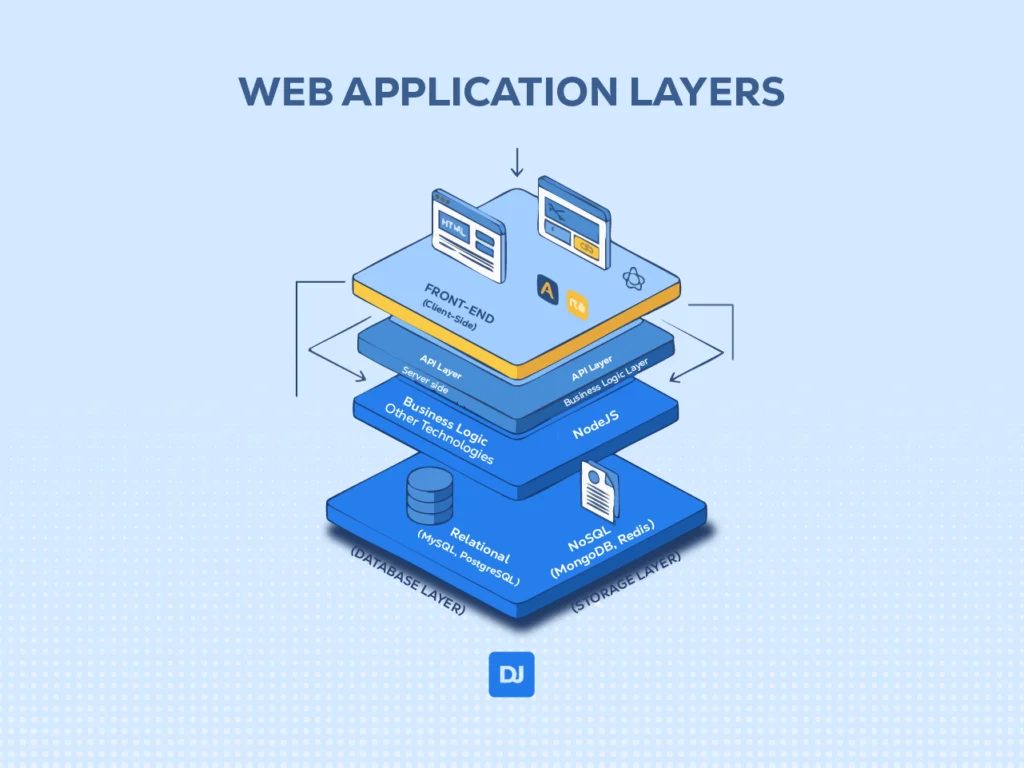
A standard web application is composed of three primary layers: Front-end, Back-end, and Database.
Front-end (Client-Side)
This is the user-facing layer, built using technologies that run in the user’s browser. It handles the user interface (UI) and user experience (UX).
Technologies: HTML, CSS, and JavaScript (using frameworks or libraries like Angular or React, we will see more of them later).
Back-end (Server-Side)
The Back-end is the engine of the application, handling business logic, user authentication, and serving data to the frontend. It consists of three sub-layers:
- API Layer: Receives requests from the frontend (via HTTP) and sends responses.
- Business Logic Layer: The core processing logic that determines the application’s functionality.
- Other Technologies: Server-side languages (Node.js, Python, Java, PHP) and frameworks (Express.js, Django, Ruby on Rails).
Database (Storage Layer)
A database is responsible for persistent data storage, retrieval, and management.
Technologies: Relational databases (MySQL, PostgreSQL) or NoSQL databases (MongoDB, Redis).
What does MEAN Stack mean?
The “MEAN” Stack is an acronym for four JavaScript-based technologies that provide a full-stack development. This tech stack is composed of MongoDB, Express.js, Angular, and Node.js.
In MEAN, Angular is the front-end framework, providing a structured, MVC (Model-View-Controller) approach to building the user interface. The back-end is handled by Node.js (JavaScript runtime) and Express.js (server framework), with MongoDB as the database.
| Component | Technology | Role |
| M | MongoDB | NoSQL database; stores data in flexible, JSON-like documents. |
| E | Express.js | Backend web application framework; handles routing and middleware. |
| A | Angular | Frontend framework; builds dynamic user interfaces (written in TypeScript). |
| N | Node.js | JavaScript runtime environment; runs server-side applications and connects to the database. |
In short, MEAN utilizes TypeScript across the entire tech stack, promoting code reusability and simplifying data exchange with JSON. Angular provides a structured, opinionated framework suitable for large-scale enterprise applications.
MEAN Stack Architecture and Interaction
The key strength of MEAN is its consistent use of TypeScript across all layers. The architecture works as follows:
- Client Request: The user interacts with the Angular frontend.
- Server Processing: Angular sends an HTTP request to the Express.js API running on Node.js.
- Database Interaction: Express.js retrieves or modifies data in MongoDB. Since MongoDB stores data in JSON (or BSON) format, and Node.js uses JavaScript, data transfer across the server and database is seamless.
- Response: The Node.js server sends a JSON response back to the Angular frontend, which automatically updates the UI using Angular’s two-way data binding.
MEAN Learning Curve
The MEAN stack has a steep learning curve. Angular is a powerful but complex. It uses TypeScript (a typed superset of JavaScript) and follows a highly structured architecture. This means there’s more to learn up front. Angular has concepts like dependency injection, decorators, and a specific project structure, requiring knowledge of TypeScript. Beginners often find Angular’s extensive feature set challenging compared to React’s relatively minimalist core library.
MEAN Community Support and Ecosystem
Angular also has a significant community and is backed by Google. The Angular/MEAN community tends to be enterprise-focused and highly professional. There are plenty of tutorials and documentation for Angular (the official docs are quite comprehensive), and you’ll find forums and Q&A specifically for Angular issues.
However, because Angular’s overall popularity among developers is a bit lower than React’s, the community is smaller. You still have solid community support, especially for big-picture, enterprise use cases. That being said, you might find slightly fewer third-party libraries or examples for very cutting-edge stuff than in React’s ecosystem.
What is the MERN Stack?
The MERN Stack shares three components with MEAN, differing only in the frontend technology. Instead of Angular, MERN uses React. React is more like a flexible, component-based library. This stack’s architecture is more about building UIs from components instead of Angular’s MVC approach.
| Component | Technology | Role |
| M | MongoDB | NoSQL database; stores data in flexible, JSON-like documents. |
| E | Express.js | Backend web application framework; handles routing and middleware. |
| R | React | Frontend JavaScript library; builds dynamic user interfaces using components. |
| N | Node.js | JavaScript runtime environment; runs server-side applications and connects to the database. |
MERN Architecture and Interaction
The MERN stack follows a nearly identical process to MEAN, with the key distinction being the frontend’s architecture and data flow:
- Client Request: The user interacts with the component-based React frontend.
- Server Processing: React sends an HTTP request to the Express.js API running on Node.js.
- Database Interaction: Express.js interacts with MongoDB.
- Response: The Node.js server sends a JSON response back. React processes this data and selectively updates the necessary parts of the UI using the Virtual DOM (Document Object Model) and a unidirectional data flow.
MERN Learning Curve
MERN is more beginner-friendly. React is simpler, with a component-based approach focusing mainly on JavaScript itself. You can start building usable interfaces relatively quickly with React. The MERN stack overall uses a single language across front and back ends, which reduces context-switching for learners, focusing solely on the view layer.
However, while React is simpler to start with, achieving an enterprise-ready application with MERN often requires more boilerplate and third-party libraries (for state management like Redux, routing, etc.). Angular provides these out of the box.
MERN Community Support and Ecosystem
React is currently one of the most popular front-end libraries, and this popularity extends to the MERN stack as a whole. By some metrics, React’s usage outpaces Angular’s by a wide margin. According to the State of JavaScript 2024, React has 82% of popularity against Angular’s 50%.
MERN developers benefit from a vast, vibrant community with abundant learning resources, open-source libraries, and quick help on forums. If you run into a problem, there’s a good chance someone on Stack Overflow or GitHub has already posted a solution.
MEAN Stack vs MERN Stack vs Full-Stack Comparison
The terms Full Stack, MEAN, and MERN represent a hierarchy of concepts. While Full Stack is the expansive, overarching practice of mastering all application layers (Frontend, Backend, and Database), the MEAN and MERN stacks represent highly specialized and efficient implementations of that practice, both leveraging JavaScript’s power across the entire application.
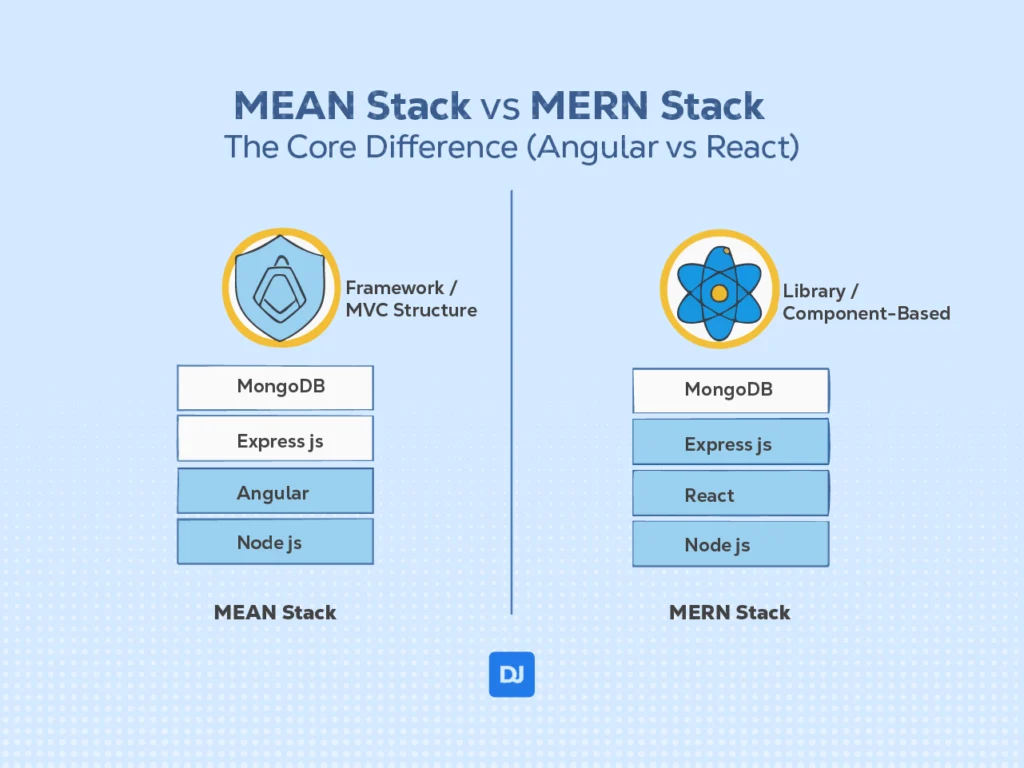
The difference between MEAN and MERN lies in the frontend: MEAN provides a more structured experience with the Angular framework and its built-in MVC architecture, offering a comprehensive solution right out of the box. In the meantime, MERN uses the highly flexible React library, which benefits from a Virtual DOM and a component-based approach. And also, MERN doesn’t demand you to use either MVC or TypeScript. The following table shows the differences and similarities among the Full Stack concept, the MEAN Stack, and the MERN Stack.
| Concept | Scope | Key Differentiating Factor |
| Full Stack | Broad Concept | The practice of working on all three application layers (Frontend, Backend, Database). |
| MEAN Stack | Specific JavaScript Stack (Structured) | Uses Angular (Framework) on the frontend. Offers MVC architecture and built-in features. |
| MERN Stack | Specific JavaScript Stack (Flexible) | Uses React (Library) on the frontend. Offers Virtual DOM and component-based architecture. |
It’s worth mentioning that the database layer is the most easily swappable component in both stacks. Instead of MongoDB, you can use PostgreSQL (PERN, PEAN).
Conclusion
MEAN and MERN are both full-stack JavaScript stacks that enable you to build an entire web application with one language. However, they differ in the choice of front-end framework (Angular vs React) and thus in developer experience.
MEAN’s use of Angular offers a more structured framework approach, which can be excellent for large, complex projects but comes with a steeper learning curve. MERN’s use of React lends itself to flexibility and quick development of rich interfaces, making it very popular for new applications and easier to pick up for many beginners.
You know the stack you need. Now you need the people to build it. Don’t waste months sifting through resumes. Let DistantJob headhunt the top 1% of global remote full-stack talent for you.