If you value simplicity and productivity, you employ Laravel. Laravel is an open-source PHP framework used to build secure, scalable, and maintainable web applications.
Choosing a new programming language means hiring a new developer and getting all these juicy Laravel Developer skills on board at your company.
When hiring a Laravel developer, knowing which skills to prioritize is crucial to finding the right fit for your team. While expertise in the Laravel framework is non-negotiable, there are other key skills to look for that will ensure you’re onboarding a top-notch developer.
The best Laravel developer skills to look for in 2026 are Blade/Livewire/Inertia front-end knowledge, advanced Eloquent, and database optimization. Other skills include clean architecture, testing, CI/CD deployment, cloud/serverless familiarity, security awareness, and strong remote communication.
They should also be proficient in other web technologies and database management, and should have a strong understanding of concepts such as Laravel’s Controller and Model-View-Controller (MVC).
However, technical expertise alone isn’t enough. A true Laravel expert should excel in collaboration and communication, possess soft skills that facilitate teamwork, and have a working knowledge of project management methodologies. This combination of technical and interpersonal skills is essential for a Laravel developer to thrive in any new team environment and deliver results efficiently.
According to a recent Adeva survey, 96% of respondents were male, 67% worked on products serving fewer than 10,000 users, and 82% used Laravel exclusively on the backend. The report also found that among Laravel products with more than 1 million users, 44% were built by companies with fewer than 50 employees.
Key Laravel Developer Skills
Now, let’s get down to business. If you have upcoming interviews for candidates looking to fill the Laravel job opening, or if you are a Laravel developer yourself, make sure these skills are on the table.
| Skill | What to look for | Why |
| Laravel Basics | Routing, middleware, queues, jobs, events, policies | Shows framework fluency |
| Front-end Stacks | Blade, Livewire, Inertia, Vue/React, Tailwind | Determines how the app UI is built |
| Database Optimization | Eloquent, eager loading, indexes, transactions, locks | Prevents scaling problems |
| Clean Architecture | Form Requests, Services, Actions, SOLID | Keeps code maintainable |
| Testing | Pest/PHPUnit, feature tests, integration tests | Reduces regressions |
| Deployment | Forge, Vapor, CI/CD, zero-downtime deploys | Protects production stability |
| Security | Auth, authorization, validation, OWASP basics | Reduces business risk |
| Remote Communication | PR notes, async updates, documentation | Makes distributed teams work |
1. Modern Front-End Mastery: Blade, Livewire, or Inertia?
In 2026, Laravel Developer skills are rarely just backend. You need to identify which Laravel flavor your candidates specialize in.
TALL Stack
The TALL Stack is composed of Tailwind CSS, Alpine.js, Laravel, and Livewire. However, the focus here is Livewire. It allows you to create dynamic interfaces (that change without reloading the page) by writing only PHP code.
This stack is great for delivery speed and keeping everything on the PHP ecosystem without a complex JavaScript framework.
VILT Stack
In the meantime, the VILL Stack is composed of a hybrid PHP/JS: Vue.js (or React), Inertia.js, Laravel, and Tailwind CSS. The rockstar here is Inertia.js, which acts as a glue between Laravel and modern JavaScript frameworks such as Vue or React.
VILL is ideal for apps that need interactivity, leveraging JavaScript’s biggest tools but keeping Laravel’s convenience.
What about Blade?
Even with the TALL and VILT stacks dominating, Blade remains the foundation. If a developer says they prefer just Blade, they’re saying they want to keep the project simple, robust, and without any fancy-schmancy JavaScript frameworks.
Ask Your Candidate
“Which stack do you prefer for a real-time dashboard, and why?” Why is this question important?
If he chooses TALL/Livewire, they probably value productivity and simple server integration.
If he chooses VILT/Inertia, they probably prefer total control over the interface and the Vue/React component ecosystem.
Hiring a Laravel developer requires understanding whether he is a “PHP purist” (TALL) or a “modern JavaScript enthusiast” (VILT). Both are excellent, but they change how the project is built.
2. Advanced Data Architecture: Beyond CRUDs and Eloquent
In software development, CRUD (Create, Read, Update, Delete) is the basics: creating, reading, updating, and deleting data. Any beginner can do this using Eloquent (Laravel’s system that translates PHP code into database commands). A senior developer needs to go beyond the basics to prevent the system from slowing down or crashing. Let’s break down the main points.
The “N+1” Problem
This is the #1 performance killer in Laravel. An expert will mention “Eager Loading” or the with() method as the solution.
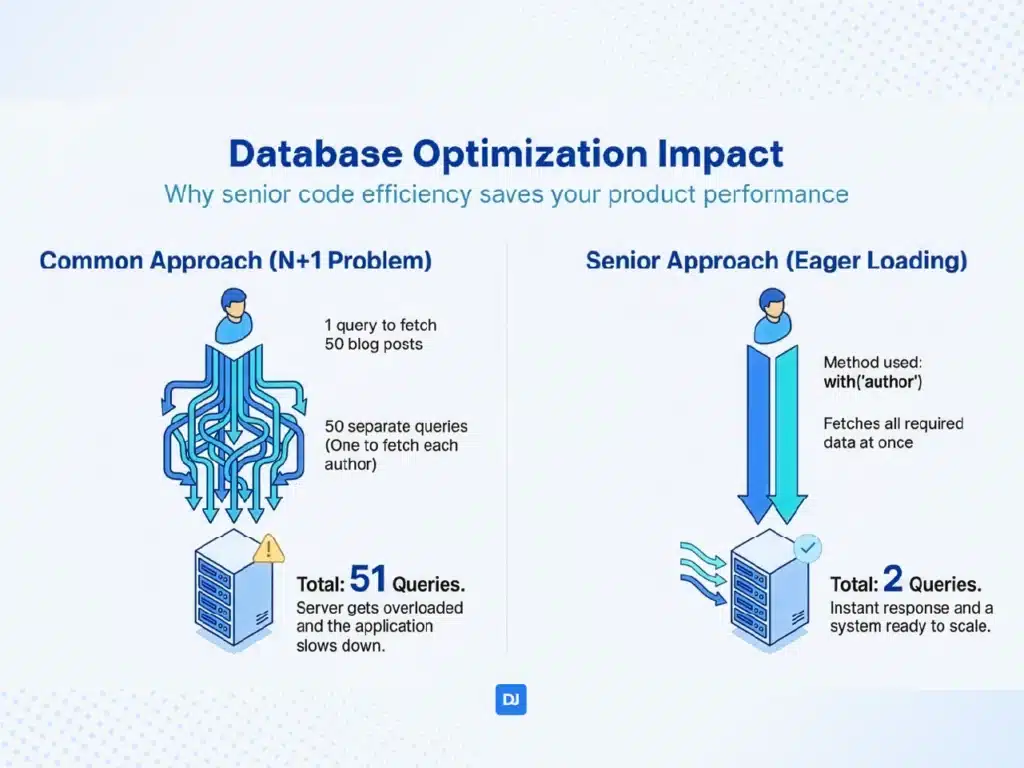
For example, imagine you have a list of 50 posts, and you would like to display the author’s name for each. The system performs one query to retrieve the 50 posts, and then performs another 50 queries (one for each author).
Total: 51 queries to the database. If there are 1,000 posts, that will be 1,001 queries. This overloads a server.
The solution is Eager Loading. A developer can use the with(‘author’) method. Laravel only makes 2 queries: one for all posts and one for all authors involved. This reduces database load and keeps response times stable as the dataset grows.
Indexing & Scaling
When a table has millions of rows, the database cannot read them one by one to find what you want. There are two potential solutions.
The first solution is Database Indexing. It’s like the index of a technical book. Instead of reading the whole book, you go to the index, see the page, and go directly to it. A senior knows which columns should be indexed to speed up searches.
The other solution utilizes Atomic Locks. They prevent two processes from modifying the same data at the same time (which would cause data corruption). It’s like a bathroom “lock”: if one process enters, it locks the door, and the other person has to wait.
Ask This Question
The final question is: “How do you identify a slow database query in a Laravel app?” An expert doesn’t guess; they use monitoring tools.
Laravel Debugbar
A bar that appears in the footer of the website under development, showing exactly how many queries were made and how long each one took.
Laravel Pulse
A real-time dashboard showing which routes and database queries consume the most resources on the production server.
Clockwork
Similar to Debugbar, but it works as a browser extension, while being visually cleaner.
In summary, beginners use Eloquent haphazardly. Seniors utilize Eloquent with an understanding of how the database (MySQL, PostgreSQL, etc.) will receive that command. If the developer doesn’t understand the N+1 problem, their system will likely slow down as soon as the number of users scales up.
3. Professional Code Standards: Design Patterns & Clean Architecture
This section touches on a sore spot in many projects that grow too fast and become impossible to manage. The focus here is on maintainability and organization.
In Laravel, the “Controller” is like a waiter in a restaurant: it receives the customer’s order and delivers the prepared dish. The common mistake is to turn this waiter into a cook, cleaner, and manager all at once.
Imagine a Controller with 500 lines of code. It validates data, sends emails, resizes images, calculates taxes, and saves to the database. If something goes wrong in the tax calculation, you have to hunt for the error in the middle of this “spaghetti code.”
The Senior’s solution is to make the Controller “lean” (Thin Controller). It should only receive the request and call whoever actually knows how to do the job.
Organization Tools
To lighten the controller’s load, developers use the following structures.
Form Requests
Instead of validating email addresses within the Controller, you create a separate class just for that. The Controller only receives the data if it has already been validated.
Service Classes
If your system has a complex rule for giving a discount on a sale, you put it in a SaleService. This way, you can use the same rule on the website, in the app, or in an automated command without repeating code.
Action Classes
This is a strong trend in modern Laravel. Instead of a giant service class with multiple methods, you create a class for a single action, such as ProcessPaymentAction. This makes the code much easier to test.
Repositories
They serve to isolate how data is retrieved. If tomorrow you decide to change the database, you only modify the Repository, and the rest of the system doesn’t even notice.
The SOLID Principles
These are the gold standard for clean code. You don’t need to know what each letter means, but to give you an idea, SOLID is a set of 5 rules that basically say the following:
- Each class should do only one thing.
- The code should be easy to extend (add functions) without needing to change what is already working.
- You should rely on abstractions, not rigid implementations.
Ask This Question
When you ask, “How do you keep your Controllers lean?”, you’re testing whether the person has a work methodology or if they just program as they go.
Junior’s answer: “I try not to write too much code there.” (Vague).
Expert’s answer: “I use Form Requests for validation and extract the complex logic into Action Classes or Services, ensuring that the Controller only coordinates the application flow.”
Good code is code that any other programmer can read and understand months later.
4. The Deployment Pipeline: Forge, Vapor, and CI/CD Automation
In the past, programmers used “FTP” (manually sending files one by one), which was slow and dangerous. However, if the internet went down in the middle, the website would go offline. In 2026, an elite professional with Laravel Skills uses what we call a Deployment Pipeline. It’s an automated process, like a factory assembly line.
The Laravel Ecosystem
Laravel has official tools that take care of the server so that the developer can focus only on the code.
Laravel Forge
A tool that manages real servers (like DigitalOcean or AWS). It automatically configures everything Laravel needs (PHP, Nginx, Security).
Laravel Vapor
Vapor is “Serverless” (without a fixed server). The system scales automatically: if 10 people access it, it consumes little resources; if 1 million people access it at the same time, it creates automatic instances to handle the load.
Security Networks (CI/CD)
Imagine that the developer made a mistake that would break the website. With CI/CD (Continuous Integration / Continuous Deployment), the code goes through an “inspection window” before being published.
GitHub Actions
This is a robot that runs automated tests every time code is submitted. If a test fails, the code doesn’t go live.
Automated Tests
The senior developer writes code that tests its own code. This guarantees that by fixing one thing, you haven’t broken another.
Zero-Downtime Deployment
You know when a website goes under maintenance for 10 minutes to update? In 2026, that’s a sign of amateurism for high-traffic websites. Here are the seniors’ deployment strategies to avoid this with their Laravel developer skills.
Envoyer / Blue-Green Deployment
The system prepares the new version of the site in a “secret folder” on the server. When everything is ready and tested, it simply swaps the “pointer” from the old folder to the new one. It’s instantaneous. The user doesn’t even notice that the site has changed while they are browsing.
Automatic Rollback
If the new version crashes in the first few seconds, the system automatically “undoes” the change and reverts to the previous version.
Ask This Question
When you ask, “How do you guarantee zero downtime on a high-traffic website?”, you want to hear about CI/CD automation.
A senior Laravel developer sets up a pipeline in GitHub Actions that runs their tests and, if approved, uses Envoyer or Vapor for an atomic deployment, ensuring the user never sees an error screen during the transition.
5. Remote Synergy: Vetting for Communication & Problem-Solving
In a remote environment, Product Thinking is more valuable than raw typing speed. You want a partner, not a ticket-taker.
Asking Why
A senior developer saves a company thousands of dollars simply by asking questions before starting.
If you request a complex feature that will take a month to develop, the senior developer might ask: “Why do we need this now? If we use this ready-made tool, we can solve 80% of the problem in 2 days. What do you think?” That’s professional maturity.
Asynchronous Skills
In remote work, people aren’t in the same room. Therefore, asynchronous communication (that which doesn’t happen in real time) needs to be perfect.
For example, the code should be self-explanatory or well-documented. If the developer disappears or gets sick, can someone else take over the work?
When delivering Pull Requests, they explain what they did, why they did it, and how to test it. They leave clear “traces” of their reasoning.
Dealing with Technical Debt
A good developer knows how to explain this to someone outside the technical field: “We can launch it like this today to validate the idea, but in two months we’ll have to redo this part so the system doesn’t crash.” They translate the “economics jargon” and “tech jargon” into language the company understands.
Laravel Salaries in Average
As of Apr 29, 2026, skilled Laravel developers in the United States earn $123,262 per year. This is $59.26 an hour, $2,370/week, or $10,271/month.
Here are some average salaries of Laravel developers in different U.S. cities, according to ZipRecruiter:
| City | Annual Salary | Monthly Pay | Weekly Pay | Hourly Wage |
| Berkeley, CA | $150,927 | $12,577 | $2,902 | $72.56 |
| Sitka, AK | $148,491 | $12,374 | $2,855 | $71.39 |
| Wyoming, WY | $147,005 | $12,250 | $2,827 | $70.68 |
| Santa Clara, CA | $145,570 | $12,130 | $2,799 | $69.99 |
| Mountain View, CA | $145,409 | $12,117 | $2,796 | $69.91 |
| San Francisco, CA | $145,224 | $12,102 | $2,792 | $69.82 |
| Sunnyvale, CA | $144,666 | $12,055 | $2,782 | $69.55 |
| San Jose, CA | $144,429 | $12,035 | $2,777 | $69.44 |
| Diamond Ridge, AK | $143,124 | $11,927 | $2,752 | $68.81 |
| Daly City, CA | $142,823 | $11,901 | $2,746 | $68.66 |
How to Test Your Laravel Candidate Skills?
Finding candidates is only part of the process. Finding a winning candidate takes some skill and a very thorough interviewing process. You’ll want to evaluate both their technical and soft skills.

These interviews can be virtual or physical, depending on what you find suitable and convenient, and may take different approaches depending on what you’re trying to evaluate. The two most common types of interviews are:
- Technical interviews: These are your typical interviews, where you prepare a battery of technical questions pertaining to the nature of the job and use them to assess the candidate. As the name implies, these are better suited to evaluating the overall technical knowledge of candidates but say little in terms of how they work as part of a team. You’ll want to use this type of interview to test your candidates on their Laravel expertise, for example.
- Coding challenges: Coding challenges, such as pair-programming interviews, are better suited to assessing a candidate’s soft skills. While they can also be used to assess technical skills, they are tailored to test creativity and problem-solving, all while in an environment that resembles the candidate’s day-to-day job. You’ll want to give your candidates a custom test that closely resembles the types of challenges they will face regularly.
Why are Laravel developers highly in demand?
Laravel is a very popular PHP framework, in no small part due to being free, fast, easy to develop in, and extremely secure. While there isn’t a definitive number of Laravel developers in 2026, MilesWeb suggests that there are over 35,000 developers in forums on the internet who use the Laravel platform.
BuiltWith shows that more than 2.4 million websites currently use Laravel, and it is used on top websites regularly.
Key Factors to Consider When Hiring Expert Laravel Developers
“How do I choose the best Laravel developers?” Skills are indeed important, but you should consider other factors when hiring your developer.
Choosing Between a Freelancer and a Full-time Laravel Developer
When choosing between a freelancer and a full-time developer, you first need to evaluate the project.
Freelancers tend to be employed on smaller and faster projects. They have a set project or job to perform, and that will be the extent of it.
But if you truly want your business to grow, you’ll want someone full-time who answers and grows with you. Full-time developers bring more value to your company and can eventually take on senior roles with experience. They are also the option to go with if you expect heavy support to be needed after a project launches.
Evaluating the Experience Level of Laravel Developers
If you’re looking for someone to integrate into an already established team and you just need more hands on deck, you can go with an associate or just a plain, regular developer. The rest of the team can help them grow and gain experience as they work.
If, however, you’re looking for someone to lead or to bolster your team’s knowledge, then you’ll want an expert or senior developer. Their expertise will be the pillar of the rest of the development team, so make sure you’re hiring someone knowledgeable of Laravel itself, but also of the specific field in your business.
Salary
Your budget will dictate the salaries you can offer your developers and thus the experience of people you can employ. Senior developers will be more taxing on your business’s finances, but these costs can be offset by the efficiency these experts bring.
You can offset part of these costs by hiring remotely (more on that later!), but it’s still important to be prepared for the costs of hiring developers. But there is a way to spend less, which leads us to…
Embrace Remote Hiring for Laravel Development
In the current job market, the best way to attract talented developers is by offering them the opportunity to work remotely. As the world is going remote, developers are beginning to value the comfort and practicality of working from home.
Remote work has also brought advantages to people looking to hire developers. Whereas previously companies would hire local talent, remote work has opened a whole world of possibilities (quite literally!).
When hiring locally, you might hire someone who has what it takes. When you hire globally, you choose the top IT talent from anywhere in the world. By hiring in countries with lower cost-of-living, you hire said top developers at a fraction of the cost for you while still offering extremely competitive salaries to your employees.
Remote workers tend to be 35-40% more productive than their local counterparts and produce 40% fewer quality defects, according to Forbes. So, it makes sense to hire a remote worker with high-level Laravel developer skills.
Final Thoughts
Now you know why hiring a Laravel developer is so important, and how to do so. It’s not always easy, especially in today’s job market: you have to look for a person with not only the right technical skills and know-how, but also soft skills and team spirit. It may seem daunting, but there are ways to land that perfect developer for your needs.
What if I told you that you can welcome your new talented Laravel developer in two weeks? If you let us help you, of course! At DistantJob, we are tired of seeing companies paying exorbitant salaries for developers who don’t meet their expectations. That’s why we have more than 15 years of experience headhunting talented remote developers. We match them with companies that, despite their significant efforts, weren’t able to find qualified candidates. We are believers that ALL companies, no matter their size or budget, should have the best tech talent. You deserve better, and we can help you! If you wish to hire a Laravel developer, reach out to us today!