Software development staff augmentation has become the default way for engineering teams to scale up without going through 30 to 70 days of in-house recruitment for every role. The model is simple, the value is real, and the failure rate when it’s used wrong is high enough that most engineering leaders have at least one cautionary story about it.
This guide covers what staff augmentation actually is, how it compares to project outsourcing and direct remote hiring, what it costs in 2026 by country, when it’s the right call, when it isn’t, and what to look for in a partner. It’s written for engineering leaders, CTOs, and hiring managers who want a clear-eyed view of a model that vendors have a strong incentive to oversell.
What is software development staff augmentation?
Software development staff augmentation is an engagement model in which a hiring company brings external developers onto its existing team to fill specific skill or capacity gaps. The augmented developers work full-time on the client’s project, attend the client’s standups, follow the client’s processes, and report into the client’s management, but are formally employed and paid by an external vendor. It is most often used when a company has an internal team but needs to add skills it can’t hire locally, scale up quickly, or cover a temporary surge in workload.
The defining feature of staff augmentation is not where the developer comes from or how they’re paid. It is that you manage the work, not the vendor. That is the line between staff augmentation and project outsourcing, and the confusion between the two is the single most common reason engagements disappoint.
In a project outsourcing engagement, you hand the vendor a specification and they deliver software. The vendor decides how to staff it, manages the developers internally, and is responsible for the outcome. You see the result at the end.
In a staff augmentation engagement, the vendor finds a developer, vets them, and places them on your team. From that point forward, the developer takes direction from you. They attend your standups, work in your Slack, push code to your repo, and report into your engineering manager. The vendor handles payroll, benefits, and HR. The work, the priorities, and the technical decisions belong to you.
Staff augmentation vs other engagement models
A clean comparison is the fastest way to see where staff augmentation fits.
| Staff augmentation | Project outsourcing | Managed services | Freelance / contract | Direct remote hire | |
|---|---|---|---|---|---|
| Who manages day-to-day | You | Vendor | Vendor | You | You |
| Who employs the developer | Vendor | Vendor | Vendor | Self-employed | You |
| Commitment level | Full-time on your project | Project-scoped | Function-scoped | Often split across clients | Full-time, long-term |
| Time to start | 2 to 6 weeks | 4 to 12 weeks | 6 to 12 weeks | Days | 4 to 8 weeks |
| Pricing model | Hourly markup or monthly | Fixed-price or milestone | Retainer | Hourly | One-time placement fee |
| Best for | Scaling an existing team | Finite, well-defined projects | Specialised recurring functions | Short bursts, niche skills | Long-term roles in your org chart |
Staff augmentation vs project outsourcing
The cleanest way to think about this: project outsourcing delegates outcomes, staff augmentation delegates labor. If you have a clear specification, a fixed budget, and a deliverable date, outsourcing fits. If you have an ongoing product and need more hands on the work your team is already doing, staff augmentation fits.
The mistake to avoid is treating one like the other. Companies that buy staff augmentation but manage it like outsourcing (handing tickets over a wall, never speaking to the developers directly) get the worst of both worlds. Companies that buy outsourcing but want to control the daily work end up paying outsourcing markups for a service they’re effectively self-managing.
Staff augmentation vs freelance contracting
Freelancers and staff-augmentation developers look similar on paper. Both are non-employees, both bill hourly, both work remotely. The differences show up under load.
A freelancer typically has three to six clients at once. Their attention to your project is real but capped. Communication may be asynchronous because they’re working another client’s standup at the same time as yours. The freelance model rewards short, defined tasks. It punishes long-term commitment.
A staff-augmentation developer works full-time on your project. They are present in your meetings, in your codebase, and on your incidents in the same way as an employee. They typically stay on the engagement for months or years rather than weeks. The trade-off is cost (you pay the vendor’s markup on top of the developer’s salary) and the fact that they remain on the vendor’s payroll.
Staff augmentation vs managed services
Managed services means the vendor owns a whole function — 24/7 monitoring, infrastructure operations, QA-as-a-service. You agree to outcomes and SLAs; the vendor decides how to staff and run it. The hiring company has minimal visibility into how the work actually gets done.
Staff augmentation is the opposite. You see every developer, you direct every task, you know who pushed every commit. The vendor’s role is to find good people and handle the employment overhead.
Staff augmentation vs direct remote hire
A direct remote hire is exactly what it sounds like. You hire a developer in another country (often through a recruitment agency or employer of record service), they become your employee, and they work for you full-time. No vendor markup, no rented-bench dynamic.
| Staff augmentation | Direct remote hire | |
|---|---|---|
| Pricing | Ongoing hourly or monthly markup | One-time placement fee, then standard salary |
| Length | Months to years | Years to indefinite |
| Commitment | Vendor-employed, can rotate | Your employee, your retention |
| Cost over 3 years | High (markup compounds) | Lower (no ongoing markup) |
| Best for | Surge work, specialised skills, project-limited needs | Permanent roles in your org chart |
The simple rule: if a role will exist in your org chart a year from now, you don’t want to augment it. You want to hire it.
When software development staff augmentation is the right call
Staff augmentation works well in a specific set of scenarios. The mistake is using it everywhere.
1. You need a specialised skill your team doesn’t have
Your team is strong in React but the project needs three months of Rust work for a performance-critical service. You’re not hiring a Rust engineer permanently because the work will end. Staff augmentation gives you the skill for the window you need it.
2. You need to scale up quickly
Internal hiring takes 30 to 70 days for a senior developer, and that’s after you start the search. If your roadmap needs four extra engineers in three weeks, traditional hiring isn’t an option. A good staff augmentation provider can place developers in 2 to 6 weeks.
3. You have a temporary capacity surge
Crunch before a launch. A migration project that doubles your team’s workload for a quarter. Seasonal traffic that needs extra hands for three months. Augmenting up and then down without hiring (and firing) permanent staff is exactly what the model is designed for.
4. You’re testing a new technology or geography
You want to know if a Latin American team can do production work for your US engineering org before committing to a long-term hire. A staff augmentation engagement is a low-risk way to find out.
5. You need to bridge a gap during recruitment
You have an open senior role that’s been unfilled for four months. The work is piling up. Augmenting with a temporary developer keeps the roadmap moving while you find the permanent hire.
When staff augmentation is the wrong call
This is the section the typical staff-augmentation vendor will never write, because their business model needs every prospect to conclude that augmentation is the answer. The honest reality: it isn’t, often.
1. Core product engineering on a long-term roadmap
If a developer is going to work on your codebase for two or three years, staff augmentation is the wrong vehicle. The vendor’s markup compounds. The developer is technically employed by the vendor, which limits how deep their commitment to your company can go. And the vendor has structural reasons to keep the developer billing through them rather than transitioning to a direct hire, even when both sides would prefer that outcome.
For a role you want filled for years, hire directly.
2. Highly speculative early-stage work
If you don’t know what you’re building yet, you can’t write a clear role description. Staff augmentation works when you know what skill you need. Pre-product-market-fit teams usually need flexibility more than specific skills, and full-time founders or early hires beat augmented developers for this work.
3. Roles that depend on deep institutional knowledge
The longer someone works on your codebase, the more valuable they get. Staff augmentation models that rotate developers throw that value away. If the work requires understanding your customer, your data model, and your product strategy at a level only built over time, augmentation is structurally a bad fit.
How much does software development staff augmentation cost in 2026?
Costs vary significantly by country, seniority, and vendor model. Here are the ranges that consistently show up in 2026 for senior developers via staff augmentation providers:
| Region | Hourly (senior) | Monthly (full-time) | Annual equivalent |
|---|---|---|---|
| US onshore | $100–$200 | $16,000–$32,000 | $190,000–$380,000 |
| Latin America (Argentina, Mexico, Brazil) | $45–$80 | $7,200–$12,800 | $86,000–$153,000 |
| Eastern Europe (Poland, Romania) | €40–€85 | €6,400–€13,600 | €76,000–€163,000 |
| Asia (India, Philippines, Vietnam) | $25–$55 | $4,000–$8,800 | $48,000–$105,000 |
For comparison, Glassdoor reports the typical pay range for Senior Software Engineers in the United States at $164,000–$259,000 per year as of May 2026, with an average of $204,540. Staff augmentation rates above that range (and many onshore rates do exceed it) reflect the vendor’s markup, payroll handling, and overhead.
A few things the rate sheet doesn’t show.
The markup is usually 30 to 100 percent. A developer billed to you at $80/hour may be paid $40–$55/hour by the vendor, with the difference covering the vendor’s overhead, recruitment cost, and margin. Reasonable vendors will tell you the split if asked. Unreasonable vendors will resist.
How IT Staff Augmentation Works
IT staff augmentation starts with understanding your needs and partnering with a competent staffing provider. This vendor then sources and vets qualified candidates matching your technical specifications, culture, and project goals.
The following steps are how a company can implement IT staff augmentation:
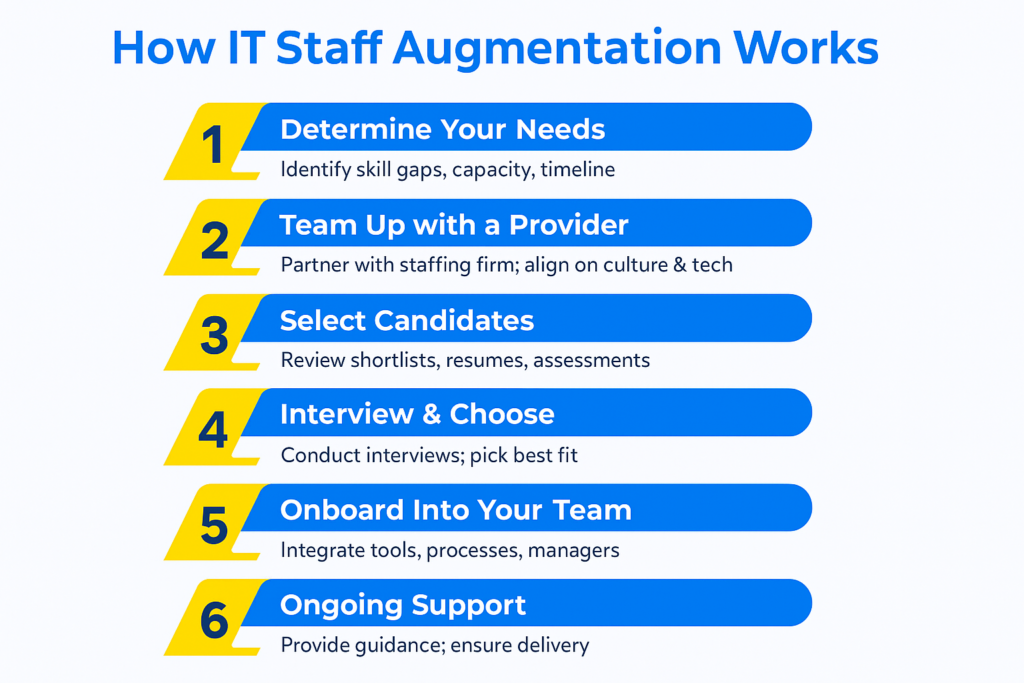
1. Determine Your Needs
Start by identifying the gaps in your current team’s capabilities or extra resources needed to complete new or ongoing projects. These could be specific technical skills, expertise in certain programming languages, or the number of extra hands needed.
What technical skills or capabilities are lacking in your internal team to achieve project objectives? Be it Python, Azure, UX/UI Design, or need to accelerate front-end delivery, or anything else.
Also, identify your needs: is it an emergency, or is it a skill gap that you don’t need to fill in the long run? Staff augmentation works best for temporary projects and needs
With that in hand, write a detailed job profile. Do you need junior, mid-levels or seniors? Which hard and soft skills do these professionals need? And what goals do they need to meet? Avoid hiring a COBIT/ITIL manager just to fix your printer; hire accordingly to the challenge.
Finally, who will be the direct manager of the staff augmentation team? It must be someone on your team to take charge of the newcomers, responsible for assigning tasks, monitoring performance, and onboarding.
2. Team Up with an Augmentation Provider
Next, find an IT staff augmentation agency. These service providers usually have a pool of pre-vetted talents and can handle interviews, onboarding, and payment processing.
Look for IT staffing agencies with proven experience in the area you need. If you need IT Governance, look for IT staffing agencies known for adopting best-in-class Governance frameworks, such as COBIT or ITIL.
Moreover, examine these agencies’ vetting process closely. Does this process guarantee technical quality?
At DistantJob, we first try to understand your business’s unique needs, applying our Three-Tier Approval Process (TAP). It’s a procedure that ensures candidates’ quality through strategic assessment. This enables us to match you with candidates who align with your company’s culture and technical requirements.
3. Select Candidates
At this stage, the staffing agency or your HR will share a shortlist of candidates that meet your predefined criteria. Then, you’ll review each candidate’s resume, skills, and experience to see how they fit your project.
The recruiters should first try to understand your business’s unique needs present only the most qualified candidates who have passed a rigorous screening process, saving you time. This ensures you interview only top talent that matches your specific requirements and company culture.
4. Conduct Interviews and Make a Selection
You will also have your own shortlist. Afterward, you will hold interviews and select the most suitable candidate.
5. Onboard the New Hire into Your Team
After a successful interview process, integrate your new IT staff into your existing team. Even though they’re external remote workers, they work for the same business and managers as in-house employees.
6. Provide Ongoing Support
The IT staff augmentation process doesn’t end after onboarding. You need to continue supporting them till they fully settle in. This is also important to ensure the timely and efficient completion of the project. Even the most talented IT professionals need guidance, especially in a new environment.
How to engage a staff augmentation provider: step by step
The process below is a sane sequence for most engagements. Some vendors will compress steps; the order is what matters.
Step 1: Write a real job description
Treat it like a job ad for a permanent hire. The same level of specificity about the stack, seniority, responsibilities, and expectations. Vague descriptions produce vague candidate matches.
Step 2: Choose two or three vendors and brief them
Compare proposals, not companies. Ask each vendor for the same information: timeline, screening process, rate range, replacement terms. Talking to multiple vendors quickly reveals which ones are real and which are pitch decks.
Step 3: Interview every candidate yourself
The vendor’s screening is the first filter. Your interview is the second. Don’t skip it. Any vendor that resists letting you interview candidates is a vendor whose definition of “qualified” you should not trust.
Step 4: Define onboarding from day one
Treat the augmented developer like an employee from the start. Slack access. Repo access. Standup invites. A buddy on the team. A clear understanding of what’s owned by them and what’s not. The first two weeks set the tone for the whole engagement.
Step 5: Run a 30-day check-in
After 30 days, do an honest review with the developer and the vendor. Is the work landing? Is the communication working? Are there context gaps that need filling? This is the moment to course-correct, not month four when the engagement is in trouble.
Step 6: Plan the long-term arc
If the engagement is going well at 90 days, decide what you want by 12 months. More developers? Convert to a direct hire? Wind down at the end of a project? Decide proactively rather than letting the vendor’s incentives shape the outcome by default.
Common challenges in staff augmentation (and how to actually solve them)
Communication and time-zone friction
Nearshore engagements (Latin America for US clients, Eastern Europe for European clients) usually have enough working-hours overlap to make this a non-issue. Fully offshore engagements (8+ hour gaps) require deliberate structure: clear handoff protocols, two daily overlap windows, async-friendly documentation. Without that structure, decision cycles stretch from hours to days.
Cultural and workflow integration
The augmented developer joining a team they’ve never met has to learn the team’s working norms, technical conventions, product context, and decision-making patterns. None of this happens by accident. A real onboarding plan (the same one you’d run for a permanent hire) is the only fix.
Knowledge transfer and bus-factor risk
If the augmented developer is the only person who understands part of the codebase, you have a single point of failure. Avoid it the same way you would for any team member: pair programming, code review, written documentation, deliberate cross-coverage. The fact that the developer is on a vendor’s payroll doesn’t change the rule.
Vendor turnover
The augmented developer is the vendor’s employee. The vendor might move them off your engagement for a higher-paying client, lose them to attrition, or rotate them as part of internal staffing. Reasonable vendors mitigate this with retention bonuses and account stability commitments. Less reasonable vendors do not. Ask the question before signing.
Misaligned incentives at scale
The longer the engagement runs, the more the vendor’s incentives diverge from yours. They want to keep billing. You want the work done well at a sustainable cost. The structural fix is to make the conversion-to-direct-hire path easy and pre-negotiate it in the contract. The vendors that resist this clause are the ones it’s most needed with.
What about direct remote hiring?
If you’ve worked through this guide and concluded that what you actually need is a permanent member of your team and not a short-term skill injection, not a project sub-contractor, not a bench-rented developer, the right model is direct remote hiring through a placement agency.
The difference:
- The developer is your employee or direct contractor, not the vendor’s.
- The developer’s incentives are fully aligned with your company. They build your codebase. They retire your tech debt. They train the rest of your team.
This is what we do at DistantJob. We run a custom search for every role, screen against your specific stack and seniority, present a shortlist, and place a developer directly on your team. Median time from kickoff to first qualified shortlist is around two weeks. Every placement carries a 90-day replacement guarantee.
It’s not the right model for every situation. If you need four developers for six months and then nothing, staff augmentation is the better fit. But for roles that belong in your org chart, direct hiring beats augmentation on cost, alignment, and outcome.
Challenges of IT Staff Augmentation and How to Solve Them
Like other hiring approaches, IT staff augmentation has some drawbacks you must consider before deciding to use it. These challenges include communication barriers, cultural fit, quality assurance, and overdependence on external support. We discuss them in-depth below:
1. Communication Barriers
Language, cultural nuances, and time zones are among the factors that can impede effective communication between augmented and in-house teams.
When communication is ineffective, it can result in misunderstandings, project misalignment, and inefficiencies. Poor communication also leads to cliques, hurt feelings, and other workplace toxicity.
To avoid this, establish clear communication channels and protocols before bringing in augmented staff. You should also encourage existing team members to be welcoming and inclusive towards incoming members.
2. Cultural Fit
A cultural mismatch can lead to friction, reduced productivity, and potential conflicts within the team.
It is one thing to find external support that meets your skill and experience requirements. However, finding one that equally aligns with your company culture is tricky but achievable. Vet candidates for cultural fit during the interview process, not just technical skills. In addition, implement a thorough onboarding process that includes cultural orientation to help new hires integrate smoothly.
3. Quality Assurance
External staff may not have the same vested interest in the company’s long-term success as full-time employees. They may not do their best work, leading to delays or poor outcomes.
The best way to avoid this is to set well-defined expectations and quality benchmarks. Also, perform regular performance reviews to maintain high standards.
4. Overreliance on External Support
Overdependence on augmented staff for critical functions can become a weakness. If there are no proper knowledge transfer processes or a lack of internal team skill development, it can make you less competitive.
Prevent this issue by documenting processes and maintaining an internal skills repository to reduce reliance on external resources.
5. Time Costs
The attraction of IT Staff Augmentation for business is that you keep control. This control, however, has a price: the time of your senior team. I am not even talking about micromanaging, God forbid, but let’s be real: a manager takes time managing new employees, and this time could be used for more tactical and strategic tasks.
To solve this, define small meetings periodically. Daily Scrums are great for it. Keep most of the communication asynchronous and limit synchronous communication to emergencies and meetings. Your manager will lose time tracking every member, so ensure they will track the new team by deliveries and value, rather than anything else.
6. Need for Infrastructure
While a staff augmentation provider might even cover basic equipment, tech stack access services are paid for by your company. The new employees need access to Slack, Jira, IDE licenses (or equivalent), and monitoring tools. The license fee paid per employee is often ignored while measuring an expert’s hourly cost. An hourly cost isn’t just a salary.
And when the staff augmentation provider doesn’t provide basic equipment? Your company must offer them laptops, software licenses, and access to inner systems. Your business is responsible for taking them under your wing; they won’t come with your contractor’s infrastructure unless stated otherwise in the contract.
Remember to allocate a budget for those spends.
7. Onboarding
While your staff augmentation employees will definitely work under your cultural and company policies, inside your team, they are temporary staff. As such, they might feel less prone to onboard in your company, since promotions are likely out of question.
Moreover, your team in-house may lose some productivity while onboarding the new staff (ramping up).
To tackle this situation, have an onboarding manual (e.g., wiki, Notion, Confluence) and map the infrastructure and security policies. Assign a worker partner (not the manager) for non-technical questions and cultural issues.
8. Security
IT staff augmentation requires setting up secure access, maintaining security privileges, and ensuring compliance, which consumes your security team’s time. The time spent on security audits and managing new access permissions is also a cost.
The staff should have restricted access only to the tools and data essential to the project (Principle of Least Privilege). Utilize VPNs and Zero Trust solutions and revoke access on the contract’s termination date.
9. Knowledge Transfer
What happens when the contract ends? If the staff augmentation team masters a critical part of the infrastructure, the abrupt end of the contract turns into a big problem. Imagine having to quickly (and more expensively) rehire someone to resolve a crisis, or the slowdown of the whole team, trying to understand an unfamiliar configuration.
Include in the contract the following obligation: decisions must be documented, and any infrastructure decisions must be registered in a central system (ADR, Architectural Decision Records). You should use this system for your code’s architecture as well.
Also, plan the end termination of the contract a month prior. In the last weeks, most of the time should be dedicated to transferring sessions or responsibilities from the staff augmentation team to the inner team, as well as updating the documentation.
10. Intellectual Property
The contract should include an unequivocal IP Assignment clause, guaranteeing that all code, design, or artifact created belongs entirely to your company.
Moreover, the contract should emphasize that the work is under the management of the supplying agency (the provider should be accountable to the agency for administrative, salary, and disciplinary matters), with your company only providing technical guidance on tasks.
You can look for local legal advice for more information. If you have your own legal team, ask them to review the contract thoroughly, especially regarding the IP assignment clause. IP protection is a non-negotiable legal concern.
Where to start
Software development staff augmentation is a powerful tool when the shape of the need matches the shape of the model. The companies that succeed with it use it deliberately, for specific situations, with vendors they’ve selected carefully. The companies that fail with it use it as a default solution for problems it isn’t built to solve.
The framework, simplified:
- Project with a clear end date and well-defined scope? Outsource it.
- Existing team that needs more hands for a defined period? Augment it.
- Role that belongs in your org chart for years? Hire directly remote
For the third case, DistantJob places full-time remote developers as direct hires under your management. Tell us what role you’re hiring for and we’ll come back within a business day with a sense of timeline, country options, and rate range.
For the second case, the checklist above should narrow the staff augmentation vendor shortlist quickly. The right vendor will answer every question on it without hedging.
Scale your IT team with DistantJob today!
Frequently asked questions
Software development staff augmentation is an arrangement in which a hiring company brings external developers onto its existing team to fill skill or capacity gaps. The augmented developers work full-time on the client’s project under the client’s management, but are formally employed and paid by an external vendor. The model is most often used for skill-specific needs, capacity surges, or bridging recruitment gaps.
In staff augmentation, the client manages the work day-to-day; the vendor only employs the developer. In outsourcing, the vendor manages both. Outsourcing fits finite, well-defined projects where you want a finished deliverable. Staff augmentation fits ongoing work where you want extra hands on a team you already manage.
A serious staff augmentation vendor can present qualified candidates within 1 to 2 weeks and have a developer working on your codebase within 2 to 6 weeks of kickoff. Vendors with pre-vetted benches are faster but offer narrower fit. Vendors running a custom search are slower but produce better matches for specialised stacks.
No. Staff augmentation places external developers under the client’s day-to-day management. Outsourcing hands a defined project to the vendor and lets the vendor manage it internally. The two terms are often confused, and the confusion is the most common reason engagements disappoint.
Choose staff augmentation when the need is short-term (under 12 months), highly specialised, or driven by a temporary capacity surge. Choose direct remote hiring when the role will exist in your org chart for years, when long-term alignment matters, or when total multi-year cost is the dominant factor.
Most vendors allow this, but the terms vary widely. Some charge a conversion fee. Some have no-poach clauses with cool-off periods (typically 12 to 24 months). Some resist entirely. The honest answer: read the contract before signing, and pre-negotiate the conversion path if you think it might matter later.