Retaining top-tier developers is about more than offering bigger paychecks. It requires creating a work environment that fosters both productivity and longevity. When your development team feels supported, challenged, and valued, they’re far less likely to look elsewhere for opportunities. Moreover, they will be far more likely to stick around and help your business grow.
Data about retention and turnover in 2026 is widely varied. Work Institute says there is a 40% turnover rate with in-house developers. This is consistent with Gallup’s findings of 42% employee turnover in general. There is a broader tech attrition of 17.4% across European tech markets (Ravio). That’s a decrease from the pandemic-era peak of 27%.
However, according to Perceptyx, “Turnover becomes unreliable precisely when change fatigue is highest. During economic uncertainty, employees stay put regardless of experience”.
In short, people fear losing their stability, but that doesn’t stop them from leaving the company when the stars align. According to Itransition, only 11% feel insecure about losing their jobs. It suggests a high degree of confidence in their ability to find new roles. Gallup finds that 1 in 2 US employees are open to leaving their company.
Here are 8 strategies that will lower your turnover rates and boost remote developer retention starting today.
Why Is Remote Developer Retention Critical for Your Business?
Replacing a single software engineer costs 30‑70% of their annual salary. That can delay active sprints by two or more weeks. Every resignation affects velocity, product knowledge, and team morale for cash-conscious companies, making proactive retention cheaper than repeated rehiring cycles.
For companies, retaining talent isn’t just an HR metric; it’s a survival metric. Why? Because:
- 1 in 2 US Employees are open to leaving their company (Gallup)
- Replacing an employee can cost between 30% and 250% of their salary (Kreischer Miller).
- Hidden costs: recruitment fees, onboarding time, lost domain expertise, and productivity dips.
- High churn signals cultural or managerial issues, raising red flags during diligence rounds.
- Nearly all leaders report challenges in finding skilled talent, and +50% predict an IT Shortage due to the Skill Gap (Robert Half)
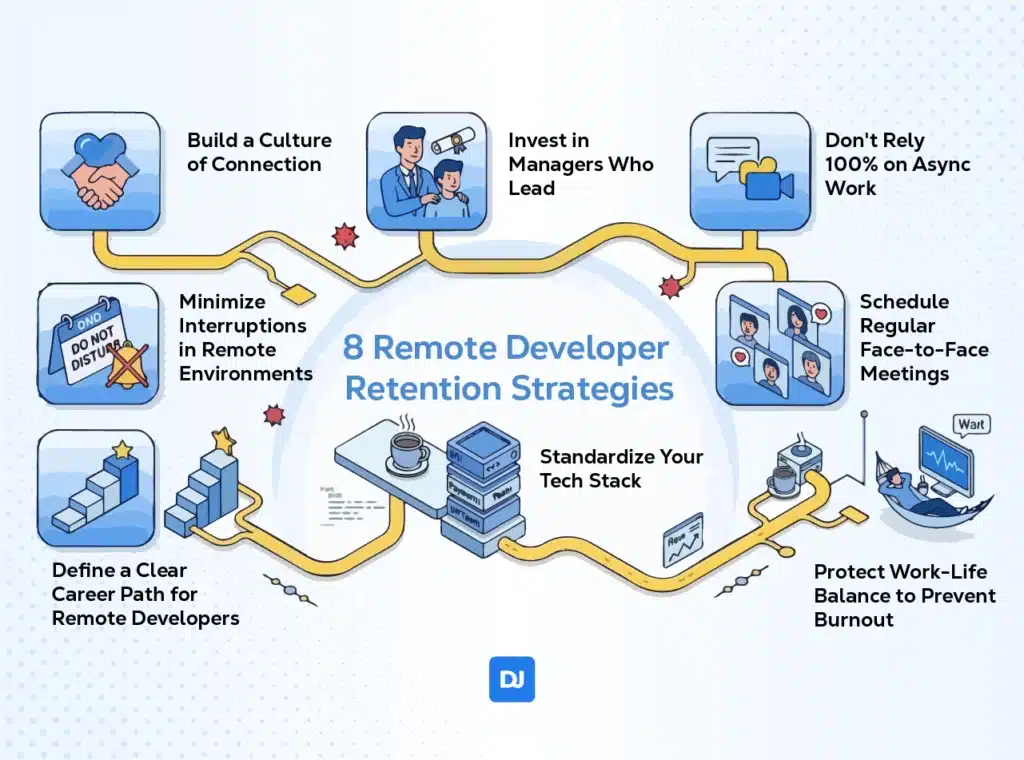
8 Remote Developer Retention Strategies
Let’s explore the 8 top strategies you can and should implement today to retain your top IT talent. From building a culture of connection to how async work is not really helping with longevity. We will also talk about what to do about interruptions and distractions, and how to empower your management team.
1. Build a Culture of Connection for Remote Teams
I often say that company culture means connection; the connection is the culture. So, if you want to build that culture of connections, start by fostering genuine personal interactions that help remote employees feel seen, heard, and valued.
So, instead of making every day or week all about work, start your meetings by asking about your developers’ weekend. Tell them a story about something that happened to you or your family, or even wish someone a happy birthday. Don’t make your team meetings about just routine check-ins; make them intentional moments to encourage genuine and real interaction. Also, share some of your hobbies on your team chat and encourage your team members to do the same, set up casual virtual hang-outs, or arrange one-on-one meetings.
When you do this, you go from having a bunch of remote workers working somewhere individually to building a true team, a cohesive, connected unit that gets along and works well together.
Another tip I always share is to be your team’s therapist. Which means paying attention and acting fast when you start noticing early signs of frustration or resentment, whether it’s passive-aggressive comments, subtle cues of dissatisfaction regarding salary or position, or even signs of depression and burnout. Besides their interpersonal relationships, their mental health should also be a top priority.
Don’t let these signals slide. Address them head-on with empathy and open dialogue before they snowball into resignation letters. When you create an environment where people feel safe to share their frustrations, you build the kind of trust that keeps developers loyal.
This is the foundation. Everything else in this article works better when a connection culture is already in place.
2. Invest in Managers Who Lead Remote Developers
Developers leave bad managers more often than low salaries. Empathetic, technically literate leaders cut churn by 25 %+.
So, it’s safe to say that strong management is, without a doubt, what holds any successful company together.
And what I’ve learned from my experience is that truly effective managers don’t just keep projects on track but also help create and put into action that connection culture we just talked about. They know their job isn’t to simply hand out tasks; it’s to work with their team and set a clear, consistent tone that everyone on their dev team can count on.
That’s why investing in your management team is key. And by investing, I mean teaching them to notice subtle hints, like a shift in tone in a written message or a bit of uncertainty or anxiety during a call, and giving them the skills and tools they need to truly bond with their staff, tackle issues before they grow, and keep an eye on team spirit.
When your leaders often check in, give clear direction, and make room for honest feedback, they build the kind of trust that keeps your IT talent loyal, which, as a matter of fact, stops them from leaving. And let’s not forget: a great manager leads by example, by setting clear expectations, keeping their word, and encouraging open and honest talks.
And here’s the thing: when you invest in your leadership by giving them the right tools and knowledge and thus empowering them to become and be better leaders, you’re not just making your day-to-day operations better—you’re making sure your top software engineers work in an environment that’s conducive to their retention, not their attrition.
3. Don’t Rely 100% on Async Work
Pure async destroys human connection. It creates a sterile, cold work environment where real connections fade away or are never built to begin with. Blend async updates with scheduled real‑time touchpoints.
| Communication Mode | Best For | Cadence |
| Async tools (Slack, Notion) | Daily status, docs | Continuous |
| Live video (Zoom) | Design debates, conflict resolution | 1–2×/week |
| In‑person/off‑site | Team bonding, roadmap planning | Quarterly |
In remote work, where we all lack live interaction, it means you end up missing those important and subtle hints like your team’s tone, their expressions, and their body language, that really help you understand how they’re actually doing. As a consequence, you risk turning your team’s interactions into robotic exchanges that don’t have the warmth and spontaneity of face-to-face conversations (and by face-to-face, I don’t mean in-person, as you can have them remotely as well).
4. Minimize Interruptions in Remote Environments
The two biggest enemies of productivity are interruption and distraction. And these two, in turn, are huge enemies of developer retention, since if they can’t get their work done, they’re more likely to feel demotivated and feel like taking other job offers.
In truth, when you interrupt someone in the middle of a task, you’re actually creating 22 minutes of damage on average. And that gets worse: studies have found that employees face disruptions every 11 minutes, and a striking 27% of these breaks actually result in delays lasting more than two hours before people can and do get back to their tasks.
That’s even more prominent in a traditional office setting, where you have a tap on the shoulder, someone invites you to a meeting you never knew about, you have to go for lunch, or you need to leave at 5 pm to go home.
Now, if you have a boss or a very intuitive leader, they would only approach their employees when they’re hanging out, meaning they would pay attention to when they’re not doing their core work, and just by the water cooler or the cafeteria.
In a remote work environment, although you don’t have the disruptions I just mentioned (lunch, going home, etc), you also don’t have the water cooler or just the ability to actually see what your team members are doing at any given period of time, which makes minimizing interruptions much more challenging. But also extremely important.
So, as a leader yourself and also when you’re instructing your leaders, you should be aware of the real need to focus on not interrupting your employees. To do so:
- Establish clear boundaries and routines that prioritize focus while still keeping communication open, since as humans we need to connect, to have conversations.
- Schedule regular check-ins. This will prevent surprise interruptions, as all team members will know exactly when they can share updates, discuss problems, and get advice.
- Encourage your engineers to set their Slack to “away” when in the flow, so there are fewer chances of disruption.
- Prevent misunderstandings and lower the overall stress of trying to make sense of bits and pieces from endless texts. So, ultimately, a good balance between minimizing interruptions and allowing for real-time interaction is key to not only top delivery but also to top IT talent retention.
5. Schedule Regular Face-to-Face Meetings
By now, we’ve already talked about how important it is to connect with people and the problems that come from using async only, especially in a remote environment where it’s far too easy and common to end up buried in endless chat threads or messy email back-and-forths that don’t leave much room for real talk.
So, in order to nurture connections and really make sure that your company culture is well and thriving, schedule regular face-to-face meetings—both in small groups and one-on-one sessions—where you can truly interact with your team on a personal level.
And when we say “face-to-face,” we mean use video, not just audio. Why? Because there’s a significant difference in terms of connections when you’re just listening to somebody speak rather than when you’re actually seeing someone’s face. In fact, 95% of professionals agree, stating that this type of meeting is key to long-term relationships.
In truth, face time has a huge impact on both establishing connections and keeping them alive, since you’re able to pick up on small signs—their expressions, body language, even the spark in their eyes—that show how they’re really feeling and doing. Which, as a result, doesn’t just bring the team closer, but also helps managers keep track of their workers’ mental health while balancing out the loneliness that often comes with working remotely.
6. Define a Clear Career Path for Remote Developers
Developers need to know where they are going. Without a defined roadmap, the only way for a developer to level up feels like switching companies.
An important note: Not every great coder wants to manage people. A mature career path offers parallel tracks where a “Staff Engineer” has the same prestige and pay as a “Staff Manager.”
Document how promotion works; it removes bias and provides a sense of fair play. Provide a path that allows developers to focus on deep work rather than worrying about whether their efforts will be noticed. And don’t forget to give them ways to keep developing their skills, funding their education, and pursuing certifications.
7. Standardize Your Tech Stack
Standardization might sound boring, but for a developer, it’s the difference between building features and fighting fires. When every project uses a different framework or deployment tool, developers spend most of their time learning the new tech and only solving actual problems.
If the stack is standardized, a developer can easily move from the “Payments Team” to the “User Experience Team” without a six-month learning curve. This keeps work fresh without the friction of a total reset.
Moreover, it’s easier to maintain high-quality CI/CD pipelines and security patches when you aren’t managing fifteen different languages and five different cloud providers.
Many top tech firms use a “Golden Path“; a pre-approved, standardized set of tools that are fully supported by the DevOps team. You can go off-path, but you’re responsible for your own support.
For remote teams, this matters even more. When everyone uses the same tools and patterns, onboarding new remote developers is faster, pair programming across time zones is smoother, and code reviews don’t become debates about framework preferences. Standardization reduces the cognitive overhead that already comes with distributed work.
8. Protect Work-Life Balance to Prevent Burnout
Burnout is the silent killer of both retention and productivity. Code is creative work; you cannot squeeze 80 hours of high-quality logic out of a human brain per week. 83% of developers have burnout (Haystack Analytics), and 22% are currently at critical, high-risk burnout levels (LeadDev).
| Feature | Impact on Retention |
| Flexible Hours | Respects the maker’s schedule and individual peak productivity times. |
| Healthy On-Call Rotations | Prevents pager fatigue. If a dev is up at 3 AM, they shouldn’t be expected at a 9 AM meeting. |
| Psychological Safety | The ability to say “this deadline is unrealistic” without fear of retribution. |
When developers feel their time is respected, they develop a sense of loyalty that a higher salary elsewhere often can’t buy.
The Bottom Line
Retention hinges on human connection, empathic leadership, balanced communication, protected focus time, and regular face‑to‑face contact. Combine these practices and make smart hiring decisions from the outset. And if you need help, you are in the right place. DistantJob’s specialty is to keep turnover low and innovation high.
Need vetted remote developers who’ll stay? Book a discovery call with our senior recruitment team.
Frequently Asked Questions
Industry studies place the cost at 30–70 % of annual salary, factoring in hiring, onboarding, and lost productivity.
Aim for ≤10 % annually; anything higher signals cultural or managerial gaps
Beyond the financial cost (30–70% of a salary), turnover acts as a “velocity killer.” Each resignation can delay active sprints by two or more weeks and lead to a significant loss of domain expertise. This “hidden cost” often results in productivity dips that can last months as new hires are onboarded.
The landscape is varied. In-house developers have a high turnover rate of approximately 40%. The European tech markets are confronting an average attrition rate of 17.4%. And 50% of US employees are open to leaving, only 11% feel insecure about their current job stability, suggesting a high level of confidence in finding new roles.
Culture is built through intentional, non-work interactions. Strategies include:
-
- Starting meetings with personal anecdotes or “weekend check-ins.”
-
- Sharing hobbies in dedicated chat channels.
-
- Prioritizing video over audio for meetings; 95% of professionals agree that face-to-face interaction is key to long-term relationships.
-
- Acting as a “team therapist” by spotting early signs of burnout or resentment before they lead to a resignation.
No. A major mistake companies make is forcing great coders into management roles to get a raise. A mature career path offers parallel tracks, such as a “Staff Engineer” path. Technical contributors should receive the same prestige and compensation as managers without having to lead people.
Since 83% of developers are reporting burnout, leaders should watch for passive-aggressive comments. They also should look for shifts in tone in written messages, or anxiety during calls. Protecting work-life balance through flexible hours and “healthy on-call rotations”. For example, if they are up at 3 AM for a server issue, they could skip the 9 AM meeting), This is essential for long-term loyalty.
Standardization reduces cognitive overhead. When a company uses a “Golden Path” (a pre-approved platform of tools), developers spend less time fighting unfamiliar frameworks and more time solving actual problems. It also allows developers to move between internal teams smoothly without a grueling six-month learning curve, keeping their work fresh without the frustration of a total “reset.”
Constant distractions are the enemies of “flow.” Research shows that a single interruption creates an average of 22 minutes of damage to productivity. If developers feel they can’t get their core work done due to constant pings or unnecessary meetings, they become demotivated and are more likely to seek a work environment that respects their focus time.