More than ever, the IT industry is highly competitive, and one of the hardest parts of tech recruitment is evaluating candidates. However, the game changed. Coding tests don’t merely provide valuable assessments of a developer’s technical skills, problem-solving abilities, and coding proficiency. Now recruiters evaluate a candidate’s capacity to govern tools, architect solutions, and deliver results.
Since LeetCode’s “death”, coding tests have changed to adapt to the AI era. SAP has completely overhauled its certification exams to focus on practical, hands-on AI-assisted coding tests rather than multiple-choice questions. SAP isn’t alone; Cisco, Red Hat, and many others all follow this shift.
But are the new AI coding tests reliable? In this article, we will examine the best coding tests for interviews and share our insights from recruiting top-tier developers worldwide, helping you determine whether these tests are worth including in your tech recruitment process.
What Are Coding Tests?
Coding tests are structured evaluations used by employers to assess a candidate’s technical abilities before hiring. These tests typically involve writing code to solve specific problems within a time limit, either on a computer, a whiteboard, or an online platform.
Why AI Broke Traditional Coding Tests and What Works Instead?
Before Generative AI, code evaluation measured a candidate’s memory, syntax knowledge, and puzzle-solving speed. Today, those metrics are largely obsolete. In the following table, we have contemporary values that truly matter in recruitment.
| Metric | Pre-AI Tech Recruiting | Modern AI-Era Tech Recruiting |
| Primary Evaluation Focus | Syntax memorization and algorithmic speed | Code verification, system architecture, and logic validation |
| Candidate Environment | Isolated IDE with internet/AI restrictions | Natural workflows (using AI coding assistants as a standard tool) |
| Failure Mode | Failing to recall an exact data structure | Accepting AI hallucinations or failing to debug bloated AI code |
| Platform Anti-Cheating Strategy | Strict proctoring and window locking | Analyzing keystroke telemetry, code evolution, and live oral explanations |
5 Next-Generation Assessment Platforms for Coding Test Platforms
Traditional platforms are adapting, and new specialized platforms are emerging to evaluate how engineers build alongside AI. They help technical teams evaluate candidates efficiently. Each serves a slightly different niche in the hiring pipeline. Here is our list of 5 coding assessment solutions to try today.
1. Alva Coding Tests
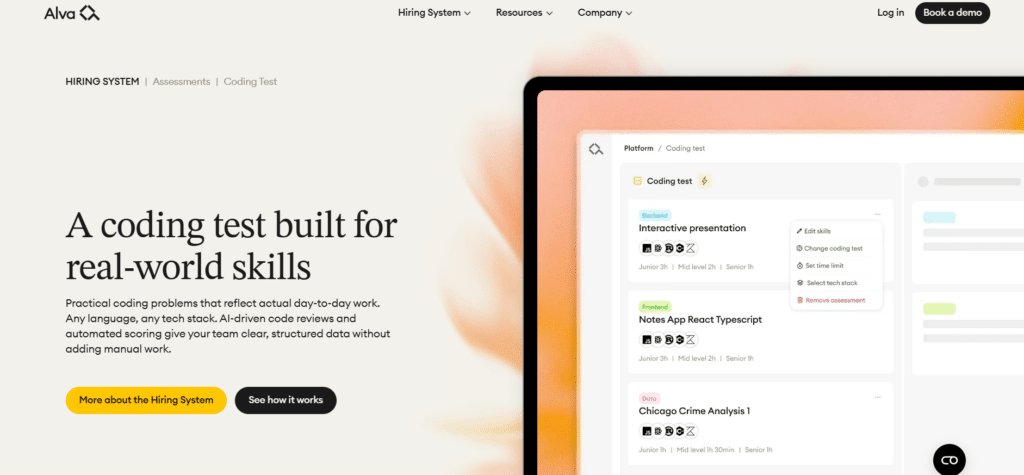
Alva Coding Tests, formerly known as DevSkills, is an advanced coding test platform designed to facilitate developer assessment. It offers an extensive library of real-world coding tests hosted on GitHub, so you can effectively evaluate candidates’ abilities and psychometric tests (Logic and Personality), with structured interview templates to feed into a single “Role Fit” score.
Most of the tests available on Alva Coding Tests have been meticulously crafted by specialists from renowned companies like Stripe, Spotify, and other industry leaders.
Main features:
- Supports most tech stacks: Alva Coding Tests are designed to seamlessly integrate with the majority of programming languages and tech stacks currently in use.
- GitHub-powered: The platform enables you to conduct interviews that closely resemble real-world development scenarios by using GitHub-powered workflows.
- AI Code review scorecards: With Alva Coding AI-powered scorecards, it’s easier to have a comprehensive and thorough assessment of code quality; scorecards highlight the major aspects so you can evaluate code effectively.
- Use a hosted Gitpod IDE: Candidates can use their own Gitpod IDE or our hosted environment, ensuring they work in a fully equipped development environment without constraints.
2. CoderPad
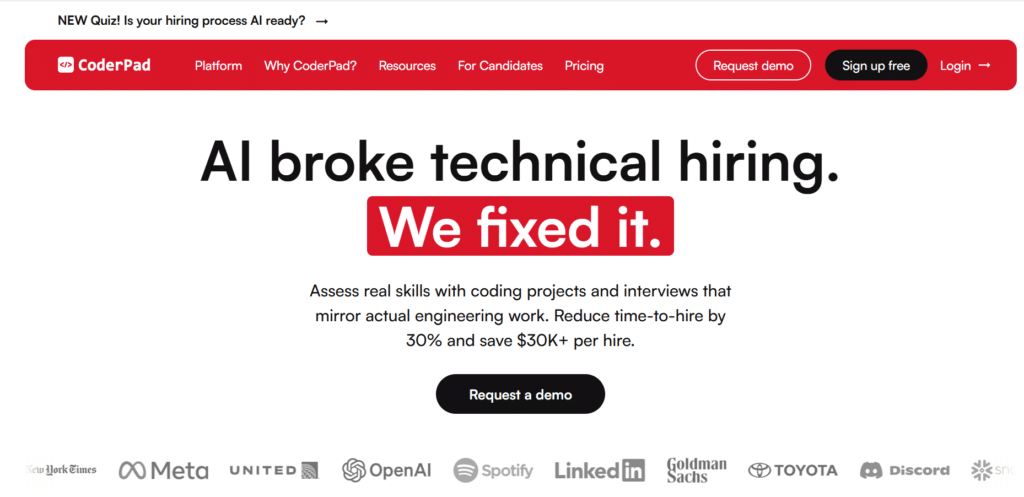
CoderPad provides coding assessment tests designed for collaborative interviews. It provides a real-time coding environment where interviewers and candidates can write, run, and share code.
With support for various programming languages and key features, the platform has become popular for recruiters conducting remote technical interviews and coding evaluations.
You can watch the candidate iterate alongside an AI assistant in real-time, focusing heavily on their verbal explanation of the code’s structural choices. Recruiters use CoderPad to see how effectively a candidate can craft prompts, debug AI-generated mistakes, and orchestrate complex systems
Main features:
- Customizable environment: CoderPad enables recruiters to customize the test according to their needs.
- Code playback and review: The platform allows to review and playback of the coding session to see closer how candidates approached the problem and iterated on their solutions.
- Secure and private: CoderPad reinforces the security and privacy of code and interviews by isolating the candidate’s sessions and preventing access to sensitive information.
- Code execution and output: CoderPad provides the ability to execute code within the platform, allowing candidates to test their solutions and see their output.
- Native AI Assist: CoderPad now features its own built-in, togglable AI Assist panel (supporting models like Claude, GPT, and Gemini). Interviewers can deliberately allow candidates to use AI during the interview.
- Keystroke & Prompt Playback: CoderPad’s classic playback feature now records every prompt the candidate types into the AI assistant and the subsequent code adjustments. Interviewers can review exactly how a candidate interacted with their digital partner after the session ends.
3. SkillPanel (DevSkiller)
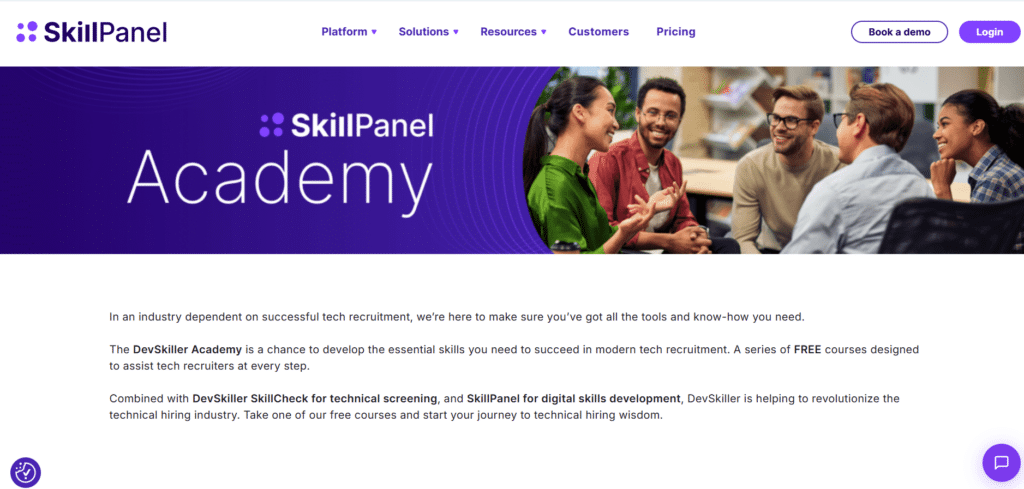
DevSkiller markets itself as “the most realistic technical screening platform with zero whiteboards in sight.” The platform was created for developers by developers. Created in 2012, their skills repository now tracks over 4,000+ specific digital and IT skills across engineering, DevOps, cloud infrastructure, and data science.
Companies use the platform to screen and interview tech candidates 100% remotely with online coding tests, virtual tech interviews, and pair programming challenges.
Main features:
- Realistic Programming Tasks: DevSkiller provides a library with realistic programming tasks and coding challenges.
- Automated skill assessment: The platform evaluates candidates’ solutions to the tasks based on correctness, efficiency, and code quality.
- Customizable tests: DevSkiller allows employers to customize tests depending on their requirements. HR teams can input a specific job description, and the platform’s wizard will auto-generate a custom, multi-stack test tailored to that exact role.
- Real-time collaboration and interviewing: The platform supports real-time collaboration and interviewing features that allow employers to conduct remote coding interviews.
- DevSkiller TalentBoost: Once a candidate is hired via TalentScore, their test data is automatically mapped into TalentBoost. Companies use this to track internal employee skills, visualize “skills gaps” across engineering teams, map out career progression paths, and plan internal upskilling/promotions.
- AI-Resistant Tasks: Rather than banning AI (which is nearly impossible to track seamlessly on home computers), DevSkiller’s modern library includes architecture, multi-file code review, and debugging challenges where AI hallucinates or struggles, forcing candidates to show real engineering critical thinking.
- Plagiarism & Integrity Tracking: Their automated grading engine now monitors browser focus, paste events, and code-writing cadences to flag anomalous copy-pasted code straight out of an external LLM.
4. Selectic
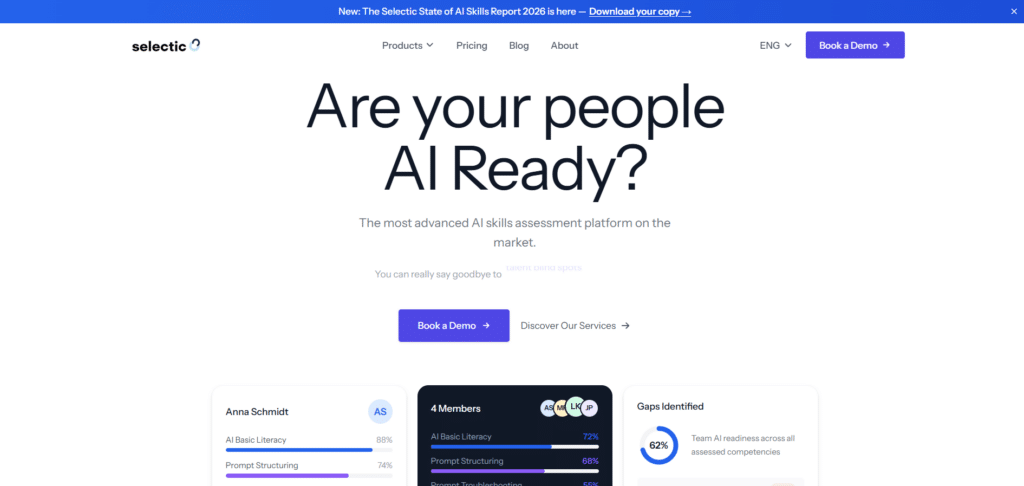
Moving away from old-school, abstract multiple-choice testing, it instead evaluates how candidates and employees perform in everyday scenarios. Beyond initial technical screening, Selectic continuously maps your talent capabilities.
Selectic is a leading platform to assess both coding and AI fluency. Instead of isolating candidates, it features AI Readiness Assessments that grade prompt engineering, operational tool usage, and human-AI collaboration workflows. Selectic markets itself as “an AI readiness and advanced skills assessment platform” built for the modern era of tech recruiting and workforce development.
Main features:
- Practical Coding Challenge Simulations: Scenario-based exercises mirror the work environment. Candidates tackle tasks drawn from real engineering contexts, such as debugging an active codebase, integrating functions with live APIs, or refactoring legacy modules.
- AI Readiness Assessment: Selectic assesses four layers of AI competence: foundational AI literacy, operational tool usage (including prompt engineering and AI-assisted development workflows), engineering judgment, and AI-human collaboration.
- One-Click Skills Mapping: The platform generates automated, real-time competency and skill matrices for teams and candidates. It helps HR teams make data-driven hiring, internal mobility, or training decisions.
- The ROI of Learning: Selectic automatically generates board-ready performance and training ROI reports.
5. Anthropos
Anthropos moves far beyond abstract coding tests; the platform uses immersive AI Simulation technology to evaluate how technical candidates and employees perform in full-context, multi-step job environments.
Main features:
- Dual Hard & Soft Skill Verification: As candidates navigate a challenge, Anthropos grades technical accuracy alongside core communication competencies, alignment with product goals, and the ability to investigate vague requirements under pressure.
- Anthropos Studio (Custom Scenario Authoring): A no-code authoring tool that allows HR, L&D professionals, and engineering leaders to design bespoke simulations. Teams can paste a specific job description or upload internal documentation to automatically blueprint custom AI actors, corporate contexts, and specialized technical evaluation criteria.
- End-to-End Skills Intelligence Mapping: Anthropos maps individual test data into a matrix. It identifies skill gaps, handles internal mobility tracking, and suggests training “Skill Paths” to upskill developers.
- Anti-Impersonation & Fraud Detection: The platform includes identity verification to protect against the rise of generative AI exploitation and fake candidates. It actively monitors code-writing cadences, detects external copy-paste cheating patterns, and utilizes voice and video matching to prevent candidate impersonation fraud.
The New Engineering Skillset: What to Test Now
Since AI can generate boilerplate code instantly, the bottleneck in software engineering has shifted from writing code to architecting, reviewing, and securing code. When assessing an engineer today, you must evaluate a completely new matrix of skills:
1. Code validation and debugging efficiency
AI writes code that looks flawless on the surface but contains subtle logical errors, edge-case vulnerabilities, or security flaws. A modern developer must be a top-tier code reviewer.
- The Test: Give the candidate an AI-generated script containing a hidden asynchronous loop bug or race condition. Evaluate how quickly they spot the logic failure, debug it, and write unit tests to prevent it from happening again.
2. Prompt engineering and tool execution
If an engineer refuses to use AI or uses it poorly, their velocity will lag behind the market standard.
- The Test: Explicitly allow AI during the test, but measure how they use it. Do they blindly copy-paste broken prompts, or do they break down complex microservices into granular, contextual prompts that steer the AI toward a safe, modular architecture?
3. Managing “AI technical debt” and code volume
AI makes it easy to generate 1,000 lines of code where 100 lines would suffice. This introduces “review fatigue” and massive technical debt.
- The Test: Evaluate a candidate’s ability to refactor and simplify bloated code. Senior developers must know when to discard AI suggestions in favor of minimalist, highly maintainable systems.
4. Broad-system architecture over code trivia
Since code snippets are trivial to produce, the real value lies in how those snippets connect.
- The Test: Pivot away from algorithmic brain teasers and focus heavily on System Design, API integration patterns, and data persistence layers.
Technical hiring
AI-Era Technical Evaluation Framework
Update your engineering screening workflow to evaluate AI-era competencies — not just coding ability.
0 of 5 steps completed
-
SETUP
Permit AI tool usage during assessments
Mirror modern production workflows where engineers use Copilot, Cursor, and ChatGPT daily.
-
TEST
Shift prompts: debug and refactor AI output
Replace “Write an algorithm from scratch” with real-world tasks like identifying bugs in AI-generated code and improving it.
-
TRACK
Track code evolution via git commits
Evaluate how a candidate’s solution develops over time rather than scoring only the final output.
-
TEST
Test for edge-case reasoning, security, and unit testing
Probe for security awareness, handling of unexpected inputs, and whether candidates write tests proactively — not just when asked.
-
TEST
Run interactive system design sessions
Use live architectural discussions to verify depth — AI tools don’t replace the ability to reason through trade-offs in real time.
Do Poor Coding Test Scores Mean You’re a Bad Coder?
No, poor coding test scores do not mean you are a bad coder. Assessments measure specific test-taking skills, while real-world engineering requires architecture, debugging, collaboration, and dealing with ambiguity.
There are several reasons why coding assessments fail to reflect a developer’s true abilities:
- Memorization over Application: Tests like LeetCode focus on niche data structures and algorithms. In daily work, you are rarely asked to build a custom binary tree from scratch; you rely on standard libraries and problem-solving skills.
- The “Whiteboard” Effect: Timed, high-pressure tests do not simulate actual working conditions. Great engineers use IDEs, documentation, Stack Overflow, and careful architectural planning.
- No Reflection of Soft Skills: Coding tests do not assess how well you collaborate, debug massive legacy codebases, communicate with stakeholders, or design maintainable systems.
Coding Test Evaluates Less Programming and More Tech Savviness
Many developers on platforms like Quora and Reddit say that coding tests usually test if the person is an expert at technology rather than programming.
I took one of those automated ‘can you program a given algorithm in an hour’ tests. Failed miserably. Twice! But none of that alters the fact that millions of people have used – and do use – my stuff, day to day. Have done this for 30 years. If you’ve eaten a commercially baked product, some of the conveyor belts that make it are controlled by my code. If you’re making a satcoms call from a ship, yep, mine too. Ever played the Bounce game on a Nokia handset? Glad you liked it. Done some web conferencing? I only boast about all that stuff to point out that you can be good at coding in many areas, and still have deficiencies in others. These are just tests. A moment in time. The random intersection of all your past training, learning and experience and a single question, phrased a certain way, with a time constraint.”
– Alan Mellow, Software Developer
Coding Tests and a Candidate’s Time Spent
Another major problem that proves that coding tests are not the only source to interview and source developers is the fact that they are time-consuming. Highly experienced developers are often reluctant to waste their time doing them, which leads to weeding out excellent candidates.
Why would a developer with a Master’s degree, a 4.0GPA, and years of experience who’s working 40+ hours a week be bothered with taking a test for a company they’ve probably never heard of? There are exceptions to this rule, for example it might be the person’s dream job or they might be out of work but on average a good developer isn’t going to waste their time. The philosophy I had to break my employer of was, “their career is worth an hour”. This is true as a person’s career is worth an hour but the company usually isn’t. You might think you’re getting a good developer, and you might actually land an okay one but you’ll never get a great one giving out tests.
– M.T. White, Software Developer.
What Really Makes a “Good” Coder
In the software industry, a good developer is a team player with a systemic understanding rather than quiz results or coding challenges.
- System Design & Architecture: Understand how to structure software so it is scalable, secure, and easy to maintain.
- Debugging & Problem Solving: Know how to track down bugs in a complex environment.
- Collaboration & Code Reviews: Write clean code, add proper documentation, and help teammates.
5 Tips for Effective Tech Evaluations
While coding tests might seem like the right way to assess a dev’s skills, we do not rely on them when recruiting top candidates. Here are our expert recommendations on what you should focus on:
1. Diversify Evaluation Methods
Relying solely on coding tests may not comprehensively assess a candidate’s abilities. Supplement coding tests with other evaluation methods such as technical interviews, behavioral assessments, pair programming exercises, or take-home projects.
This allows you to understand a candidate’s technical skills, problem-solving approach, and collaborative abilities.
2. Seek Expert Guidance if you are a Non-Tech Interviewer
If you do not have any technical background, partnering with a specialized IT recruitment agency like DistantJob can make your hiring process easier and more effective.
With more than 10 years of experience, we know coding tests are not the only way to evaluate candidates. The evaluation process begins with a deeper understanding of the role itself, considering the necessary experience and skills.
Our technical recruiters craft evaluations that encompass a range of methods, including interviews that assess not only technical proficiency but also qualities such as being a top performer and a team player. By incorporating different evaluation techniques, we gain valuable insights to identify the best candidates.
3. Don’t Forget About Soft Skills
Assessing a candidate’s soft skills and communication abilities is crucial, as these attributes significantly impact collaboration and team dynamics.
Incorporate behavioral interviews or group discussions to evaluate how effectively candidates can articulate their ideas, listen actively, and work collaboratively with others.
4. Review Real-World Projects
Ask candidates to share their previous work or provide samples of code they have developed in real-world projects.
Reviewing their codebase and understanding their contributions can provide insight into their problem-solving skills, code organization, adherence to best practices, and ability to work on complex projects. This works particularly well with high-level roles with years of experience in the field.
5. Focus on Practical Scenario-Based Assessments
Present candidates with real-world scenarios or case studies relevant to the role they are applying for. This allows them to demonstrate their problem-solving skills, analytical thinking, and ability to apply their technical knowledge to practical situations.
It also provides a glimpse into their decision-making process and how they approach and solve complex problems.
Start Evaluating World-Class Developers Today!
Now, you have the right tools to assess your future developer’s skills with a coding interview test. But note that the best tech talent usually is not looking for a job, as they already have one. But a tempting offer can make them change their mind. Here’s where we can help you.
Our recruitment model not only focuses on active candidates but also on highly experienced developers who can be the perfect match for your organization. We focus on attracting top tech talent with the skills and experience you need, prioritizing culture fit and other aspects such as language and time zones.
Want to know more? Book a call today to learn what we can do for you!
Frequently Asked Questions About Coding Interview Tests
Coding tests usually range from 45 minutes to 2 hours for live sessions, while take-home assignments may span 2-5 days with 4-8 hours of expected work time.
Most companies allow popular languages like Python, Java, JavaScript, C++, or C#. Choose the language you’re most comfortable with, as interviewers focus on problem-solving rather than specific syntax.
You don’t need to memorize every algorithm, but understanding fundamental concepts like sorting, searching, recursion, and common data structures (arrays, linked lists, trees, hash tables) is essential.
Partial solutions are often acceptable. Explain your approach, write pseudocode, discuss time complexity, and demonstrate your problem-solving process even if you don’t finish the implementation.
Use platforms like LeetCode, HackerRank, or CodeSignal. Practice explaining solutions aloud, focus on problem patterns, and time yourself to simulate real interview conditions.
Senior developers decline generic algorithmic screening tests since they do not reflect senior-level responsibilities. For senior roles, favor live system architecture discussions, code review exercises, or structured deep-dives into their past production environments over basic coding puzzles.
Reviewing the completed test live with the candidate during a follow-up interview, asking them to explain their logic and trade-offs.
Yes. Automated tests frequently prioritize rapid memorization of specific algorithmic structures over architecture, clean testing habits, and domain-specific problem-solving. This is why automated scores should serve as an initial signal, never the final hiring metric.
Utilize live pair programming sessions. Observe how the developer handles unexpected errors, whether they ask clarifying questions before writing code, and how clearly they explain their technical choices to your interviewing team.