If you are trying to hire a developer in Poland, a data engineer in Colombia, or a DevOps engineer in Romania, you will run into two terms before you can get anyone on payroll: Employer of Record and Staffing Agency. They sound like they might do the same thing. They do not.
The distinction matters because choosing the wrong model can leave you without the candidate you wanted, expose you to compliance risk in a foreign jurisdiction, or cause you to pay fees you did not budget for. Choosing the right one, or knowing when to use both from a single provider, is the difference between a hire that takes two weeks and one that takes three months.
The choice depends on whether your roadblock is legal infrastructure or talent discovery. And if you have both impediments, you can leverage both for your global expansion.
In this guide, we explain the five major differences between an Employer of Record and a staffing agency. We compare the real costs of each model, and help you figure out which one fits your hiring strategy, or if you should use both.
Employer of Record (EOR): A third party that becomes the legal employer of your workers, handling payroll, taxes, compliance, and contracts, you retain day-to-day control of the work.
Staffing Agency: A third party that finds and places candidates for you, legal employer responsibilities stay with your company once the hire is made.
The key question: Do you have the talent but not the legal infrastructure? Use an EOR. Do you have the budget but not the talent? Use a staffing agency. Need both? Read the final section.
What is an Employer of Record (EOR)?
An Employer of Record (EOR) is a third-party organization that legally employs workers on behalf of your company, managing payroll, tax withholding, statutory benefits, employment contracts, and local labor law compliance, while you retain full control of the employee’s day-to-day work and output.
The practical value of an EOR is that it lets you hire in a country where your company has no legal entity. Setting up a local entity in Romania, Colombia, or the Philippines can take three to nine months and cost tens of thousands of dollars in legal and administrative fees. An EOR already has that infrastructure in place. You bring the candidate; the EOR handles everything required to employ them legally in their country.
However, an EOR is not a hiring model. An EOR service won’t find you the global talent. It will just provide you with the means to hire it legally and in full compliance.
How the EOR Model Works Legally
Legally, the EOR acts as the registered employer for your workers on paper. While the employee performs work exclusively for you, the EOR handles the “back-office” legalities.
Contracting
An EOR issues locally compliant employment contracts.
Taxation
The EOR service withholds and files local income taxes.
Benefits
They manage mandatory social security, health insurance, and pensions, so your company doesn’t have to.
Liability
The EOR assumes the risk for employment-related legal violations, so it has your back.
Critical compliance note
Operating without an EOR when hiring internationally exposes your company to worker misclassification risk — treating someone as an independent contractor when local law classifies them as an employee. Penalties include back taxes, fines, and in some jurisdictions, mandatory reinstatement. An EOR eliminates this risk by ensuring correct employment classification from day one.
What an EOR does NOT do
An EOR is an infrastructure partner, not a recruitment partner. It does not find your candidates, assess their skills, or decide whether they are a good cultural fit. You identify the person you want to hire; the EOR handles the legal mechanics of employing them. This is the fundamental boundary between the two models.
EOR pricing: what to expect
EOR platforms typically charge in one of two ways: a flat monthly fee per employee, or a percentage of the employee’s monthly salary. Major platforms in the market charge the following:
| EOR Provider | Pricing Model | Approximate Cost |
|---|---|---|
| Deel | Flat fee | $599/employee/month (EOR) |
| Remote.com | Flat fee | $599/employee/month |
| Rippling | Flat fee | $500+/employee/month |
| Papaya Global | Percentage | ~$650/employee/month |
| DistantJob | Recruitment fee + EOR | Monthly recruitment fee, developer salary negotiated directly |
For a developer earning $70,000 per year ($5,833/month), a $599/month EOR fee represents roughly a 10% employment overhead, on top of which you still need to find the person yourself.
Pros and Cons of Using an EOR
If you’re weighing the decision to use an Employer of Record (EOR), it really boils down to a trade-off between operational speed and long-term granular control.
Here is that data organized into a comparison table for a clearer look:
| The Upside (Pros) | The Downside (Cons) |
| Rapid Market Entry: Hire globally in days without setting up a local entity. | No Talent Sourcing: The EOR handles the paperwork, but you still have to find the talent. |
| Low Upfront Cost: Avoid the massive legal and registration fees of incorporation. | Per-Employee Fees: Costs can add up quickly when hiring a large local team. |
| Built-in Compliance: The EOR assumes the risk of navigating local labor laws. | Standardized Culture: Benefits and perks are often preset, leaving less room for custom culture. |
What is a Staffing Agency?
A staffing agency (also called a recruitment agency or placement firm) is a company that sources, screens, and places candidates into roles at client organizations, handling the recruitment funnel while the client company assumes the legal employer responsibilities once the hire is made.
Unlike EOR, they do not necessarily manage global talent, while many do. When they do, it means they provide an EOR service in addition to staff augmentation.
The Role of a Staffing Agency in Recruitment
Staffing agencies act as talent matchmakers, unlike an employer of record. They maintain deep databases of vetted candidates and handle the entire recruitment funnel:
Sourcing
A staffing agency finds the most suitable candidates and hidden talent (workers who are already employed and excel in their careers).
Screening
The agency conducts interviews and technical tests.
Vetting
The staffing agency presents you with the “best of the best” candidates for final approval.
What a staffing agency does NOT do (by default)
Once a candidate is placed in a permanent role, the staffing agency’s legal involvement ends. Your company becomes the legal employer. Payroll, taxes, benefits, and compliance are yours to manage — either internally or through a separate EOR partner. For temporary placements, the agency may technically employ the worker and contract their services to you, but for the full-time remote hiring model, legal responsibility transfers.
Pros and Cons of Staffing Services
Staffing Services shifts focus from the administrative side of hiring (Employer Of Record) to the recruitment side. This model is essentially the inverse of the EOR. While an EOR handles the legal side after you find someone, an agency handles the search, so you don’t have to.
Here is the comparison table for your talent acquisition:
| The Upside (Pros) | The Downside (Cons) |
| Time Savings: Reclaims hundreds of hours for your HR team by outsourcing the “hunt.” | Higher Upfront Costs: Placement fees are often a significant percentage of the hire’s annual salary. |
| Specialized Expertise: Direct access to niche pipelines, like AI engineers or rare technical roles. | Temporary Feel: Agency-sourced workers can sometimes feel less integrated into the core company culture. |
| Flexibility: Perfectly suited for handling seasonal surges or “trial run” projects. |
EOR vs. Staffing Agency: 5 Key Differences
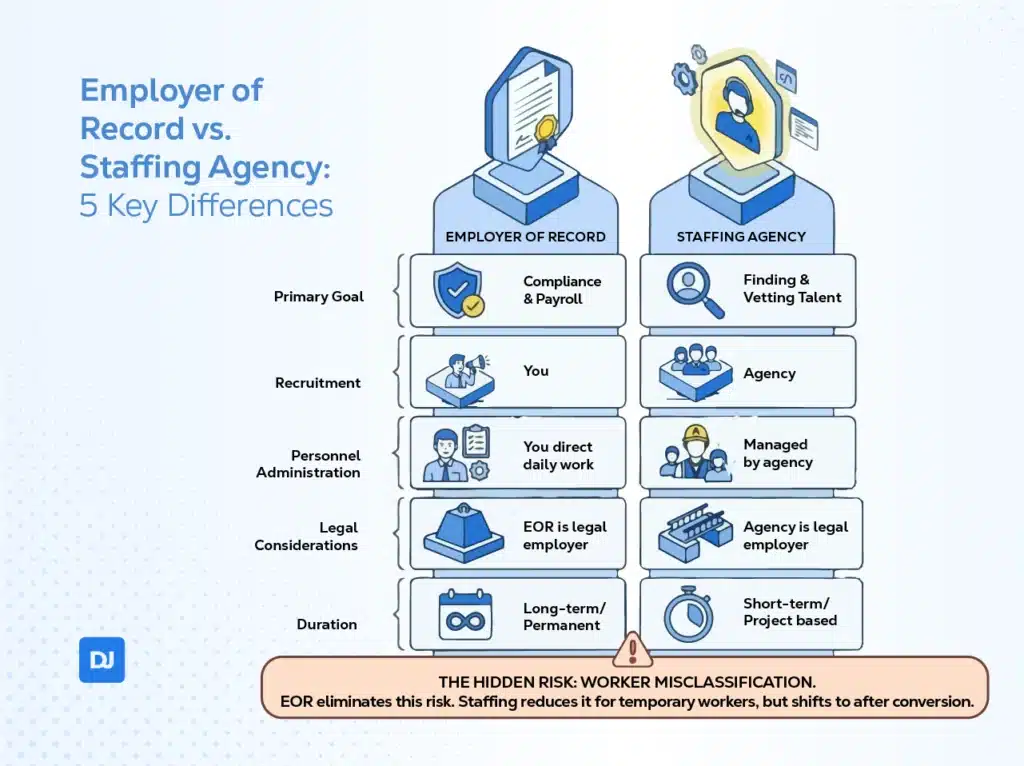
While both models allow you to work with talent without setting up a local entity, they solve fundamentally different problems. The distinction lies in who owns the talent versus who owns the legal burden.
An EOR is an infrastructure partner that stays in the background of your daily operations. In contrast, a staffing agency is a front-facing scout that actively shapes your workforce.
| Feature | Employer of Record (EOR) | Staffing Agency |
| Primary Goal | Compliance & Payroll | Finding & Vetting Talent |
| Recruitment | None; you find the talent | They find the talent |
| Duration | Long-term/Permanent | Often Short-term/Project-based |
| Personnel Administration | You direct the daily work | Managed by the agency |
| Legal Considerations | EOR is the legal employer | Agency is the legal employer |
Recruitment Process
With an EOR, you own the process. You write the job description, post it, and interview. With a staffing agency, they own the process until the final interview stage. If you are struggling to find candidates, an EOR won’t help you; you need an agency.
Legal Responsibility and Compliance Risk
An EOR assumes full legal liability for employment. If there is a wrongful termination claim, the EOR’s legal team handles it. Staffing agencies also assume risk, but often for shorter durations and with specific clauses that allow for easy termination of the assignment.
The Hidden Risk: Worker Misclassification
One compliance risk that both models address, but in different ways, is worker misclassification. This happens when a company incorrectly classifies a full-time employee as an independent contractor, either intentionally or by mistake.
The consequences are severe. In the U.S., the IRS can impose back taxes on Social Security and Medicare contributions, plus penalties of up to 100% of unpaid FICA taxes if the misclassification is deemed intentional. High-profile cases have resulted in massive settlements.
Uber paid $100 million in New Jersey alone for misclassifying roughly 300,000 drivers. Internationally, enforcement is tightening just as fast: Germany imposes fines up to €10 million with potential personal liability for executives, and the EU’s Platform Work Directive (taking effect in 2026) will intensify enforcement across all member states.
An EOR eliminates this risk by becoming the legal employer from day one, ensuring the worker is classified correctly and receives all mandatory benefits. A staffing agency also reduces the risk for temporary workers under its umbrella, but once a worker converts to a permanent hire, the classification responsibility typically shifts back to you.
If you’re hiring remote developers across borders, misclassification is the single most expensive compliance failure you can make.
Day-to-Day Employee Management
In an EOR model, the employee is effectively yours. You manage their deadlines, tasks, and performance reviews. In many staffing models (especially “Managed Services”), the agency may provide a project manager to oversee the workers directly.
Payroll, Taxes, and Benefits Administration
Both handle these, but EORs specialize in complex international compliance. They ensure that a worker in Brazil gets their 13th-month salary and that a worker in France gets their mandatory 30 days of vacation.
Cost Analysis: Which Option is More Scalable?
Scalability depends on your growth strategy. If you are hiring 50 people in 10 different countries, an EOR is infinitely more scalable because you don’t need to learn 10 different legal systems. However, if you are scaling a single local department quickly, a staffing agency is better for high-volume sourcing.
| Service Type | Pricing Model | How it Works | Typical Cost/Rate |
| Employer of Record (EOR) | Flat Fee | A fixed monthly rate per employee, regardless of their salary. | $500 – $800 / month |
| Percentage | A fee based on a portion of the employee’s gross monthly pay. | 10% – 15% of salary | |
| Staffing Agency | Markup | Used for temporary roles; added on top of the worker’s hourly pay. | 20% – 75% markup |
| Placement Fee | A one-time “finder’s fee” for permanent, full-time hires. | 15% – 25% of annual salary |
When to Choose an EOR, a Staffing Agency, or Both
The choice boils down to your talent pipeline. Do you have the person but not the legal entity? Choose an Employer of Record instead of a staffing agency. But if you do have the budget and not the person, choose a Staffing Agency.
When to Choose an EOR (Global Expansion & Compliance)
Choose an Employer of Record when you have already identified the perfect “unicorn” candidate but lack the legal infrastructure to hire them in their home country.
Since the EOR handles all the heavy lifting regarding payroll, local tax compliance, and mandatory benefits, it allows you to bypass the months-long process and high costs associated with setting up a local legal entity.
This model is particularly effective for businesses looking to test the waters in a new international market without a massive financial commitment.
If it doesn’t work out, you can exit with minimal friction. Furthermore, transitioning long-term remote contractors to an EOR allows you to provide them with the same full-time benefits and job security as your local team, fostering better loyalty and reducing the legal risks associated with misclassification.
- You found a “unicorn” candidate in a country where you have no office.
- You want to test a new international market without a massive financial commitment.
- You want to offer full-time benefits to remote contractors.
When to Choose a Staffing Agency (Short-term Needs & Local Talent)
Turn to a Staffing Agency when your challenge is an empty talent pipeline, not a lack of legal presence (provided by an EOR). If you have the budget but not the person, an agency can fill those seats in days rather than months
Agencies are also invaluable for sourcing niche roles where local competition is fierce, as their recruiters specialize in active headhunting that internal teams may not have the capacity for.
Moreover, staffing agencies act as a crucial safety net for culture-conscious companies. They allow you to observe a candidate’s performance and social fit in a real-world environment before committing to a permanent employment contract.
- You need 10 developers to finish a project in three months.
- You are struggling to find qualified applicants for a niche role.
- You need “temp-to-perm” options to see if a candidate fits the culture.
Navigating International Laws: Country-Specific Considerations
In 2026, many countries (like Spain and parts of the EU) have tightened “Permanent Establishment” laws. If an employee stays too long on an EOR, the government may require you to establish a local entity. Always check the maximum duration allowed for EOR/Agency employment in the specific jurisdiction.
United States: State-by-State Complexity
While the U.S. doesn’t have a single federal standard, every state has its own rules for unemployment insurance, workers’ compensation, and paid leave. The DOL announced in May 2025 that it would stop enforcing the stricter 2024 independent contractor classification rule, returning to the more flexible “economic reality” test. However, states like California continue to enforce the strict ABC test under AB5, and New Jersey and New York maintain aggressive misclassification enforcement.
If you’re hiring across multiple U.S. states through a staffing agency, you need to verify that the agency handles state-level compliance in each jurisdiction, or partner with an EOR that does.
The Bottom Line: Always check the maximum duration allowed for EOR or staffing agency employment in the specific country. Laws change frequently, and what worked in 2024 may not be compliant in 2026.
Use both — ideally from one provider — when:
- You need to find a specialized developer AND employ them legally in a foreign country
- You are building a full-time remote team in Eastern Europe or Latin America from scratch
- You do not have internal HR capacity to manage international employment compliance
- You want one contract, one invoice, and one point of accountability for the entire hire lifecycle
DistantJob: recruitment + EOR in one engagement
DistantJob headhunts full-time remote developers from Eastern Europe and Latin America and acts as Employer of Record for each placement.
You get: specialist technical recruiting + multi-stage vetting + international payroll + compliance management — under a single contract.
No platform EOR fee stacked on top of a separate recruiting fee. No internal HR burden for international employment law.
Average time from search initiation to first interview: 2 weeks. 80% of clients hire from the first shortlist presented.
Why DistantJob Occupies a Different Category
EORs are compliance companies. Their specialty is covering payroll and employment law in countries around the world. They are not recruitment companies focused on finding you the best senior Rust engineer available in Bucharest or the best data engineer in Medellin. And in the rare instance they do claim to match, they only accomplish it via an automated algorithm.
Most staffing agencies are talent discovery businesses. They are good at finding and vetting candidates. They are not set up to become the legal employer in fourteen countries or manage Romanian tax withholding and Colombian social contributions.
DistantJob staffing agency was built to do both. We headhunt candidates, using human recruiters with deep technical domain knowledge, not automated screening, and we act as the Employer of Record for every placement. Our senior developers lead the vetting process end to end. We source passive candidates who are not on any platform because they do not need to be. We find people in the top 1% of their regional markets.
The result: you get a vetted, culture-fit, fully-employed senior developer in your tech stack, working exclusively for your company, on your payroll via a single consolidated invoice, within two weeks of starting a search. At 40 to 65% below the cost of a comparable US hire.
The Practical Bottom Line
The line between EORs and Staffing Agencies is blurring, but the core distinction remains. An EOR solves compliance; a Staffing Agency solves recruitment. Most modern enterprises use a hybrid approach to maintain a competitive global edge.
Your decision comes down to one question: Do you already have the person, or do you need to find them?
If you have a candidate but no legal entity in their country, an EOR gets them on payroll. If you have the budget but an empty talent pipeline, a staffing agency fills the gap. And if you want a pre-vetted remote developer hired compliantly with zero friction, that’s exactly what DistantJob does.
Whether you need an EOR, a Staffing Agency, or both, contact us today!
Frequently Asked Questions
No. An EOR is a legal employment infrastructure provider; it becomes the official employer of your workers and manages payroll, taxes, benefits, and compliance. A staffing agency is a talent sourcing provider, it finds and places candidates. The EOR’s work begins after you have a candidate.
If you are hiring internationally and your company does not have a legal entity in the worker’s country, yes, you need EOR services regardless of how you found the candidate.
The main disadvantages of a standalone EOR service are: (1) it does not help you find talent — you must source candidates yourself; (2) the recurring monthly fee adds up over multi-year engagements; (3) some EOR platforms use standardized contracts that may limit flexibility on custom employment terms; and (4) you typically have less direct relationship with the worker’s employment documentation than if you employed them through your own entity.
The main disadvantages of a staffing agency are: (1) it does not resolve the legal employer question for international hires — you still need EOR or entity infrastructure; (2) agency quality varies significantly — generalist agencies rarely have the technical depth to vet specialized developer roles accurately; (3) placement fees are a significant upfront cost; and (4) some agencies prioritize speed over quality of match, leading to higher early-tenure turnover.
Yes, and this is actually a common setup for companies hiring internationally without internal recruiting capacity. The staffing agency finds and vets the candidate; the EOR employs them legally in their country. The main drawback is cost and coordination overhead from managing two vendor relationships. Using a single provider that handles both (like DistantJob) eliminates this friction.