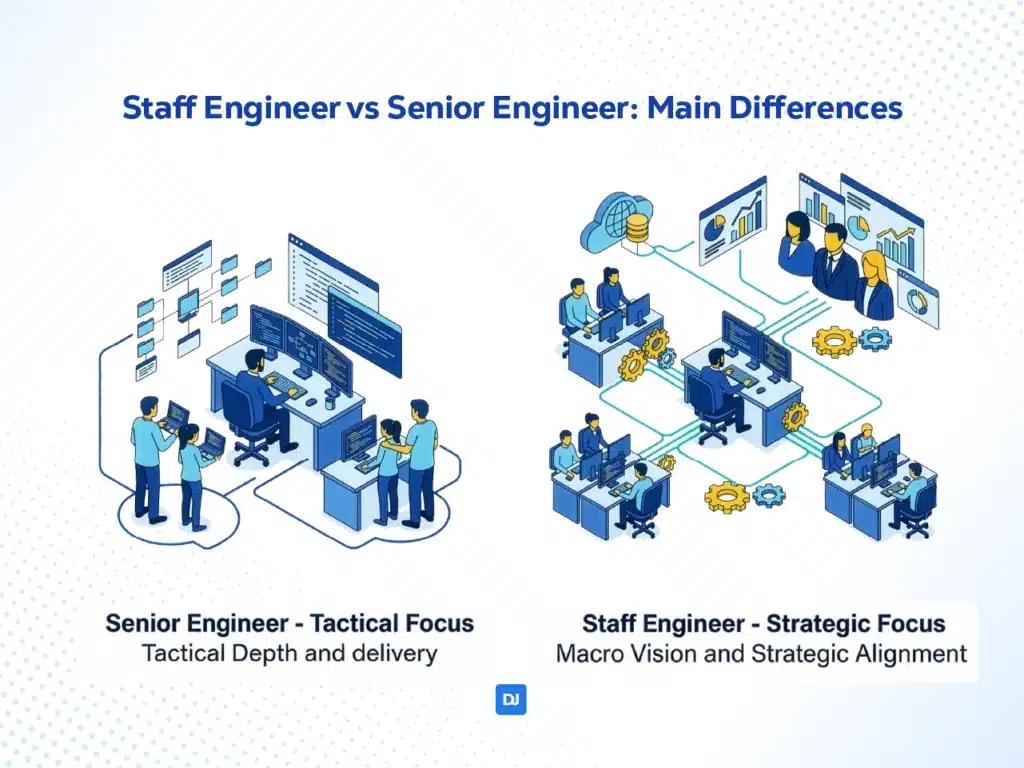
While the Senior Engineer focuses on task execution and delivering functionalities with a tactical vision, the Staff Engineer focuses on strategic technical direction, considering long-term trade-offs and alignment with business objectives. A Senior Engineer delivers a high-quality, tested system, while the Staff Engineer takes responsibility for business results and success metrics (such as increased revenue or reduced user churn).
Understanding the differences between a Staff Engineer and a Senior Engineer is not as easy as it seems at first glance. A senior engineer is oriented to the team and the product. A staff engineer aims to improve business efficiency by solving problems for the company (and not just the team).
Is Staff higher than Senior? While a Staff Engineer might be above a Senior Engineer, this significantly depends on the company’s organizational hierarchy.
Knowing the difference helps software developers and the company to understand more about their capabilities and goals.
Both roles typically involve working as software developers, but their contributions to projects differ, and they often report their activities to separate superiors.
But this is what Google doesn’t tell you! There are clear signs to know when a senior engineer is ready to make the transition into the Staff tier! While the internet usually focuses on “coding faster” or “mastering Kubernetes,” the real indicators of readiness have very little to do with raw technical output. This is the reason for this article.
Here is a razor language explanation if you are busy and need pointers quickly:
| Senior Engineer | Staff Engineer | |
| Focus | Projects (months) | Strategy (years) |
| Main Goal | Solves complex technical problems | Determines the priority of problem-solving |
| Scope | Team/Product | Company/Business |
| Success Metrics | Code quality and delivery, planning, and coordinating the team | Long-term impact and business efficiency |
| Key Skills | Design, architecture, execution | Mentorship, alignment, and strategic vision |
We will navigate thoroughly between the differences.
What is a Senior Engineer?
A senior engineer (or Senior Software Engineer) is a highly experienced software developer who typically leads the development efforts of one or more teams or projects. They are experts in a particular system or feature area within the company.
Senior engineering positions generally require extensive experience. It’s not uncommon for a senior engineer to have on the order of 8–10 years of industry experience in software development.
While they remain hands-on with coding, senior engineers also begin to engage in higher-level tasks, such as system design, code reviews, team coordination, and occasionally interacting with customers or other departments to clarify technical requirements.
Senior Engineer’s Roles and Responsibilities
Senior engineers ensure that complex projects are executed successfully and meet all requirements. They often lead the team for major features or components under their responsibility, making high-level decisions about how software is structured and which technologies to use.
They ensure their team deployments meet the end-users’ needs and quality standards, and that projects stay on schedule and within budget. Given their experience, senior engineers serve as the point of contact for technical issues on their team and are skilled in root-cause analysis to troubleshoot problems.
The salary for senior engineers reflects their high level of skill: in the U.S. As of April 29, 2026, the average annual pay for a Senior Software Engineer in the United States is $143,292 per year (though top performers or certain locations can be higher).
In their day-to-day responsibilities, senior engineers might lead design review meetings, ensure the software design aligns with both technical and business objectives, and verify that the team’s output satisfies client or stakeholder requirements.
They often liaise with other teams or even directly with clients – for example, coordinating with a client’s technical staff to establish project scope or to report progress.
Senior engineers also play a significant role in mentoring and guiding junior engineers on their team. They provide feedback through code reviews, share knowledge of best practices, and help junior developers resolve roadblocks.
Additionally, many senior engineers are involved in strategic team tasks such as evaluating new tools or technologies, planning future upgrades, or even contributing to hiring by interviewing candidates for technical roles. The keyword here is “team”. While comparing staff vs senior engineer, staff has another keyword: “business”.
As projects evolve, senior engineers may find themselves shifting some focus away from pure coding to ensure broader project success, balancing hands-on development with planning, coordination, and leadership within their project team.
Senior Engineer Key Takeaways
- High-level software developer
- Oversees software development for 1-2 teams
- Expert understanding of a particular feature/system
- Manages the team’s activities at the departmental level
- Official position or delegated seniority after years of experience
- 8-10 years of experience, maybe a university degree
What is a Staff Engineer?
A staff engineer is a senior-level software engineer who plays a pivotal role in technical leadership and project execution. They often act as a bridge between the engineering team and upper management, overseeing the technical direction of projects and ensuring alignment with broader business goals.
As Reddit user scinos would put it: “Senior focus on finding and implementing the best solution for a problem. Staff/principal focus on finding critical problems worth solving”.
In many companies, a staff engineer is considered one step above a senior engineer in the technical career hierarchy. This means they are typically very experienced engineers (often with a decade or more of industry experience) entrusted with high-impact technical decisions and mentorship responsibilities.
Staff Engineer’s Roles and Responsibilities
With this advanced role comes a high level of responsibility and a high income. For example, ZipRecruiter shows that staff software engineers earn an average salary of $161,148 per year in the U.S. as of April 29, 2026.
It reflects the expertise required (notably higher than that of a senior engineer). As technical leaders, staff engineers are responsible for managing complex or high-risk projects and guiding their teams through technical challenges.
They provide context and technical direction for the team by creating specifications, setting coding standards, and establishing best practices for development and deployment. Staff engineers often oversee the quality of engineering work, ensuring thorough testing, smooth rollouts, and consistent system monitoring for the projects under their purview.
In addition, staff engineers take on a mentorship and coaching role. They share knowledge and best practices with other engineers (juniors and seniors), help onboard new team members, and mentor less-experienced developers to elevate the overall skill level of the team.
They frequently collaborate with engineering managers and product managers to make sure that technical efforts align with the company’s priorities. Notably, a staff engineer usually spends a smaller portion of their day writing code compared to earlier in their career; instead, they focus more on high-level design discussions, code reviews, and coordinating work across multiple teams. In essence, the staff engineer controls much of the day-to-day technical activities with a degree of autonomy, while also supporting management’s strategic goals.
Finally, staff engineers implement their vision, identifying problems in a company that no one else sees. They suggest innovative solutions that become the basis for the tech department’s strategy.
Staff Engineer Key Takeaways
- Professional software developer
- Works with upper management
- Senior-level engineer
- Leadership track
- Guides across various engineering departments and influences the company’s direction.
- Official position for individuals meeting specific requirements
The Four Archetypes of Senior Engineer
Will Larson, a veteran engineering leader with experience at heavyweights like Stripe, Uber, and Calm, proposes that the Staff Engineer be divided into four distinct archetypes. Identifying which archetype resonates with your strengths is the first step toward navigating a successful high-level technical career. Here are the four profiles:
- Architect: This professional focuses on high-level technical decisions that impact multiple teams or the entire organization. They rarely write production code, concentrating instead on system design, long-term technical direction, and creating organizational standards and guidelines.
- Tech Lead: A Tech Lead is responsible for a specific product or technology area. They balance their time between hands-on coding and leadership, mentoring team members, and acting as an interface between the technical team and stakeholders.
- Solver: A Solver is brought in to address the most complex and critical technical challenges within an organization. They often work independently or in small groups, focusing on high-level technical execution, debugging, and optimization as needs arise.
- Right Hand: The Right Hand works directly with senior executive leadership (such as CTOs or VPs of Engineering). They act as a technical extension of executive leadership, balancing technical and business perspectives while often leading strategic cross-functional projects.
Staff Engineer vs Senior Engineer: Main Differences
Staff engineers and senior engineers hold different positions in an organization’s hierarchy. In many companies, Staff Engineer is a higher-level role than Senior Engineer, though titles can vary by company. Each comes with its own scope of influence and decision-making authority.
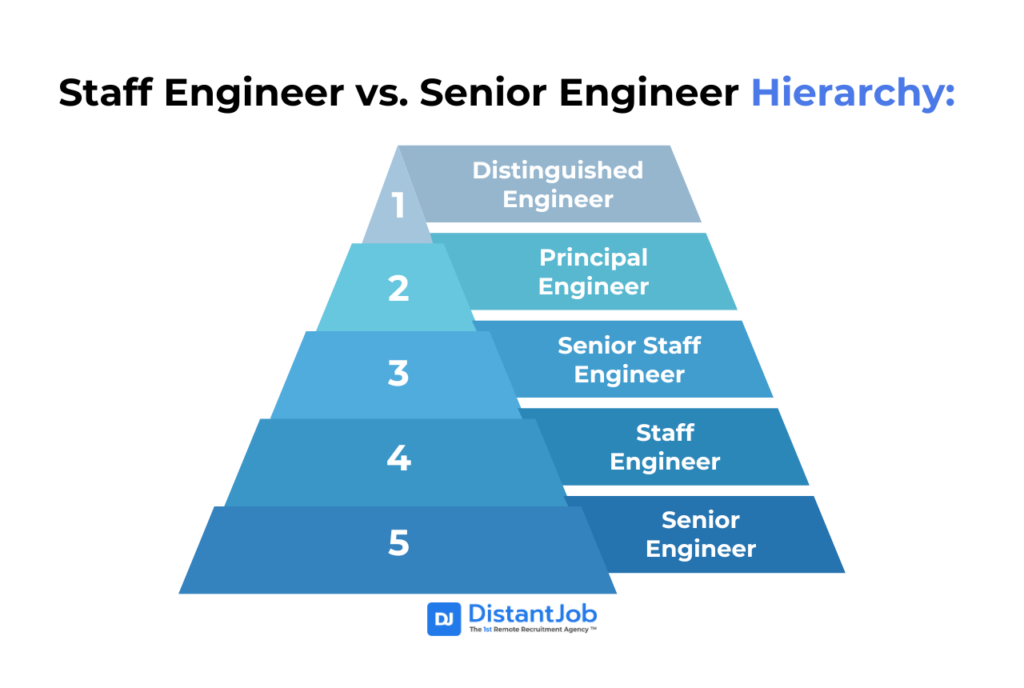
Example of a possible hierarchy:
| Distinguished Engineer |
| Principal Engineer |
| Senior Staff Engineer |
| Staff Engineer |
| Senior Engineer |
Staff Engineer vs. Senior Engineer
While both staff and senior engineers are part of the individual contributor (IC) career path in software development, there are clear differences in their scope, focus, and authority. In many organizations, a staff engineer is ranked above a senior engineer, indicating a broader scope of responsibility and influence. Here’s a breakdown of how the two roles compare:
Scope of Influence
A senior engineer typically has a narrower scope, focusing on one team or one major project where they are the technical expert. A staff engineer has a broader scope, often spanning multiple projects or teams. Staff engineers influence technical decisions across the company and may contribute to company-wide engineering strategies.
Role and Focus
The senior engineer’s role centers on being the owner of a specific system or feature; they ensure that their project is designed well, built correctly, and delivered on time.
The staff engineer’s role is more about technical leadership: they act as a technical lead or architect who guides several projects and solves high-level problems that affect multiple teams or the entire product.
In practice, a staff engineer might be called upon to review designs across different teams, set coding standards for the whole department, or spearhead the adoption of a new technology across the company.
A senior engineer focuses on the success of their particular project or area, while a staff engineer focuses on the success of many projects or an entire tech domain.
Hierarchical Level
In terms of job title progression, staff engineers are usually one level above senior engineers (followed by titles like principal engineer, etc.). This hierarchy means staff engineers are entrusted with higher-level decisions.
However, not every company has the staff engineer title; smaller companies might simply use “Senior Engineer” for their top individual contributors. In organizations that do have both, the staff engineer is recognized as a more senior position, reflecting their cross-team responsibilities and advanced expertise.
Hands-on Coding vs. Strategic Work
Both senior and staff engineers write code and solve technical problems, but the balance differs.
Senior engineers still spend a significant portion of their time coding or reviewing code within their project, leading by example in implementation.
Staff engineers, by contrast, spend relatively less time coding day-to-day and more time on architecture, design reviews, and strategic planning for the technical direction of multiple efforts.
For instance, a staff engineer might create a high-level design document for a new system and delegate coding tasks to various teams, whereas a senior engineer might be implementing critical components of a system themselves and guiding their immediate team members in coding tasks.
To summarize these differences, the following table highlights how a staff engineer’s role compares to a senior engineer’s role on key dimensions:
| Aspect | Senior Engineer | Staff Engineer |
| Organizational Level | Below the Staff Engineer, a seasoned IC role on a team. | Above Senior Engineer in rank (higher-level IC role). |
| Scope of Responsibility | Focused: Leads the development of a specific project, feature, or team’s scope. Deeply involved in one area. | Broad: Leads technical direction across multiple teams or projects. May influence company-wide engineering practices. |
| Primary Role | Project Technical Owner: Designs and implements solutions for their project, ensures quality, and delivers features. Acts as an expert in one domain. | Technical Strategist/Leader: Defines architecture, sets technical standards, and mentors across teams. Bridges engineering and management. |
| Decision Making | Tactical decisions within their project or feature. Oversees day-to-day technical choices for their team. | Strategic decisions affecting multiple systems or long-term technology choices. Guides others without formal authority. |
| Coding vs. Management | Still codes regularly, doing hands-on development and code reviews, while also planning and coordinating within the team. | Codes less frequently; spends more time in design reviews, cross-team coordination, and high-level problem solving. |
Technical Skills Required
Advancing to a senior or staff engineering position requires a strong foundation of technical skills. Both roles demand proficiency in software design, coding, and problem-solving, but the focus and application of these skills can differ between the two roles.
Here are the technical capabilities for each role.
Senior Engineer’s Technical Skills
Senior Engineers independently identify and solve complex technical problems within their domain, quickly pinpointing and addressing issues like subtle design flaws causing performance bottlenecks.
They often take on project leadership and execution, skillfully planning, coordinating, and driving technical work, breaking down large features, assigning tasks, and ensuring seamless integration.
Being a senior also involves large-scale design and delivery, where they are responsible for creating robust, scalable systems or features, meticulously handling edge cases, and upholding high code quality standards through thorough reviews.
Independent Problem Identification
Senior engineers recognize complex technical problems within their scope, then formulate effective solutions. They have a deep understanding of the systems they work on, quickly pinpointing the source of bugs or inefficiencies to address them. For example, a senior engineer might detect a subtle flaw in a system’s design that’s causing performance issues and redesign that component to fix it.
Project Leadership & Execution
A senior engineer often leads the technical execution of a project. They need skills in planning and coordinating technical work, such as breaking down a large feature into manageable tasks, assigning those tasks (if working with others), and ensuring everything integrates correctly.
Seniors can also organize and run weekly technical meetings, communicate status updates, and keep the team focused on the project goals. They ensure the project moves forward and any technical obstacles are overcome.
Large-Scale Design & Delivery
Senior engineers are expected to design systems or features with a larger scope in mind and drive them to completion successfully. They should be skilled at creating robust designs, whether it’s an API, a module, or an entire sub-system, and then implementing them with high efficiency and quality.
Seniors think through edge cases, ensuring scalability, and possibly coordinating with other teams whose systems interface with their project. Moreover, senior engineers carry out code reviews and uphold code quality standards, which requires a keen eye for detail and a strong grasp of software engineering principles.
Staff Engineer’s Technical Skills
Staff Engineers are crucial for technical leadership, excelling in system design and architecture by crafting complex solutions and setting high standards. They drive technical direction and strategy, making key decisions and planning long-term improvements aligned with business goals.
Their strong collaboration and leverage skills enable them to unite teams and integrate diverse components. Ultimately, Staff Engineers are adept at problem-solving and innovation, tackling the most challenging technical issues with both immediate fixes and strategic, long-term solutions.
System Design & Architecture
Staff engineers must be able to design and implement complex components of a system or product. They are often responsible for defining the architecture of large systems and ensuring that components integrate smoothly. This responsibility includes shipping high-quality work, best practices, testing, successful deployments, and actively monitoring systems. Staff engineers craft the blueprint of a new service and set the standards for how to structure and test code for business needs.
Technical Direction & Strategy
They lead technical efforts that set the direction for teams or even the entire engineering company. For example, they may drive the technical roadmap for a product area, making decisions on which technologies to adopt or which technical debts to address. Staff engineers propose both short-term and long-term technical solutions for persistent pain points in the system, laying out clear action plans to implement these improvements in alignment with business goals.
Collaboration & Leverage
Staff engineers work across multiple teams, so they must excel at collaboration. They leverage the work of their colleagues by integrating modules built by different teams into a cohesive whole. They often coordinate with other developers, tech leads, and project managers to drive large initiatives. Strong collaboration skills enable the staff engineer to bring people together to solve broad, cross-cutting technical problems.
Problem Solving & Innovation
At the staff level, engineers identify nearly invisible technical problems. They need to identify issues (often spanning across systems) and devise innovative solutions. For example, if a system is experiencing scalability issues, a staff engineer might analyze it and design a new scalable architecture. They also anticipate future problems by evaluating long-term needs. In doing so, a staff engineer will propose short-term and long-term architectural changes and an action plan to address root causes.
Soft Skills Needed
Soft skills encompass communication, leadership, teamwork, and other interpersonal abilities. Both staff and senior engineers rely on these skills to succeed, though the contexts differ:
For Staff Engineers
Soft skills are critical because staff engineers lead through influence rather than authority. A key part of the staff role is guiding the technical direction of tasks without being a direct manager of those executing the work. A staff engineer must excel at communication, clearly articulating technical ideas and decisions to build consensus. They also focus on positively influencing the engineering culture: for example, championing best practices, encouraging knowledge sharing, and fostering collaboration among teams.
Staff engineers also help onboard new team members (whether junior developers or new seniors); they must be effective mentors and coaches. Therefore, patience and the ability to teach are valuable traits. Moreover, staff engineers frequently negotiate priorities and timelines between different teams or between engineering and management, which requires empathy, tact, and strong interpersonal skills. Finally, building trust is essential. Team members need to trust guidance even though the staff engineer isn’t their direct boss. All these soft skills enable the staff engineer to coordinate great efforts and drive technical initiatives to success across an organization.
For Senior Engineers
Senior engineers communicate with their team and other stakeholders. For instance, they may need to explain complex technical issues in clear terms to non-engineering managers or clients. Being able to translate tech-speak into plain language is a valuable skill when ensuring everyone is on the same page regarding a project’s status or needs.
Within their team, senior engineers act as leaders and mentors. They should be adept at providing constructive feedback during code reviews and guiding junior engineers through challenges in a supportive manner. Leadership for a senior engineer also means taking initiative to improve team processes and being accountable for the outcomes of their projects.
They collaborate closely with product managers, designers, and possibly external vendors or partners, which requires strong negotiation and conflict-resolution skills. For example, aligning what the client wants with what’s technically feasible.
Time management is another crucial soft skill. Senior engineers juggle coding tasks, design work, and coordination duties. This is why they need to prioritize effectively and help the team do the same. In summary, a senior engineer’s success depends not only on what they can build, but on how well they can guide and inspire the people around them.
Challenges Faced by Senior Engineers
As engineers climb to the senior level, they encounter a unique set of hurdles. These challenges go beyond coding; they require strong communication, leadership, and adaptability.
1. From Writing Code to Leading Work
Senior engineers often shift from hands-on coding to guiding a project’s architecture, planning, and execution. Balancing coding with strategic decision-making and task coordination can be a significant learning curve.
2. Keeping Up with Rapid Change
Technology evolves quickly. Senior engineers must stay updated on emerging tools, frameworks, and best practices without losing momentum on current projects. In summary, they must balance new techs with the stability of their systems.
3. Managing Ambiguity & Changing Requirements
Requirements often shift mid-project. Unlike earlier roles with defined goals, senior engineers must deal with changing or unclear problem statements, requiring adaptability and proactive planning to keep projects on track.
4. Cross-Team Communication
Projects often span multiple teams or departments. Senior engineers must communicate effectively, translate technical concepts for varied audiences, and keep everyone aligned—crucial yet challenging in distributed or hybrid environments.
5. Dealing with Complexity & Legacy Code
Many senior engineers are tasked with maintaining or upgrading legacy systems, which are often poorly documented or outdated. These systems are complex and risky to modify, demanding patience, deep troubleshooting skills, and careful coordination with ops teams.
Challenges Faced by Staff Engineers
Stepping into a staff engineer role comes with new challenges that go beyond pure technical work. Because it’s a high-level position, a staff engineer’s obstacles often involve leadership and big-picture problem solving.
1. Guiding Without Authority
Staff engineers commonly face the hurdle of leading technical direction without formal management authority. Unlike a manager, a staff engineer usually can’t simply mandate their team to follow orders; instead, they must persuade and influence.
2. Ambiguous Problem Spaces
Rather than being assigned a clearly defined task, a staff engineer might be asked to “improve the platform’s scalability” or “reduce load times significantly” without clear instructions on how. It becomes the staff engineer’s responsibility to identify and define the problems to tackle.
3. Balancing Time and Priorities
Staff engineers have to juggle their own project work with broader support duties. They might be simultaneously coding a critical feature, reviewing design documents for another team, and mentoring a couple of engineers – all while perhaps contributing to high-level strategy meetings. Managing this requires strong time management skills.
4. Cross-Team Communication
Because staff engineers often work across multiple teams, they must maintain clear and healthy communication channels between different groups (stakeholders, managers, teams, etc.). It’s one of the most demanding aspects of the role. For example, a staff engineer might coordinate a project that involves the front-end, back-end, and DevOps teams all at once. Misalignment or miscommunication can derail the projects.
Senior to Staff Engineer: The Early Signs
According to Jeferson Fernando, Founder of LINUXtips and Principal Engineer at iFood (the largest food delivery platform in Latin America), there are 7 definitive telltale signs that a Senior Developer is ready for promotion to Staff Engineer. These early indicators show leadership, strategic thinking, and organizational impact. If you recognize four or more of these signs in your professional attitude, you are likely ready to accelerate your transition to a Staff Engineer role.
1. Naturally assuming responsibility for results, not just tasks
Instead of just completing tickets or features, you focus on ensuring business outcomes. A senior engineer ready for the transition questions requirements that don’t align with business goals. They also propose improvements beyond the original scope, and tracking the impact of your work through metrics.
2. Serving as a technical reference for other engineers
Other developers naturally seek you out for technical advice, architecture decisions, or complex debugging. You become a reference not just for solving problems, but for teaching best practices and simplifying complex concepts for others.
3. Influencing technical decisions without formal authority
Candidates for the Staff Engineer position take important technical choices and build consensus by merit, not by hierarchy. They are consulted before major decisions and successfully change others’ minds through technical arguments.
4. Thinking in systems and long-term impacts, not just features
You shift from focusing on the current feature to strategic thinking, focusing on the system as a whole. A future Staff Engineer anticipates future needs, prevents problems through design, and questions quick fixes that might create significant technical debt.
5. Communicating technical complexity to non-technical stakeholders
You can translate complex technical issues into language that product managers or executives understand. For example, instead of talking about “technical debt,” you explain how a refactor will improve time-to-market or reduce the financial risk of downtime.
6. Proactively solving problems that affect multiple teams
You identify and attack systemic problems rather than just local team issues. A few examples include creating shared tools, defining organizational standards, or coordinating efforts across different groups to solve wide-reaching technical challenges.
7. Taking ownership of your own career evolution
You have a clear vision of your professional path for the next 2-3 years and take concrete actions to reach it. This includes identifying your own skill gaps, seeking strategic projects to bridge those gaps, and actively soliciting feedback and mentoring.
Promotion to Staff Engineer
The transition from Senior to Staff Engineer entails significant shifts in focus, impact, and required skills, especially in leadership without formal authority. Companies typically “play it safe” and expect to see this performance.
Beyond individual aptitude, there also needs to be an organizational need for a Staff Engineer role. Sometimes, a Senior Engineer might already be working in a “Staff capacity” without formal recognition, which can, ironically, delay their promotion if not noticed.
The staff engineer Alex Ewerlöf, who worked in big companies such as Amazon and Google, shares his experience in this blog post. He also had an interview with an unnamed senior engineer, which inspired this section.
A crucial litmus test often seen in Staff promotion discussions is the question: “Is this engineer a good role model?. This encompasses several aspects:
- Whether their behavior is something the organization wants to see amplified.
- If they are already perceived as a role model, especially by top performers.
- If they represent the type of engineers the company desires.
- Their ability to help hire and retain talent by demonstrating good behaviors and skill levels.
- Their integrity when unwatched.
- Their capacity to forge new paths without constant guidance.
Common factors that prevent Senior Engineers from advancing to Staff level include a lack of soft skills and communication, hard skills in areas critical to the company, and being perceived by decision-makers.
Senior to Staff Engineer Transition: Key Differences and Expectations
Going from Senior to Staff Engineer is a great change with expectations and responsibilities. Advancing to a Staff Engineer role is a move into the leadership track within software engineering. Staff Engineers are pivotal in guiding the technical direction of projects and their teams, while learning more about business and management.
Skill Focus
While both roles require hard skills (programming languages, design patterns, etc.), the difference in hard skills between Staff and Senior is not as large as between Junior and Senior. Staff Engineers have less time for coding due to other responsibilities (except for PoC). The critical differentiator is soft skills, such as influence, negotiation, coaching, and leadership. These are often not taught in engineering schools and are acquired through experience.
Impact Radius
A Senior Engineer is typically measured by their direct contributions to code, whereas a Staff Engineer’s effectiveness is measured by their “impact radius” – empowering other engineers to do their job. Staff Engineers are still individual contributors (IC) and are expected to code when needed, but their impact extends beyond direct code contributions.
Time Horizon
Staff Engineers operate over longer time horizons, anticipating, preparing, and planning for 1-3 years into the future, making their role more strategic compared to the tactical focus of junior or senior engineers whose concerns might span days, sprints, or a quarter.
Impact Growth
Up to the Staff level, impact growth is primarily “vertical,” focusing on improving individual professional skills. From the Staff level onwards, impact growth becomes primarily “horizontal,” meaning they empower other engineers and act as a “force multiplier”.
Organizational Scope
While senior and junior engineers mostly operate within one team, Staff Engineers usually serve multiple teams and cover a larger organizational scope. Their full potential is realized when they operate across teams, break silos, and prevent issues from “falling between the cracks”.
Proximity to Business
The higher you climb the IC career ladder, the closer you are expected to be to the “business”. This involves understanding the company’s market and industry, simplifying technical terms for non-technical stakeholders, discovering and solving business problems, thinking about the impact of work on the business and customer, prioritizing high-impact work, and effectively negotiating deadlines and risks.
Autonomy
Staff Engineers have more autonomy in setting their tasks, which can be appealing but also carries the risk of workaholism or burnout. The complexity of the problems they face requires them to build clarity rather than just receiving it.
Challenges and How to Prepare for the Transition
The transition presents unique challenges. There is a difference between a staff engineer vs senior engineer while dealing with new roles and responsibilities. These hardships must be overcome to achieve a successful career transition.
Less Coding, More Collaboration
Staff Engineers spend less time in the IDE and more time collaborating with people. This can be a challenge for engineers who prefer working with “logical, transparent, and predictable” computers over “harder to work with” humans, who involve emotions, misunderstandings, and biases.
Leadership Without Mandate
Staff Engineers are on the IC ladder, meaning they have no direct reports, nor do they have a mandate over product or engineers. Their impact depends on influencing things and people they have no direct authority. This requires strong soft skills to avoid getting in the way or merely carrying a title without fulfilling expectations.
Managing Expectations and Preventing Burnout
Increased responsibilities, dotted reporting lines, and the need to sync with various leaders can lead to being overwhelmed. It’s crucial to be skilled at negotiation and expectation management to sustain a career and prevent burnout. It’s emphasized not to “borrow private time” to cope with job expectations, as this is unsustainable.
Demonstrating Soft Skills
It can be challenging to dedicate time to developing soft skills when performance is often primarily judged on hard skills. However, you don’t need the Staff title to lead; leadership is about caring for a vision larger than oneself and coordinating others to achieve it.
Showing Your Decision-Makers Your Development
To prepare and demonstrate readiness for the Staff Engineer role, Senior Engineers must take some preparatory steps. These steps will strengthen your transition and claim the new role:
Actively seek opportunities for a larger impact
Look for problems that span across multiple teams, listen to complaints, and identify issues where things are “falling between the cracks”.
Take on leadership responsibilities
Consider roles like release manager or team lead, which are stepping stones.
Develop soft skills through practice
This is primarily learned on the job. Alex Ewerlöf recommends three books about the subject:
- “Soft Skills: The Software Developer’s Life Manual” by John Sonmez
- “Staff Engineer: Leadership beyond the management track” by Will Larson
- “Software Engineering – The Soft Parts” by Addy Osmani
Focus on business outcomes
Instead of just producing code, aim for “outcome” (the value generated for the customer). A staff engineer must understand how to solve business problems, how to communicate in business terms, and how the company makes money.
Cultivate collaboration
Learn how to frame opportunities to attract collaborators and negotiate with managers to motivate these collaborations.
Improve visibility
Bring attention to blind spots and propose solutions that get added to the roadmap.
Maintain technical skills
Despite the increased focus on soft skills, a Staff Engineer is still an “engineer” and needs to “sharpen the axe” (maintain good technical knowledge). It’s about finding a balance between hard and soft skills.
Conclusion
Staff engineers tend to emphasize strategic thinking and mentorship, spending more time on architecture reviews, long-term planning, and cross-team coordination. Senior engineers focus more on tactical execution and domain expertise, investing a lot of their effort in writing code, solving immediate problems, and steering their specific project to completion.
Both roles require strong technical skills and soft skills, but they represent different stages of the engineering career ladder. Whether you aspire to become a senior engineer or move further up to a staff engineer role, understanding these distinctions can help you plan your career path.
Frequently Asked Questions
A:In many organizations, yes – Staff Engineer will be a higher-level position than Senior on the technical career track. A staff engineer typically has more influence and broader responsibilities than a senior engineer. However, note that job title hierarchies can vary by company.
A: The key differences come down to scope and focus. A senior engineer leads one team or project and is the expert in that specific domain, ensuring the project is completed successfully. That being said, a senior engineer sometimes has the role of a staff engineer in everything but name.
A: A staff engineer’s role is to lead and support the engineering efforts across an organization in a technical capacity. They manage high-priority or high-risk projects and make critical technical decisions to guide those projects to success. Staff engineers also foresee problems and design solutions; they support the engineering organization as a whole to build quality software efficiently.
A: A senior engineer is responsible for the successful delivery of the projects or features under their ownership. This means they take charge of designing the software solution for their project and then implementing key parts of it, while guiding their team members in implementation as well. Senior engineers wear multiple hats: lead developer, architect, and team mentor for their specific area of responsibility.
A: Staff engineers need a very strong technical skill set, typically building on many years of experience. Important technical skills include system architecture and design – the conceptualization and structure of large-scale software systems, understanding how all the pieces fit together. Finally, they must be able to evaluate new tools or techniques and propose long-term technical solutions.
A: They should have expert-level proficiency in the programming languages, frameworks, and technologies that their team uses. Senior engineers need to be able to understand and navigate a complex codebase quickly. Critical technical skills include strong problem-solving abilities. A senior engineer can diagnose tough bugs or performance issues and implement effective fixes. They should also be adept at system design within their area. Overall, a senior engineer’s skill set is about depth in their specialization, combined with enough breadth to make sound technical decisions for their project.