When planning a project, one of the biggest decisions is choosing how to pay for it. Do you lock in a fixed price upfront, or pay for time and materials (T&M) as you go? The choice isn’t just about money; it affects project risk, flexibility, and the way you and your team work together. There’s no one-size-fits-all answer to the Time & Materials vs. Fixed Contract dilemma; the best option depends on the context.
In this article, we’ll break down what each contract type means, its pros and cons, and how to decide which model fits your needs. We’ll also uncover how these models align with Agile vs. Waterfall methodologies and give pointers tailored for your business.
Fixed Contracts Explained
A fixed-price contract is an agreement where you pay a set total price for a defined scope of work. In other words, the vendor or contractor quotes a single price to deliver the complete project, regardless of how many hours or materials it actually requires.
This means all key details (the features, specifications, timeline, and cost) are determined upfront in the project. You pay according to a schedule tied to milestones or deliverables, and the project should be completed within the agreed budget and time frame.
Fixed-price contracts naturally align with a Waterfall approach to projects, where there is a sequential plan and a fixed scope from the onset. Since everything is defined at the start, this model works best when you have clear requirements that are unlikely to change. It’s used for smaller projects or phases where uncertainty is low.
How Fixed Contracts Work
Before work begins, you and the contractor invest time in planning and specification. The contractor then provides a quote that includes all work to be done for that price. If the project is software development, for example, the contract might say: “Build feature A, B, and C by date X for $Y total.”
Once the contract is signed, any change in scope usually requires a formal change order (often meaning extra cost or a new agreement). This upfront clarity gives you a firm budget and timeline from day one.
Fixed Contracts Pros
In summary, fixed-price contracts shine when your project is well-defined, small to medium in size, and you need cost certainty. They’re common for traditional, Waterfall-style projects where changes are unlikely and you can clearly specify the deliverable from the beginning.
Budget certainty and transparency
You know from the start exactly how much you’ll pay and when, which is helpful if you have a strict or limited budget. The cost is fixed, so as long as the scope doesn’t change, you won’t get surprises. This predictability is often crucial for projects with rigid deadlines or funding (for example, government contracts).
Defined outcomes
Because the scope is mapped out in detail at the beginning, you have a clear vision of the end product. You can plan business strategies around it, knowing what will be delivered.
Less day-to-day management for the client
After the initial planning, a fixed-price project can run with minimal client oversight. Your heavy involvement is mostly early on. As soon as development starts, you monitor progress over the agreed plan. It can free you up to focus on other things, as the vendor is responsible for delivering to spec on time.
Fixed Contract Cons
The flip side of fixed contracts is a lack of flexibility. Once you sign on the dotted line, making changes as difficult and managing evolving requirements can become expensive.
Slower project launch
Preparing a detailed specification for a fixed-price deal takes significant time. Every feature and requirement must be nailed down before coding or construction starts. This upfront planning can take weeks to months. It delays the start of actual work.
Inflexible to change
Fixed-price contracts are rigid when it comes to scope changes. If you realize mid-project that you need a new feature or a modification, it requires separate negotiation and payment. Development pauses and costs increase. For fast-moving markets or evolving projects, this lack of flexibility can be painful.
The Quality Trade-Off
There is a hidden psychological cost to fixed-price contracts: Misaligned Incentives. If a developer finds a smarter, better solution mid-project that takes 10 extra hours, they won’t do it because it eats into their margin. You often trade product quality and innovation for budget certainty.
Potential for higher cost (risk buffer)
Vendors know they’re bearing the risk of unexpected hurdles. To protect themselves, they often build a buffer into the price, sometimes adding around 30% or more to the estimate as a safety margin. That means you might be paying extra for contingencies that might not even occur. Also, if the work ends up easier or faster than expected, you still pay the full fixed price (the vendor keeps any savings).
Limited client input during execution
Since the plan is set in stone, the project can turn into a “black box” until final delivery. You don’t see or use the product until it’s almost done, so you can’t validate it against your expectations until late in the process. If something isn’t quite right at the end, correcting it can be costly and feel like a whole new project. In other words, you sacrifice some control and early feedback for the sake of upfront certainty.
Time & Materials Contracts Explained
A Time and Materials (T&M) contract is a flexible agreement where you pay for actual work and expenses. The cost is the hours worked (at agreed hourly rates) plus the cost of materials used. The contractor bills you periodically for the labor hours multiplied by the rate, and for any materials or supplies, usually with a markup percentage for overhead and profit.
How Time & Materials Work
For example, if a developer’s rate is $100/hour and they worked 10 hours, that’s $1,000 in labor; if $200 in materials were used (say, licenses or hardware) and the contract says 20% markup on materials, you’d pay $240 for those materials.
The major appeal of T&M is its flexibility: you don’t need a complete scope locked in upfront. You can adjust requirements, add new features, or handle unforeseen tasks on the fly. Instead, you simply pay for the extra time and materials involved.
Unlike fixed contracts, a T&M contract shifts more risk to the client. You’re essentially saying, “I’ll pay for whatever the project takes.” If the work ends up taking longer or requiring more resources than initially thought, the client bears that cost overrun. Moreover, if the client is unsure of what the project needs and keeps adding to the scope, the project may take forever.
Time and Materials Pros
T&M contracts are well-suited for projects where the scope is likely to change or isn’t fully known upfront. That’s common in startups, R&D, or any Agile endeavor. They give you the freedom to adapt and typically result in a closer working relationship with the development team.
Flexibility with changing scope
T&M thrives on undefined requirements. You don’t have to foresee the end product at the start. If you discover new needs or market changes, you can incorporate them as you go. The contract accommodates changes flexibly without a formal renegotiation. Therefore, T&M is ideal for projects pursuing innovation or when you’re still discovering what the product should be.
Faster start and iterative progress
Since you don’t need a detailed spec to begin, you can kick off the project quickly. Planning and requirements are still done, but more are just-in-time for each phase rather than all upfront. You also get to see work in progress regularly. For instance, in software, you might get to test new features every two weeks. Continuous testing and quality checks are built into the process, so issues are caught early, and the solution can be refined in multiple iterations.
Transparency and client control
With T&M, you receive detailed reports of hours spent and tasks completed, giving you visibility into the project’s progress and cost at a granular level. This transparency can build trust; you see exactly what you’re paying for.
It also allows you to manage priority: you can decide to pull the plug or pivot if you feel the ROI isn’t panning out, since you haven’t committed the entire budget upfront. If the project is completed under the expected hours, you only pay for the actual time, potentially saving money compared to a bloated fixed price.
Higher quality through collaboration
T&M contracts encourage a closer collaboration between you and the development team. You’re more involved in setting priorities, reviewing progress, and providing feedback continuously. This proximity can lead to a better end product, since it leverages your insights throughout development.
Time and Materials Cons
The trade-off is that you assume more responsibility for managing the project and the budget as it evolves. Good communication, trust, and possibly contractual safeguards (like cost caps) are key to making T&M work effectively.
Uncertain final cost and timeline
The biggest worry with T&M is that you don’t have a guaranteed final price tag or end date at the start. The budget can exceed initial expectations. For clients with limited funds, this uncertainty can be uncomfortable.
A way to mitigate this is by setting a budget cap (as mentioned) or regularly re-forecasting the remaining work as the project progresses. Still, budget management remains an active task; you need to keep an eye on burn rate and progress.
More management effort from the client
T&M projects demand ongoing involvement and oversight from the client side. You’ll likely have planning meetings every iteration, frequent check-ins, and you may need to review and approve timesheets or monthly invoices.
If you prefer a hands-off approach or simply don’t have time to engage regularly, T&M can be taxing. In a fixed-price scenario, you might set it and forget it for a while, but in T&M, you are a continuous participant in decision-making and prioritization to keep the project on track.
Risk of inefficient work
Since the contractor is paid for time spent, there’s a risk (at least in perception) that they might work more slowly or pad hours. When not managed well, inefficient practices could inflate the cost. Trust is important in a Time and Materials contract. Sometimes, a not-to-exceed clause or tying payments to milestones can help.
Some clients also worry that without a hard deadline, a project could drag on. The remedy is to have good project management: set targets, monitor team velocity, and maintain open communication. A reputable vendor will also want to deliver value to keep you happy, not just run the clock.
Harder to compare bids
If you’re shopping around for vendors, fixed prices are straightforward to compare. However, T&M proposals can be trickier to evaluate, because one team might estimate 1000 hours and another 1500 hours for the same project. You have to look at rates and also trust the estimation.
This isn’t a con, but it can make the vendor selection phase more complex if you were hoping for a simple apples-to-apples bid comparison. In some cases, you might start with a small T&M discovery phase to get a better handle on scope, then switch to a fixed price for implementation once things are clearer.
Is There a Middle Ground?
Many sophisticated buyers use a hybrid approach called “T&M with a Cap” (Not-to-Exceed). In this model, you agree to pay for time and materials, but the vendor guarantees the total cost won’t exceed a certain limit (e.g., $50k).
If the project finishes early, you save money. If it runs over, the vendor eats the cost. This protects your downside while keeping the flexibility of Agile.
Time and Materials vs Fixed Contract Comparison
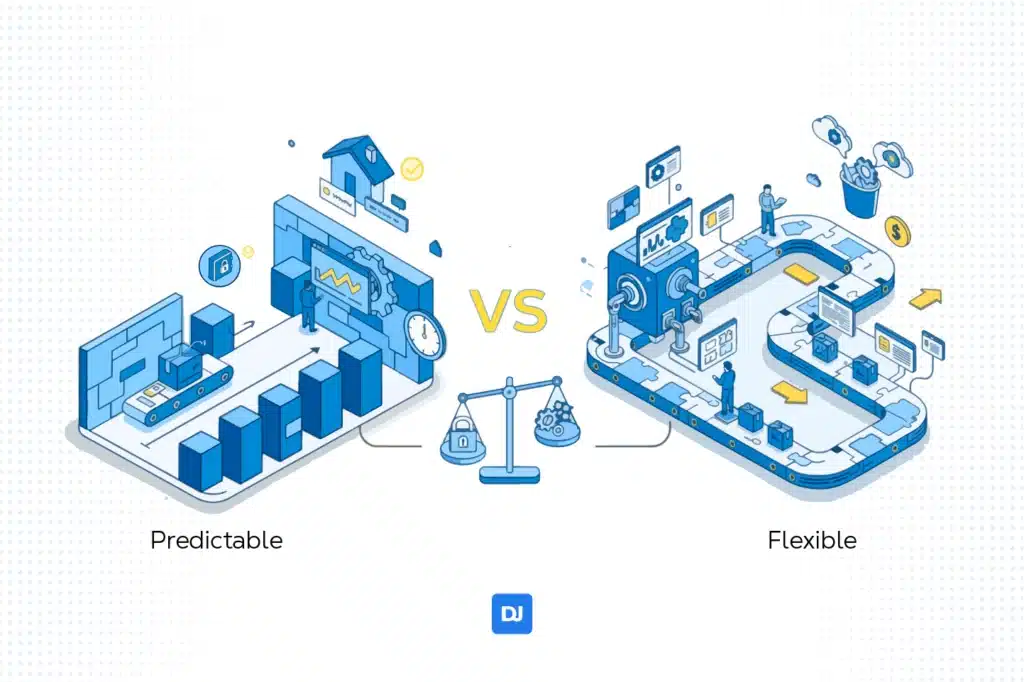
Choosing between a fixed-price and a T&M contract can feel like balancing a scale of trade-offs. Here are some key differences and considerations to help you weigh your options.
| Feature | Fixed-Price Contract | Time & Materials (T&M) Contract |
| Scope Flexibility | Rigid scope; changes need a formal order. | Flexible; adjust work as you proceed easily. |
| Risk and Responsibility | Mostly on the vendor; they cover cost overruns. | Mostly on the client; the client pays for all time spent. |
| Budget Predictability | High; total price is known upfront. | Lower cost adjusts with time and scope. |
| Budget Flexibility | Low; extra scope costs more money. | High; can pause or invest as the project unfolds. |
| Timeline | Fixed deadline tied to set milestones. | More fluid; end date is often a moving target. |
| Client Oversight | Low; somewhat “hands-off” after kickoff. | High; requires active involvement and review. |
| Payment Structure | Simpler: pay a fixed amount per milestone. | Detailed; involves approving timesheets and expenses. |
| Quality/Adaptation | Lower incentive for extras; less early feedback. | Higher quality through iteration and continuous feedback. |
Choosing the Right Model for Your Project
Between Time and Materials vs Fixed Contract, both contract types have their place, and it truly depends on your project specifics and business needs. Fixed Contract offers budget certainty and low management overhead for projects with stable, clear scopes. Meanwhile, Time & Materials is essential for projects requiring flexibility, supporting iterative development, adapting to evolving requirements, and fostering close client-vendor collaboration to maximize value delivery.
Here are some guidelines to help decide which model might be the better fit:
| Consideration | Choose Fixed-Price When… | Choose Time & Materials (T&M) When… |
| Requirements Clarity | Scope is well-defined and will not change. | Scope is uncertain or expected to evolve. |
| Project Size | The project is small or very short-term. | The project is long-term or an ongoing engagement. |
| Budget/Deadline | You have a hard budget cap or fixed launch date. | You can tolerate some budget uncertainty (within a range). |
| Development Approach | The standard or waterfall approach is sufficient. | You prefer an Agile or iterative approach. |
| Client Involvement | Hands-off management is strongly preferred. | You value closer collaboration and active control. |
| Vendor Trust | You want a small pilot to test a new vendor. | You trust the team to use time efficiently and openly. |
The Third Option: Staff Augmentation
There is a third way to solve the biggest hurdles on both models: Hiring Dedicated Developers through Staff Augmentation.
You don’t have to pay a fixed price for a “Project” or an hourly rate for “Time.” Instead, just pay a flat monthly salary for a dedicated engineer who works for your company.
Staff Augmentation Benefits
Staff Augmentation has many benefits. For example, you know exactly what your developer costs per month. Plus, you can change the scope at will, pivot features, or switch tasks daily without renegotiating. And since the developer is part of your team, they are incentivized to build the best product, not just the fastest one.
- Predictable Budget (Like Fixed Price)
- Total Flexibility (Like T&M)
- Total Alignment
Conclusion
Choosing between Time & Materials and Fixed-Price comes down to what you need to control most.
- If you need control over the budget (but are willing to sacrifice product flexibility), choose Fixed Price.
- If you need control over the product (but are willing to manage budget risk), choose Time & Materials.
But if you want control over the Talent, choose Staff Augmentation.
At DistantJob, we believe the best code comes from developers who are fully integrated into your vision.
We don’t sell you a “Project” that fights you on change orders, and we don’t sell you “Hours” that tick up indefinitely. We find you the top 1% of remote global talent to join your team for the long haul, at a fraction of the onshore cost.
Contact us and let’s find exactly what you need!