Senior developers often have to choose between shipping fast and building robust systems. This is a choice in software engineering that comes with trade-offs. And the outcome defines both a digital product’s lifecycle and the business’s viability.
Before AI and automated deployment pipelines, development speed was constrained by the labor-intensive nature of manual coding, integration, and feature development. However, artificial intelligence (AI) and automated deployment pipelines have changed the bottleneck.
The real challenge is not picking a side. It’s knowing when speed matters more than robustness, and when robustness becomes non-negotiable
This article explores the trade-offs, the hidden costs of each approach, and a practical framework to help teams decide how much engineering rigor is appropriate at different stages of a product’s lifecycle.
Why Shipping Fast Wins in Early-Stage Development
Early in a product’s life, the biggest risk isn’t system failure. The biggest risk is building the wrong thing. If a team spends months building a perfect platform for a product nobody wants, velocity becomes irrelevant. Speed helps teams validate ideas faster.
In Facebook’s early days, there was a mantra: “Move Fast and Break Things.” The idea was handling daily trade-offs, prioritizing the launch of scrappy minimum viable products (MVPs) over the pursuit of perceived perfection.
It empowered engineers to take risks and push the limits of development speed. After all, the fastest way to learn is to place functional software in the hands of real users. This era was defined by a transition from the “weekly push” model to continuous deployment, where features could move from development to a global audience in a single day.
Benefits of Shipping Fast
Shipping fast has benefits for startups and new markets that build robustness that cannot compare. They could be summarized by “fail fast and change course”.
1. Faster Product-Market Fit Discovery
Rapid releases allow companies to test hypotheses quickly. Instead of debating internally, teams can answer questions through real user behavior. Real usage data beats speculation.
Example questions that fast shipping helps answer:
- Do users actually want this feature?
- Which workflow do users prefer?
- Does the pricing model work?
2. Competitive Advantage
In many markets, speed of iteration beats perfection. This approach is common in startups where survival depends on momentum.
Companies that ship frequently can respond to customer feedback faster, experiment with features, and outmaneuver slower competitors.
3. Learning Through Real Systems
Some engineering insights only emerge after real usage. Building something simple and shipping it quickly often reveals the real problems earlier.
Examples include unexpected traffic patterns, performance bottlenecks, and user behavior edge cases.
The Hidden Costs of Prioritizing Speed Over Code Quality
Speed is powerful, but it introduces technical debt. Technical debt is not inherently bad when it is a deliberate trade-off. Problems arise when teams accumulate debt without a strategy to manage it.
1. Increasing Fragility
Fast-built systems may lack clear architecture boundaries, reliable tests, and consistent data models. As complexity grows, small changes begin to break unrelated components.
2. Developer Velocity Collapse
Ironically, excessive speed can slow teams down later. It causes long debugging sessions, frequent regressions, and/or fear of changing existing code.
Eventually, teams reach a point where adding features becomes painfully slow.
3. Operational Instability
Without robust infrastructure, systems may suffer from outages, cascading failures, and poor observability. These issues become especially damaging when customers depend on the system.
Why Building Robust Systems Becomes Non-Negotiable at Scale
As a product matures, the cost of failure increases. A prototype crashing is merely inconvenient, but a mature product crashing can cost millions. Robust engineering practices reduce these risks.
Facebook’s “break things” philosophy eventually met its ceiling. By 2014, the mantra evolved into “Move Fast on Stable Infra”. Production breaks are inevitable in software development. It must be managed through tough infrastructure. Instead of reckless speed, the focus was now high-velocity deployment supported by safety nets, such as granular feature rollouts and automated rollbacks.
Benefits of Building Robust Systems
Build robust systems for an already evolved, growing user base. Under these conditions, shipping fast will make them fail fast, which will frustrate a large number of users (and investors). The less likely the system fails, the stronger the business will be.
1. Reliability
Robust systems are designed with failure in mind. These systems include many safeguards such as redundancy, graceful degradation, monitoring, alerting, and automated recovery mechanisms.
Reliability becomes critical when businesses depend on the platform. At scale, the losses can be tremendous when the system fails.
2. Long-Term Maintainability
A clean architecture paired with strong testing allows engineers to modify systems safely. It enables easier refactoring, faster onboarding for new developers, and eventually lower debugging costs.
Well-structured systems age more gracefully, like an elder who performs exercises every day.
3. Scalability
Systems built with robustness in mind can handle growth. Without robustness, rapid user growth can break systems.
The Hidden Costs of Over-Engineering
While robustness is valuable, over-engineering too early is a common mistake. Teams sometimes design complex systems for problems they do not yet have.
For example:
- Introducing microservices for a small product
- Building highly abstract frameworks
- Implementing distributed systems before scale exists
These decisions increase development time without immediate benefit.
Over-Engineering Early Signs
Engineering teams may be over-engineering if they design elaborate architectures for simple problems. They also might create abstractions without real use cases, or build infrastructure before demand exists.
Also, pay attention to time: if they spend more time planning than shipping, it’s also a sign of over-engineering.
Premature complexity can slow innovation significantly. If your system needs time-to-market to test ideas, building robustness earlier is overkill.
Ship Fast vs Build Robust: How to decide
Choosing between Ship Fast and Build Robust depends on uncertainty and scale. When uncertainty is high, speed is more valuable to iterate and change course rapidly. When the scale is large, stability becomes vital to keep the business’s health.
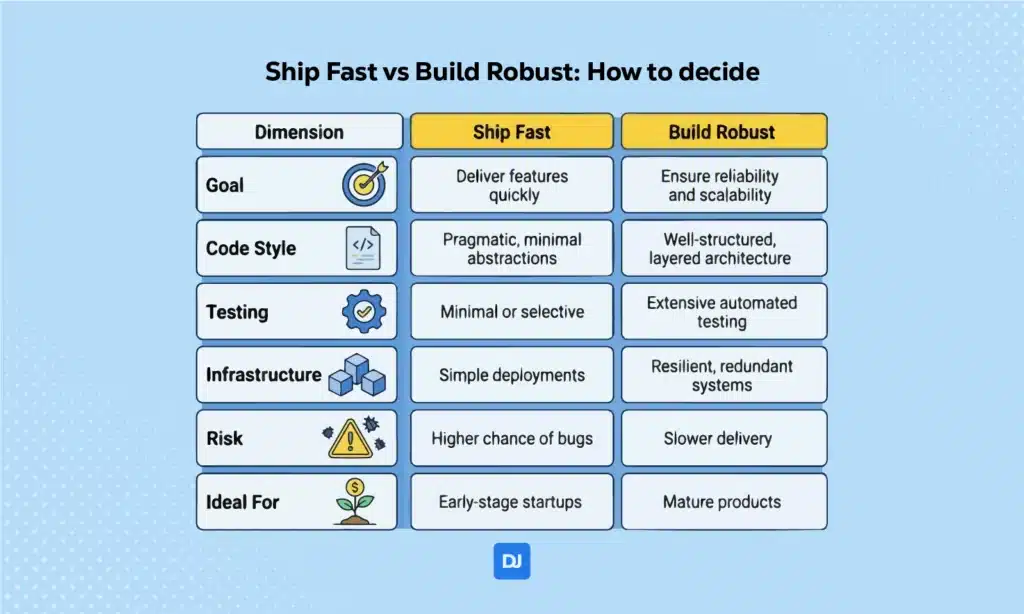
| Dimension | Ship Fast | Build Robust |
| Goal | Deliver features quickly | Ensure reliability and scalability |
| Code Style | Pragmatic, minimal abstractions | Well-structured, layered architecture |
| Testing | Minimal or selective | Extensive automated testing |
| Infrastructure | Simple deployments | Resilient, redundant systems |
| Risk | Higher chance of bugs | Slower delivery |
| Ideal For | Early-stage startups | Mature products |
Framework for Decision-Making
The key question is not “ship fast or build robust”. The real question is what level of robustness is appropriate for your product’s current stage.
| Product Stage | Priority | Recommended Approach |
| Idea Validation | Speed | Minimal architecture, rapid iteration |
| Early Product | Speed with guardrails | Basic testing and modular design |
| Growth | Balanced | Introduce stronger architecture and monitoring |
| Scale | Robustness | Reliability engineering and strong infrastructure |
Guardrails for Shipping Fast Safely
Teams can move quickly without sacrificing all reliability. Several practices help maintain balance.
Keep Architecture Simple
Simple systems are easier to modify and debug. Avoid unnecessary complexity early on. A well-structured monolith is often the fastest and safest starting point.
Maintain Core Tests
Even fast-moving teams should maintain tests for critical functionality. Here is what the critical functionality is for most systems:
- authentication
- payment flows
- core APIs
Track Technical Debt Intentionally
Technical debt should be documented and prioritized. Teams can maintain a backlog of debt items and schedule time to address them.
Ignoring debt is risky. Managing it deliberately is healthy. Document your technical debt to deal with it when you scale.
Invest in Observability
Monitoring and logging provide visibility into real system behavior. Basic observability includes application logs, performance metrics, error tracking, and alerts for critical failures.
These tools allow teams to move fast while still detecting problems.
When Robustness Becomes Non-Negotiable
Certain situations demand reliability regardless of development speed.
Financial transactions, healthcare data, infrastructure platforms, and safety-critical operations are all critical and need robust reliability.
In these domains, system failure has serious consequences.
Engineering teams must prioritize testing, redundancy, fault tolerance, and security. Speed becomes secondary to correctness.
Modern Engineering Tools To Ship Fast Without Sacrificing Robustness
In the AI era, the “Ship Fast vs. Build Robust” debate is being redefined. Unlike traditional software, AI introduces probabilistic, non-deterministic behavior. To manage this, we use Safe Velocity: a framework where rapid deployment risks are mitigated by automated safety systems.
We aren’t making AI “robust” in the traditional, unbreakable sense; we are building better cages (guardrails and monitoring). The goal is to ensure that when the model inevitably trips, the damage is contained.
Feature Flags and Observability
Feature flags are the kill switches of modern engineering. They allow teams to:
- Dogfood: Test unfinished code in production with internal users only.
- Progressive Rollouts: Gradually increase user exposure while monitoring health.
- Instant Remediation: Disable faulty features without a full codebase rollback.
When integrated with observability platforms like Datadog, these flags create a closed-loop system. If telemetry detects a latency spike or an error rate increase, the system can trigger an automated rollback. This ensures only high-caliber code survives, balancing speed with strict quality standards.
AI-Driven Quality Assurance
AI is now “self-healing” the very tests used to monitor it. These tools identify coverage gaps and update test scripts automatically as the application evolves. This maintains a “robustness baseline” without increasing the manual burden on developers.
However, AI-driven QA faces the Oracle Problem: AI can write a test, but it often cannot determine if a subjective or generative output is “correct.” In the AI era, a senior developer shifts from writing the code to judging it.
Conclusion
Ship fast vs build robust is all about managing trade-offs consciously. Speed helps teams discover what matters. Robustness ensures systems survive success.
Architecture decisions are economic decisions. They balance speed and reliability based on product maturity, risk tolerance, and business goals.
These decisions evolve as the product and company grow. Software architecture is not static. It adapts to the realities of the business.
However, implementing feature flags, AI-driven QA, and observability requires more than just tools; it requires an elite team.
None of this works without engineers who understand both sides of the equation, developers experienced enough to ship fast when it counts, and disciplined enough to build robust systems when the stakes demand it.
That combination is rare in any single market. DistantJob specializes in finding it globally. We identify and place senior developers from all over the world who bring exactly this kind of balanced engineering judgment without the overhead of local hiring.If your team is navigating the shift from velocity to stability, or needs to do both at once, contact DistantJob to find the engineers who’ve done it before.