Hiring Latin American (LatAm) developers is one of the unique opportunities that allows US businesses to take advantage of the huge economic, cultural, and timezone differential. You get skilled engineers in your time zone, at 40–60% less than domestic rates, from a region with over 2 million software professionals and 220,000+ new STEM graduates every year.
But it’s not just about cost savings. There’s something genuinely different about LATAM talent when it comes to remote teamwork, and the data backs it up.
The GLOBE study (Global Leadership and Organizational Behavior Effectiveness), one of the most comprehensive workplace culture research projects ever conducted, interviewed 18,000 managers across 62 cultures over more than a decade. Their findings on team orientation scores are striking:
- Colombia: 6.09
- Mexico: 6.03
- Brazil: 5.98
- Venezuela: 5.95
- Argentina: 5.87
- United States: 3.68
That’s not a small gap: LATAM countries score nearly twice as high as the US on in-group collectivism, which measures how strongly people prioritize their team. Harvard Business Review corroborated this in a six-month study of global project teams, finding that collectivist cultures like those in Latin America delivered a 25% higher positive impact on team performance compared to individualistic cultures.
When it comes to remote work specifically, the numbers are equally compelling. According to research from the Journal of Cross-Cultural Psychology, Latino employees have a 20–30% better chance of forming meaningful relationships with their peers. Remote work satisfaction surveys consistently show that LATAM remote workers report higher team communication satisfaction and lower feelings of disconnection compared to their US counterparts.
Think about it: in a world where everyone is working remotely, would you rather have:
- A team where 20% of people feel disconnected (hello, US workers!)
- Or a group that naturally builds stronger connections and genuinely enjoys working together?
This growing trend is reflected in our client base, with the majority opting to hire from LatAm for their tech needs also due to cultural fit but mainly because LATAM offer competitive rates, providing cost savings of 30% to 50% compared to U.S. counterparts.
Now, let’s break down everything you need to know to hire LATAM developers the right way.

How Much Do LATAM Developers Cost? Salary Breakdown by Country and Seniority
This is the question every hiring manager asks first, and it deserves a detailed answer. Developer costs in Latin America vary significantly based on country, seniority level, and specialization. Here’s what you can expect in 2026 based on verified payroll and market data.
Annual Salary Ranges by Country (USD, Full-Time)
| Country | Junior (0-3 yrs) | Mid-Level (3-5 yrs) | Senior (5+ yrs) |
|---|---|---|---|
| Argentina | $18,000 – $30,000 | $30,000 – $50,000 | $50,000 – $72,000 |
| Brazil | $15,000 – $28,000 | $28,000 – $48,000 | $48,000 – $70,000 |
| Mexico | $18,000 – $32,000 | $32,000 – $55,000 | $55,000 – $80,000 |
| Colombia | $14,000 – $25,000 | $25,000 – $45,000 | $45,000 – $65,000 |
| Chile | $20,000 – $32,000 | $32,000 – $55,000 | $55,000 – $80,000 |
Hourly Rates by Country (USD, Contract/Freelance)
| Country | Junior | Mid-Level | Senior |
|---|---|---|---|
| Argentina | $20 – $35 | $35 – $55 | $55 – $80 |
| Brazil | $20 – $30 | $30 – $50 | $50 – $70 |
| Mexico | $25 – $40 | $40 – $65 | $65 – $85 |
| Colombia | $20 – $32 | $35 – $58 | $55 – $75 |
| Chile | $25 – $38 | $40 – $65 | $65 – $90 |
LATAM vs US: The Cost Comparison
To put these numbers in perspective, here’s how LATAM developer costs compare to US equivalents:
| Seniority Level | US Average (Annual) | LATAM Average (Annual) | Savings |
|---|---|---|---|
| Junior | $75,000 – $95,000 | $16,000 – $30,000 | ~60–70% |
| Mid-Level | $95,000 – $130,000 | $30,000 – $52,000 | ~55–65% |
| Senior | $130,000 – $185,000 | $50,000 – $75,000 | ~45–60% |
Keep in mind that specialized roles command premiums. AI/ML engineers typically see a 12–15% increase above standard rates, fintech specialists add 10–12%, and cybersecurity experts earn roughly 10% more than generalist developers at the same seniority level.
Best Countries to Hire LATAM Developers
Latin America is home to over 2 million software developers across dozens of countries. While you can find strong talent everywhere, five countries stand out as the top destinations for US companies. Here’s a detailed look at each.
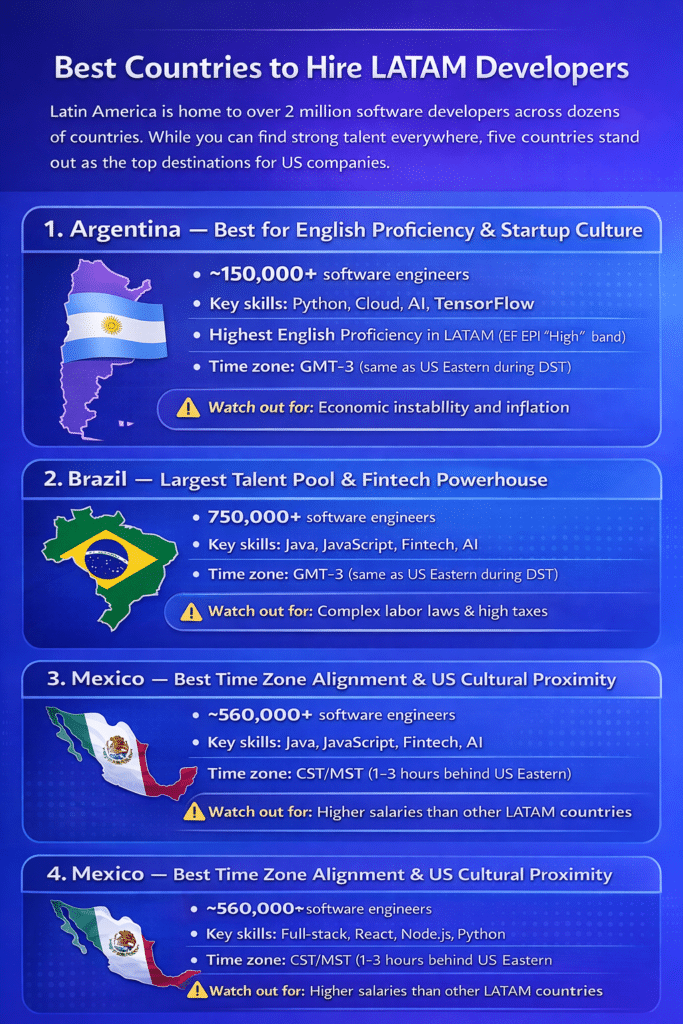
1. Argentina — Best for English Proficiency and Startup Culture
Argentina consistently leads Latin America in English proficiency, ranking highest in the region on the EF English Proficiency Index (High proficiency band, ranked #1 in LATAM). Buenos Aires, the country’s capital and tech hub, has a thriving startup ecosystem, with 11 unicorns and more than 17 IT clusters nationwide.
- Developer pool: ~150,000+ software engineers
- Annual STEM graduates: ~50,000
- Top tech hubs: Buenos Aires, Córdoba, Mendoza, Rosario
- Key strengths: Python, Cloud APIs, TensorFlow, SQL, open-source, AI research, mobile app development, data analytics
- English proficiency: Highest in LATAM (EF EPI “High” band)
- Time zone: GMT-3 (same as US Eastern during DST)
- Watch out for: Economic instability and inflation can complicate contracts and payment structures. Working with an EOR service helps mitigate this.
2. Brazil — Largest Talent Pool and Fintech Powerhouse
Brazil has the biggest developer workforce in Latin America by far, with an estimated 750,000+ software professionals. The country produces more than 100,000 IT graduates annually. São Paulo’s startup ecosystem outpaces the combined venture activity of Chile, Colombia, Argentina, and Mexico.
- Developer pool: 750,000+ software engineers
- Annual STEM graduates: 100,000+
- Top tech hubs: São Paulo, Rio de Janeiro, Campinas, Florianópolis, Belo Horizonte, Curitiba
- Key strengths: Java, Python, JavaScript, cloud architecture, AI/ML, IoT, fintech (340% sector growth from 2017–2023)
- English proficiency: Low to Moderate (varies; tech professionals in major cities tend to have stronger English)
- Time zone: GMT-3 (same as US Eastern during DST)
- Watch out for: Complex labor laws, high taxes, and bureaucratic red tape when hiring directly. An EOR or recruitment agency is strongly recommended.
3. Mexico — Best Time Zone Alignment and US Cultural Proximity
Mexico has the second-largest developer pool in LATAM (~560,000 professionals) and the best time zone overlap with the US. Guadalajara has been called “the Silicon Valley of Latin America” and hosts 6 unicorn startups. Mexico is also becoming a hub for LLM post-training and deep learning.
- Developer pool: ~560,000+ software engineers
- Annual STEM graduates: 110,000+
- Top tech hubs: Mexico City, Guadalajara, Monterrey
- Key strengths: Full-stack development (React, Node.js), Java, Python, cloud computing, AI/ML
- English proficiency: Low to Moderate (improving, especially among younger tech professionals; about 47% of developers speak English at an advanced level)
- Time zone: CST/MST (1–3 hours behind US Eastern — best for real-time collaboration)
- Watch out for: Salaries are slightly higher than other LATAM countries due to US proximity and high demand.
4. Colombia — Fastest-Growing Tech Ecosystem
Colombia has transformed from tech afterthought to major player almost overnight, growing from 62,000 IT professionals in 2021 to over 85,000 today. With 800+ tech organizations across the country (per Crunchbase), a business-friendly environment, and cities like Medellín earning recognition as innovation hubs, Colombia is increasingly the go-to destination for cost-effective LATAM hiring.
- Developer pool: 85,000+ (rapidly growing)
- Annual STEM graduates: 13,000+
- Top tech hubs: Bogotá, Medellín, Cali
- Key strengths: Java, Python, C#, SQL, Ruby, JavaScript, MEAN stack development, MVP solutions, e-commerce
- English proficiency: Moderate (improving rapidly, especially in tech hubs)
- Time zone: GMT-5 (same as US Eastern Standard Time)
- Watch out for: Smaller talent pool than Brazil or Mexico, so niche roles can take longer to fill.
5. Chile — Digital Skills Leader and Stable Economy
Chile produces some of the top-performing developers in Latin America for digital skills, according to the Coursera Global Skills Report. The country is known for its political stability, strong government support for tech (via the Digital 2035 plan), and growing AI/ML community.
- Developer pool: ~66,000+ software engineers
- Annual STEM graduates: 5,000+
- Top tech hubs: Santiago (6+ million population, Latin America’s largest cosmopolitan capital)
- Key strengths: Java, Python, PHP, DevOps, cybersecurity, data analytics, data engineering, regulatory compliance
- English proficiency: Moderate to High
- Time zone: GMT-4 (1 hour ahead of US Eastern)
- Watch out for: a smaller talent pool and higher rates than in most LATAM countries. Best for quality over volume.
Best Places to Hire LATAM Developers [Compared]
When it comes to hiring LATAM developers, you have multiple options to choose from. The best approach depends on your project needs, budget, and desired level of involvement. Here’s how the main options compare:
Platform Comparison Table
| Platform Type | Best For | Speed to Hire | Cost | Vetting Quality | HR/Legal Support |
|---|---|---|---|---|---|
| DistantJob (Specialized IT Recruitment Agency) | Full-time remote developers with cultural fit | 2–4 weeks | Recruitment fee + salary | ★★★★★ Deep technical + cultural vetting | ✅ Full HR, payroll, EOR included |
| Toptal / Arc (Elite Freelance Networks) | Top-tier freelance talent for specific projects | 1–2 weeks | $60–$150+/hr | ★★★★★ Top 3% acceptance rate | ❌ Limited |
| Upwork / Fiverr(Freelance Marketplaces) | Project-based work, budget flexibility | Days | $20–$75/hr | ★★☆☆☆ Self-reported, client reviews | ❌ None |
| LinkedIn / Indeed (Job Boards) | Direct hiring with internal recruiting team | 4–8 weeks | Job posting fees | ★★☆☆☆ No pre-vetting | ❌ None |
| BairesDev / Revelo(Outsourcing Firms) | Team augmentation, managed teams | 2–4 weeks | Monthly retainer | ★★★★☆ Internal screening | ⚠️ Partial |
1. Specialized IT Recruitment Agencies
Partnering with recruitment agencies that specialize in LATAM talent can streamline the entire hiring process. These agencies understand the local job market, cultural nuances, and can identify candidates who genuinely align with your company’s needs.
DistantJob specializes in helping businesses of all sizes recruit senior software engineers who meet specific technical requirements and fit the company culture. We help companies hire remote developers who not only satisfy technical expectations but also complement organizational culture and workflows. Beyond recruitment, we provide an all-in-one HR solution, including payroll and EOR services, managing all legal, financial, and administrative tasks.
2. Elite Freelance Networks
Toptal and Arc are excellent for finding top-tier freelance talent. Toptal has a famously selective acceptance process (top 3%), offering access to an extensive network of freelance software developers, designers, and product managers.
3. Freelance Marketplaces
Upwork and Fiverr are suitable for project-based hiring and accessing a wide range of skill levels. Upwork lets you review developer work samples and client evaluations to gauge expertise and past performance. Fiverr offers over a million software engineers across different specializations. These platforms work best for short-term projects or when you have strong internal technical assessment capabilities.
4. Job Boards
LinkedIn and Indeed give you direct visibility into talent, but they require the most internal resources; you’ll need a recruiting team to write job descriptions, manage requisitions, conduct interviews, and handle onboarding. They don’t pre-vet candidates, so the screening burden falls entirely on you.
How to Hire LATAM Developers: Step-by-Step
Whether you go through a recruitment agency or hire directly, these strategies will help you find and retain the right LATAM talent.
Step 1: Define Your Requirements Clearly
Before you start, get specific about the role. Define the tech stack, seniority level, working hours (and time zone overlap requirements), English proficiency expectations, and whether you need a full-time employee, contractor, or freelancer. The more precise your requirements, the faster the process.
Step 2: Understand Local Labor Laws
Each LATAM country has its own set of labor laws concerning contracts, benefits, and termination procedures. A report from Vorecol highlights that 75% of companies face challenges navigating the complex web of employment laws across different jurisdictions.
Before hiring, invest time in understanding the labor laws of your target country. Draft comprehensive employment contracts that align with local regulations, clearly outlining roles, responsibilities, and terms. Consider collaborating with legal professionals or recruitment agencies that specialize in the local employment landscape to ensure compliance and smooth onboarding.
Alternatively, partner with an Employer of Record (EOR) service to handle all legal and administrative tasks on your behalf. This is the recommended approach for most US companies hiring their first LATAM developers.
Step 3: Conduct Multi-Faceted Interviews and Assessments
When evaluating LATAM developers, use a layered approach:
- Video interviews — Assess communication skills, English proficiency, and cultural alignment to ensure seamless integration with your team.
- Technical assessments — Implement targeted coding challenges to evaluate practical skills and problem-solving abilities in real-world scenarios.
- Pair programming sessions — Observe firsthand how candidates tackle complex problems, adapt to feedback, and work alongside team members.
By combining these methods, you’ll get a comprehensive picture of each candidate’s technical ability, communication skills, and cultural fit.
Step 4: Consider a Trial Period
Begin with a short-term contract or project to assess compatibility before committing to a long-term partnership. This approach lets you evaluate skills, communication, and cultural fit in a low-risk way, ensuring smoother collaboration in the future.
Step 5: Offer Competitive Compensation and Benefits
While LATAM rates are lower than US rates, offering competitive packages within the local market is crucial for attracting and retaining top talent. Research local salaries (see our salary tables above) and don’t just focus on the number, consider offering a complete benefits package:
- Health insurance (very important in many LATAM countries)
- Professional development opportunities (conferences, training, certifications)
- Equipment provision (laptops and hardware)
- Flexible working hours
- Performance-based bonuses or stock options for key positions
- Local holiday compliance
By offering a package that covers both financial and career development needs, you’ll stand out in the competitive LATAM tech market and increase retention.
Step 6: Set Up Reliable Payment Methods
Navigating payments to Latin American countries can be complex due to varying currencies and exchange rate fluctuations. Argentina, for example, has experienced significant inflation and dual exchange rates that can impact how much employees actually receive.
To handle this effectively, use international payment platforms like Wise, Payoneer, or PayPal that simplify transactions and ensure fair compensation. Even better, work with an EOR provider (like DistantJob’s fully managed HR services) that handles payroll, currency conversion, and tax compliance for you.
Overcoming Challenges in Hiring Latin American Developers
When looking to hire LATAM coders, several aspects must be considered to better assess the qualifications and potential of Latin American tech talent.
Diverse Educational Backgrounds
Many developers in Latin America might not follow the traditional educational path of obtaining university degrees. They often gain tech skills through online courses, self-learning, or local companies and universities. Expect resumes to include personal photos and practical courses and certifications over formal degrees.
Flexible Payment Methods
Navigating payments to Latin American countries can be complex due to varying currencies, with exceptions like Ecuador, Panama, and El Salvador, which use the U.S. dollar. Exchange rates play a crucial role and can impact how much employees actually receive. For instance, Argentina has both an official exchange rate and a higher “blue” market rate, potentially leading to significant losses for employees when paid at the official rate.
To mitigate these challenges, your company should consider flexible payment methods. Utilizing international payment platforms like Wise, Payoneer, and PayPal can simplify transactions and ensure that Latin American employees receive a fair amount, accounting for exchange rate differences and minimizing loss.
Paperwork & Tax Laws
Hiring developers from Latin America involves doing some extra work for paperwork that includes tax documentation, worker benefits, and more.
While this may seem like a lot of work, it’s only a matter of familiarizing yourself with local laws. You can also avoid all this and get the help of experts.
At DistantJob, we match you with your ideal candidate and handle all the HR tasks. We offer fully managed HR services tailored to your specific needs.
Conclusion
Hiring LATAM developers offers US companies a unique opportunity to access a wealth of tech talent while optimizing costs and fostering global collaboration. By understanding the LATAM tech landscape, implementing effective hiring strategies, and focusing on seamless integration, businesses can leverage this rich talent pool to drive innovation and growth.
Hiring remote developers from Latin America requires a tailored approach, as what works best can vary significantly from one company to the next. While some may find job boards perfectly suited to their hiring strategy, others like you might benefit more from partnering with a specialized IT recruitment agency.
While hiring skilled developers from Latin America provides many benefits, it still requires work and consideration of local laws, payments, and more.
At DistantJob, we focus on each candidate’s fulfilling all your requirements. In addition to helping you find, hire, and onboard, we also ensure you have a smooth HR experience. Give us a call if you want to know more, or visit us at our office in Montreal.
FAQ on Hiring LATAM Developers
Annual salaries for LATAM developers range from $14,000 to $80,000 depending on country, seniority, and specialization. On an hourly basis, expect to pay $20–$40 for junior developers, $35–$65 for mid-level, and $55–$90 for senior engineers. This represents savings of 40–65% compared to equivalent US hires.
The top five countries are Brazil (largest talent pool with 750,000+ developers), Mexico (best US time zone alignment), Argentina (highest English proficiency in LATAM), Colombia (fastest-growing tech ecosystem and competitive rates), and Chile (top digital skills and economic stability). The best choice depends on your specific needs for language, time zone, specialization, and budget.
Use online job boards like LinkedIn, engage remote IT recruitment agencies like DistantJob, or use freelancing platforms like Upwork and Toptal.
Yes, it’s fully legal. US companies can hire LATAM developers either as independent contractors or as full-time employees. For full-time employment, you’ll need either a local legal entity or an Employer of Record (EOR) service to handle local labor law compliance, payroll taxes, and benefits. Many recruitment agencies like DistantJob include EOR services to simplify this process.
Through a specialized recruitment agency, expect 2–4 weeks from initial requirements to onboarding. Job boards and freelance platforms can be faster (days to weeks) but require more internal effort for vetting. The first candidate profiles can typically reach your inbox within 48 hours when working with an agency.
English proficiency varies by country and individual. Argentina has the highest English proficiency in the region, followed by Uruguay, Chile, and Costa Rica. In countries like Brazil and Mexico, while average proficiency is lower, tech professionals in major cities — especially those with experience on international teams — typically have strong working English. Always include an English assessment in your hiring process.
Latin America spans five time zones, with most developers working within 0–3 hours of US Eastern Time. Colombia, Peru, and Ecuador share the same time zone as US Eastern (GMT-5). Argentina, Brazil, Uruguay, and Chile are GMT-3 to GMT-4. Mexico ranges from GMT-6 to GMT-8, aligning perfectly with US Central and Pacific time.