There is an obsession with microservices in modern software architecture. However, adopting microservices, instead of a monolith, traps new projects prematurely. Instead, a new project should start with a modular monolith.
A monolith’s entire architecture is a self-contained unit, tightly bundled inside a codebase. It includes business logic, user interface, and data access. On the other hand, microservices architecture splits an application into a set of smaller services integrated via APIs. The best approach is the one optimal for companies at different stages of development.
Although popular on job postings, microservices exponentially increase technical and infrastructure complexity. They are not ideal for the start of a project, where the focus should be on rapid validation (MVP).
Here, we discuss when and why to choose monoliths vs microservices, and vice versa.
Quick Decision Framework
| Your Situation | Recommended Architecture |
| Team under 15 developers, building an MVP | Modular monolith |
| Early-stage startup validating product-market fit | Monolith |
| Domain requirements are still evolving | Monolith |
| Budget and DevOps maturity are limited | Monolith |
| Team of 50+ across multiple domains | Microservices |
| Millions of users with independent scaling needs | Microservices |
| Stable, well-bounded domain contexts | Microservices |
| Strong DevOps/SRE automation in place | Microservices |
If you’re somewhere in between, a modular monolith gives you the simplicity of a monolith with the structural readiness to evolve into microservices later.
What is Monolithic Architecture?
In a monolithic architecture, all components of an application (business logic, user interface, and data access) are bundled into a single, unified codebase. The model relies on a single programming language, a shared repository, and a unified deployment environment.
Historically, the monolith was the default choice because it aligns with the early-stage needs of a product: speed, simplicity, and ease of management.
Advantages of Monoliths
The technical benefits of the monolith are rooted in its simplicity. Because all code resides in one place, new team members can navigate the codebase more effectively.
Moreover, developers benefit from centralized data and ACID-compliant transactions across the entire system. In the monolith, every function call is local, occurring within the same memory space, eliminating network calls’ latency in distributed systems.
Simpler Development
A monolith is easier to understand because everything lives in one place. Developers navigate the codebase without worrying about network calls between services.
Easier Testing
Testing a monolith is straightforward because components interact through in-process function calls rather than network APIs.
Faster Initial Development
Startups often benefit from monoliths because they allow rapid iteration without the time overhead of distributed systems.
Simpler Operations
Running a monolith typically requires:
- One deployment pipeline
- One service runtime
- One monitoring stack
It dramatically reduces operational complexity.
Disadvantages of Monoliths
The limitations of the monolith are felt at scale. When team sizes exceed 10 to 15 developers, coordination requires a single deployment pipeline, which leads to significant friction.
Imagine multiple teams working on a single codebase frequently encounter merge conflicts and deployment contention. One team’s feature update must wait for another team’s testing cycle. A monolith that decreases velocity leads to the decision to decompose the system into microservices.
Scaling Limitations
Scaling a monolith requires scaling the entire application, even if only a single component needs more resources.
For example, if the search feature experiences heavy traffic, the whole system must scale.
Slower Deployments
As the codebase grows, deployments become riskier because small changes can affect the entire system.
Tight Coupling
Modules often become intertwined over time, making refactoring difficult.
Team Coordination Challenges
Large monoliths often require synchronized releases, which slows development across teams.
What is Microservices Architecture?
A microservices architecture breaks an application into small, independent services that communicate via APIs. It decomposes a large application into a collection of smaller autonomous services, each responsible for a specific business capability within a “bounded context”.
These services communicate via well-defined APIs, often using HTTP/REST or asynchronous message queues. The final result not only scales better, but it also enables teams to work independently, deploying their own services without affecting the rest of the system.
Advantages of Microservices
Microservices provide superior fault isolation over a monolith. If a recommendation service fails, all other services remain operational. Furthermore, microservices allow better scaling. If one component of the application experiences high demand, only that specific service needs to be scaled horizontally, optimizing resource usage compared to scaling the entire monolithic unit.
Independent Scaling
Each service can scale individually. For instance, a recommendation engine can scale horizontally, a payment service can scale vertically for reliability, and a catalog service can scale for read traffic. All other services remain unaffected.
Faster Team Autonomy
Teams can work independently without coordinating large releases. It supports Conway’s Law: system architecture mirrors team structure.
Fault Isolation
Failures in one service are less likely to cause the entire system to crash. For example, if the recommendation service fails, the other services continue to work seamlessly.
Technology Flexibility
Different services can use different technologies and programming languages. For example, Python for data science, Go for high-performance APIs, Java for enterprise services, JavaScript for UX interfaces, and C for better performance in low-level environments.
Disadvantages of Microservices
However, this flexibility introduces complexity. Developers must now account for network latency, partial failures, and the challenges of maintaining data consistency across multiple databases. It also shifts the burden from development to operations.
A mature microservices ecosystem requires advanced DevOps capabilities, including container orchestration (Kubernetes), service discovery, and distributed tracing.
Operational Complexity
Microservices introduce many new challenges, such as service discovery, API versioning, distributed logging, network latency, retry logic, and circuit breakers.
Dealing with this complexity requires mature DevOps practices, beyond the incorrect mindset of “DevOps is deploying in the cloud”.
Harder Debugging
In a monolith, a stack trace shows the full request path. In microservices, a request may travel across 10+ services, requiring distributed tracing.
Data Consistency Problems
Each service often owns its own database, introducing challenges like:
- Eventual consistency
- Distributed transactions
- Saga patterns
- Infrastructure Overhead
Microservices typically require containers, Kubernetes orchestration, service meshes, API gateways, and observability platforms. For small teams, this can be overkill.
Monolith vs Microservices: Key Differences
Monolithic architecture uses a single codebase deployed as one unit, while microservices architecture uses multiple independent codebases deployed separately. The monolith trades scalability for simplicity; microservices trade simplicity for flexibility.
Choosing between monolith and microservices is a matter of balancing competing priorities. Companies must weigh the latency, operational burden, and team velocity against their specific requirements.
| Dimension | Monolith | Microservices |
| Codebase | Single codebase | Multiple services |
| Deployment | One deployment unit | Independent deployments |
| Scaling | Scale entire app | Scale individual services |
| Complexity | Lower | Higher |
| Team structure | Small teams | Multiple autonomous teams |
| Failure isolation | Low | Higher |
| Infrastructure | Simple | Complex |
| Data management | Single database | Distributed data |
Performance: The Numbers Nobody Talks About
The performance difference between monoliths and microservices is staggering. While an in-process call in a monolith takes nanoseconds, a network call RPC within a microservices ecosystem takes milliseconds; a 1,000,000x difference.
| Communication Path | Latency Estimate | Relative Speed |
| Monolith (In-Memory) | Nanoseconds | 1x (Baseline). |
| Microservices (Same Region) | 1–10 ms | 1,000,000x Slower. |
| Microservices (Cross-AZ) | 10–30 ms | 3,000,000x Slower. |
| Microservices (Cross-Region) | 50–200 ms | 10,000,000x+ Slower. |
As a request traverses a chain of five microservices, the cumulative latency can reach 50–100ms before any actual work is performed. For low-latency requirements (in the game industry, for example), this overhead is often unacceptable.
Operational Costs and SRE Ratios
Microservices require an expensive workforce. A mature microservices organization typically requires 1 SRE for every 10–15 services. On the other hand, compare with a monolith: just 1–2 operations engineers for a standard monolithic application.
Furthermore, the cost of observability (tracing, logging, and metrics) for a 50-service deployment can range from $50,000 to $500,000 annually.
| Deployment Type | Ops Staffing Ratio | Primary Overhead Costs |
| Small Monolith | 1 Ops: Total App | Low Infrastructure Costs. |
| Modular Monolith | 1-2 Ops: Total App | Medium Tooling Costs. |
| Mature Microservices | 1 SRE: 10-15 Services | High Tracing/Observability Costs. |
| Immature Microservices | 1 SRE: 5-10 Services | High Coordination/Debugging Debt. |
This is where remote hiring becomes a strategic advantage. Companies transitioning to microservices can source experienced DevOps engineers and SREs from Latin America and Eastern Europe, regions with deep infrastructure engineering talent pools, at 40–60% lower cost while maintaining the same seniority level. DistantJob specializes in headhunting these exact profiles as full-time, dedicated team members.
Decision Criteria for Selection
The consensus among industry experts is to start with a monolith and transition only when its constraints become unbearable.
| Choose Monolithic Architecture If: | Choose Microservices Architecture If: |
| Team size is < 15 developers. | Team size is > 50 developers across multiple domains. |
| Building an MVP or early-stage product. | The application handles millions of users at scale. |
| Domain requirements are evolving or muddled. | Domain contexts are stable and well-bounded. |
| Budget and operational skills are limited. | Strong DevOps/SRE maturity and automation. |
| Strong transactional consistency is required. | High availability and fault isolation are priorities. |
Monolith vs Microservices: When To Use Each
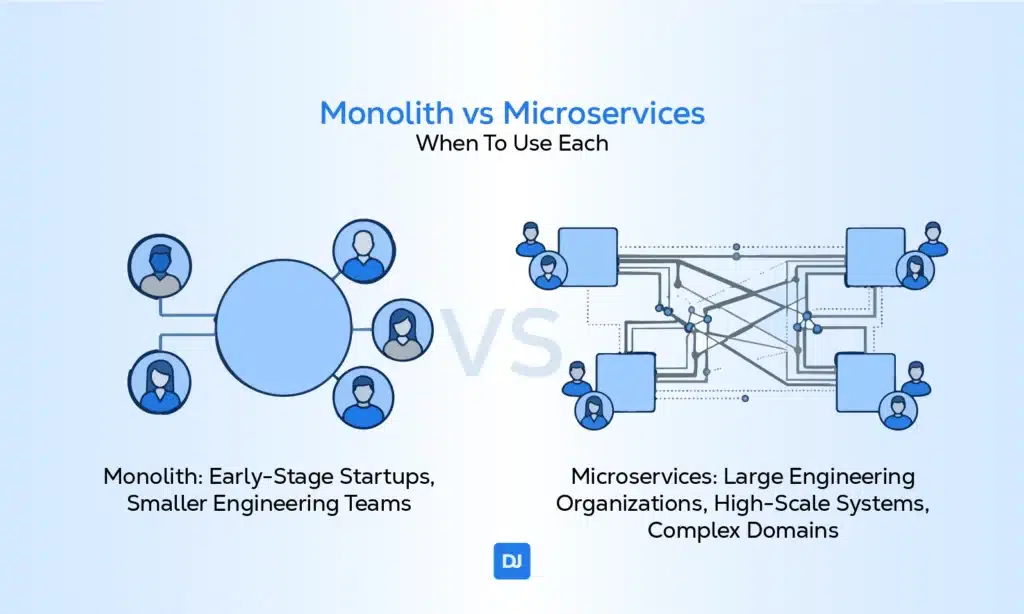
Monoliths excel in the early stages of a product, providing the speed and simplicity needed to reach product-market fit. Microservices offer a path to massive scale and team autonomy, but they come with a high operational cost and complexity that can drown an unprepared company.
When a Monolith Is the Better Choice
Despite industry trends, monoliths remain the best choice in many situations.
Early-Stage Startups
Startups prioritize speed of development over scalability. A monolith allows faster iteration, less operational overhead, and simpler deployments.
Smaller Engineering Teams
Teams with fewer than 10 engineers in a single project often struggle to manage the operational burden of microservices.
Products with Simple Domains
If the business domain is straightforward, microservices may introduce unnecessary complexity.
Prototyping and MVP Development
A monolith is ideal when validating product-market fit.
When Microservices Make Sense
Microservices shine when systems grow large and complex.
Large Engineering Organizations
Companies with multiple teams working simultaneously benefit from service autonomy.
High-Scale Systems
Platforms with millions of users often require independent scaling of services.
Rapid Feature Expansion
Microservices enable teams to deploy independently without waiting for coordinated releases.
Complex Domains
Large systems often evolve into bounded contexts, where separating services improves maintainability.
The Modular Monolith: A Modern Alternative
A modular monolith combines the simplicity of monoliths with the structure of microservices. Instead of splitting services into separate deployments, teams maintain strong module boundaries within a single application.
This alternative creates a unified system, but internally organized by well-defined modules (such as catalog, orders, and payments). It’s ready for a future migration to microservices when needed.
A modular monolith keeps all code in a single deployment unit but enforces strict boundaries between modules using language-level constructs (like packages in Java or namespaces in C#).
Teams achieve autonomy and faster development without the “latency tax” and operational complexity of microservices. Companies like Airbnb and GitHub have scaled their core applications as modular monoliths, demonstrating that this approach is viable for high-traffic platforms.
Preparing for the Transition
Companies moving to microservices should follow a paved path. Invest heavily in infrastructure as code (IaC), centralized observability, and self-service deployment platforms from day one.
The “Strangler Fig” pattern (where specific, high-value components are extracted from the monolith one by one) is the most reliable way to migrate without causing catastrophic downtime.
The Impact of AI and Serverless
As we look toward 2026 and beyond, the integration of AI agents into the development lifecycle is expected to change the calculus. Airbnb, for example, is already utilizing AI for high-precision audience expansion and real-time edits in its systems.
AI can potentially manage the complexity of microservice interactions, automating tracing and debugging, lowering the operational burden of distributed systems.
Additionally, the shift toward serverless (for example, using AWS Lambda) continues to offer a “pay-for-what-you-use” model, though as Amazon Prime Video demonstrated, it must be used with a deep understanding of its cost and scaling limits.
Case Study: Airbnb’s Evolution From Monolith to Microservices
Airbnb’s journey offers a broader look at how architecture must evolve alongside business scale. Their history is divided into three distinct phases: the Monorail, the Service-Oriented Architecture (SOA) transition, and the current hybrid “Service Blocks” model.
The Monorail Phase (2008–2017)
For nearly a decade, Airbnb operated on a single Ruby on Rails monolith, known as the “Monorail”. This architecture was key in Airbnb’s early success. It allowed full-stack engineers to build and ship features quickly within a single repository.
By 2017, however, the Monorail became a bottleneck. The engineering team had grown from a few dozen to hundreds, and the tightly coupled nature of the code meant that a small change in one area could have unpredictable ripple effects elsewhere.
Deployment cycles slowed, taking hours to run, and ownership of different parts of the code by different teams became tangled.
The SOA Transition (2017–2020)
To overcome these challenges, Airbnb migrated to a Service-Oriented Architecture. The goal was to split the Monorail into hundreds of independent microservices.
This transition required a fundamental change in both company structure and engineering culture.
Airbnb established clear rules for the new architecture:
- Every service should own both the reads and writes to its data (database-per-service),
- Services should address specific concerns,
- And data changes should be communicated via standard events to ensure loose coupling.
The migration strategy was incremental and data-driven. When a request was made, it was sent to both the old Monorail and the new service.
The engineers used a comparison framework to verify the results between the module inside the monolith and the future microservice. Only after verifying consistency was the traffic fully shifted from the module to the new service.
For write requests, they employed “shadow databases,” where the new service would write to a temporary store for validation before touching the production database.
By the end of this phase, Airbnb’s architecture was organized into four layers:
- Data Services: Low-level services that were the sole entry point for database interactions.
- Derived Services: Services that applied basic logic to data from multiple sources.
- Middle-tier Services: Contained complex business logic that did not fit at the data service level.
- Presentation Services: Aggregated data from lower tiers to serve specific client needs (web, iOS, Android).
The Service Blocks Era (2020–Present)
While the SOA shift solved the scaling issues, it introduced “service sprawl.” With thousands of microservices, the cognitive load on developers became heavy, and dependencies grew complex.
Small changes often require updates to multiple fine-grained services. In short, despite and because there were many services, the microservices looked more like a distributed monolith.
In response, Airbnb evolved to a hybrid model called Macroservices, which divides clusters of microservices into Service Blocks. It focused on all APIs tied through a GraphQL interface.
Instead of individual services, related microservices are encapsulated within Service Blocks, which provide a single point of interaction for other parts of the system.
The change simplified the orchestration logic and made data flow more predictable while retaining the scalability of a distributed system.
| Airbnb Evolution Stage | Period | Primary Architecture | Core Challenge Solved | New Challenge Introduced |
| The Monorail | 2008–2017 | Ruby on Rails Monolith. | Initial speed and agility. | Deployment and team bottlenecks. |
| SOA Transition | 2017–2020 | Microservices. | Independent scaling and team autonomy. | Service sprawl and dependency complexity. |
| Service Blocks | 2020–Present | Hybrid Micro + Macroservices. | API unification and reduced cognitive load. | Balancing abstraction with service granularity. |
Conclusion
There is no universal answer in the “monolith vs microservices” debate, and the best for your business depends on context.
A monolith offers simplicity, speed, and operational efficiency. Monoliths are ideal for startups and smaller teams. Building a modular monolith will make your system ready to scale to microservices, as the Airbnb case highlights.
Microservices offer scalability, team autonomy, and resilience, but they introduce substantial complexity. As thousands of microservices emerge, you might want to establish a set of microservices to map them out (as Airbnb did with Service Blocks).
The most successful engineering teams treat architecture as an evolving strategy rather than a fixed decision. Start simple, build strong module boundaries, and evolve the architecture as the system (and the company) grows.
Are you transitioning your system into microservices? This is not a trivial shift. You need seasoned senior engineers to lead that change step by step.
This is where DistantJob comes in. We headhunt and pre-vet the top 0.1% of global talent to ensure your company has the best microservices experts who fit your business needs and culture.
It’s risk-free: you only pay when you actually hire a professional of your dreams.
Scale up your business today with DistantJob!