When you sell a SaaS (Software as a Service) solution, it’s unlikely to be plug-and-play. B2B software often requires a bridge between complex code and real-world business problems, built by Solution Engineering (SE). However, if you’re looking to hire one (or become one), you’ll realize there are two distinct roles: Pre-Sales and Post-Sales Engineers.
In the SaaS business model, customers often pay monthly or yearly. If they can’t get the tech to work, they cancel their contract and turn to another vendor. Therefore, both pre-sales and post-sales engineers are crucial for retention and continuous revenue. Unlike traditional support, they try to solve the problem before the customer even realizes there is one.
Both require a mix of hard and soft skills, and their daily missions often overlap. Let’s break down the divide.
What are Pre-Sales Solutions Engineers?
Pre-sales Engineers, also known as Solutions Engineers, are software engineers involved in sales and the customer’s first contract. The Pre-Sales engineers design solutions for the client’s business problems, deal with stakeholders, and perform presentations. Unlike Post-Sales engineers, Pre-Sales don’t implement the solution; instead, they demonstrate that it will benefit the customer.
They are frequently referred to by various titles, including Sales Engineers, Solutions Architects (SAs), or Solutions Consultants (SCs).
Their goal isn’t just to sell a product, but to prove that the product actually solves the customer’s specific problem.
What Pre-Sales Solutions Engineers Actually Do
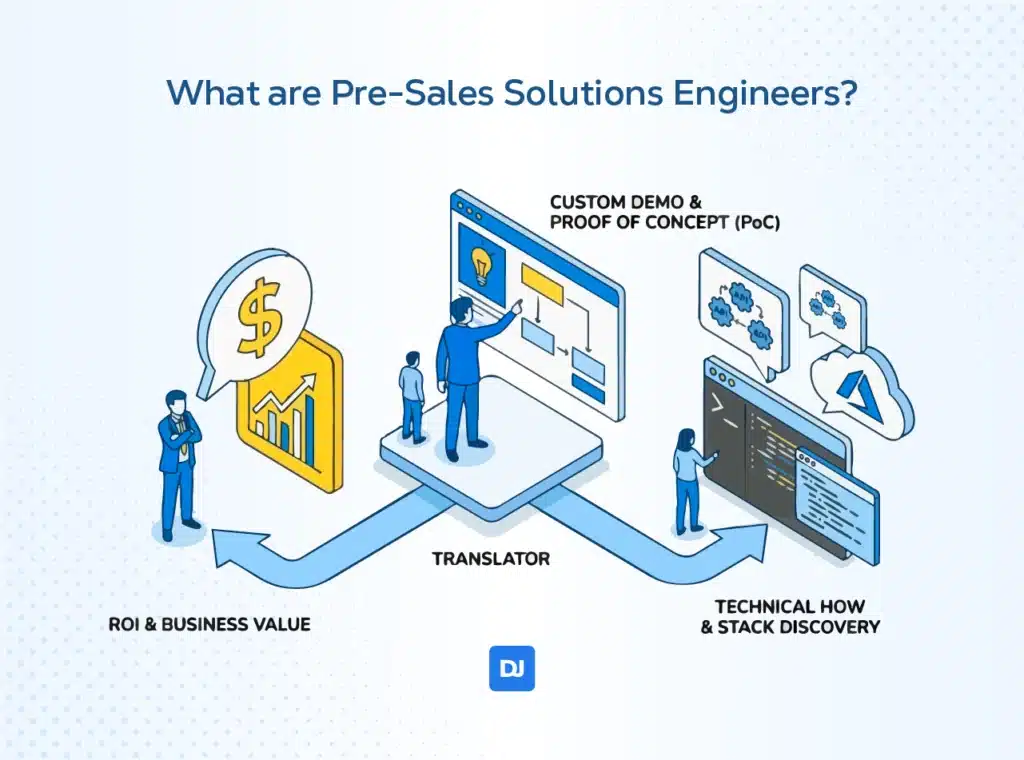
While a salesperson focuses on the “Why” (ROI, business value, contracts), the Pre-Sales SE focuses on the “How.” Their goal is to prove that the product can actually solve the customer’s specific technical problems.
1. The Discovery Phase
Before a demo ever happens, SEs dig into the customer’s current tech stack. They ask the hard questions:
- “How does your data flow from Point A to Point B?”
- “What are the security bottlenecks in your current workflow?”
2. The Custom Demo
An SE builds a live environment that mirrors the client’s world. If a client says, “We use Playwright and AWS,” the SE ensures the demo shows exactly how the product interacts with those specific tools.
3. Proof of Concept (PoC)
This is the trial by fire. The Pre-Sales Engineer stays with the client for a few weeks to implement a limited version of the software. They troubleshoot bugs, answer security questionnaires, and essentially act as a temporary consultant to earn the client’s trust.
The Pre-Sales Engineer Skill Set
In Pre-Sales, you aren’t just a coder; you are a translator. You must be able to pivot from discussing API documentation with a developer to explaining ROI to a CFO within the same hour.
| The Technical Side | The Social Side |
| Deep knowledge of APIs, Cloud (AWS/Azure), and Security. | The ability to explain complex tech to a non-technical CEO. |
| Troubleshooting on the fly during a live meeting. | High emotional intelligence (reading the room). |
| Understanding the competitive landscape (why your tech is better). | Active listening to find the “pain points” behind the complaints. |
What is a Post-Sales Solutions Engineer?
The Post-Sales Solutions Engineer (sometimes called a Customer Success Manager or Technical Account Manager) ensures that everything in the sales contract is implemented by the product. They install and maintain products or solutions in the client’s environment, guaranteeing software works without issues and achieves the customer’s business goals.
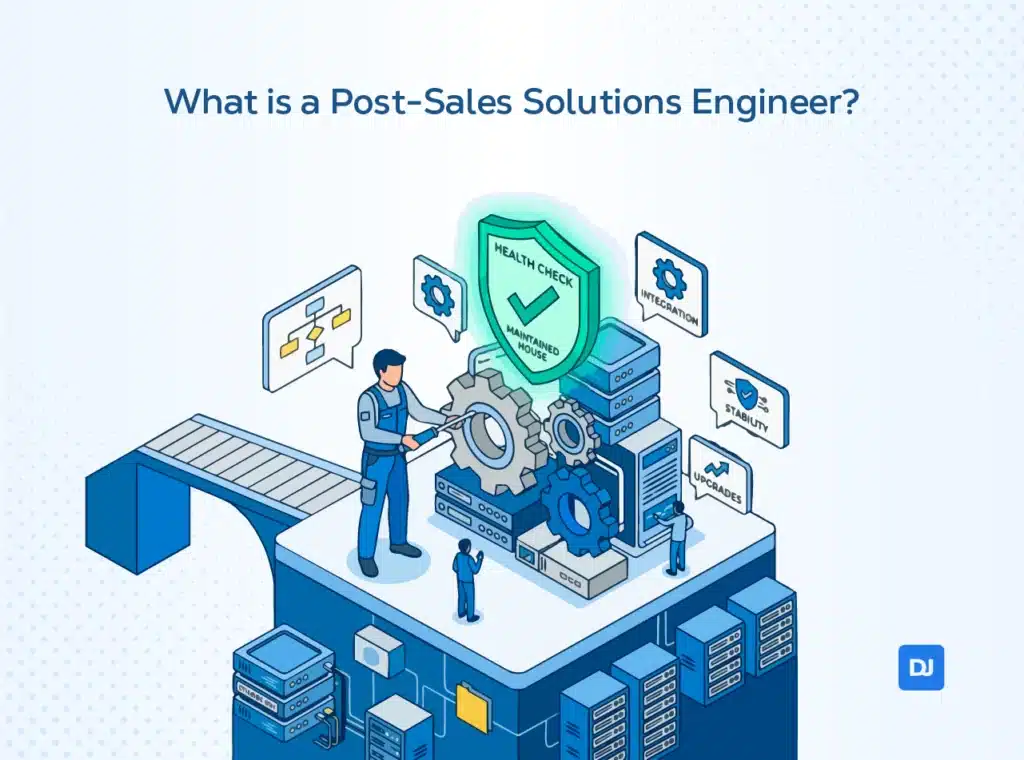
The Pre-Sales Engineer promises the product will meet expectations, and the Post-Sales Engineer (often called a Customer Success Engineer, Implementation Engineer, or Technical Account Manager) is the one who delivers on it.
Once the contract is signed, the Sales team moves on to the next lead. The Post-Sales Engineer steps in to ensure the customer doesn’t end up with shelfware (expensive software that nobody knows how to use).
What Post-Sales Solutions Engineers Actually Do
Post-sales is where the rubber meets the road. Think of them as a blend of a high-level consultant, a debugger, and a teacher. Their day-to-day usually breaks down into three phases:
1. Implementation & Onboarding
This is the heavy lifting phase. Post-sales engineers ensure the software or hardware integrates seamlessly with the customer’s existing tech stack. The first 90 days are critical, and the Post-Sales Engineer handles the heavy lifting:
- Integrating the product into the client’s production environment.
- Writing scripts or using APIs to make sure Product A talks to the customer’s Database B.
- Migrating legacy data without breaking things.
- Configuring custom workflows meets business goals promised during the sales cycle.
2. Technical Troubleshooting
Unlike standard customer support, which handles “How do I reset my password?”, a Post-Sales Engineer handles deep architectural issues. If the API is latency-heavy or a specific integration is failing under load, they are the ones diving into the logs.
Post-sales engineers are the “voice of the customer” inside the company. If a major client needs a feature that doesn’t exist, the engineer gathers the technical requirements and lobbies the Product Team to build it. They translate “This isn’t working” into “There is a latency issue in the API endpoint under high load.”
3. Education and Advocacy
Post-sales engineers train the client’s internal team to become power users. They also act as an internal advocate, taking customer feedback and bugs directly to the Product/R&D teams to influence the software’s future roadmap
The Post-sales SEs don’t just fix things when they break; they look for ways to optimize them. They run “Health Checks” to see if the customer is using the latest features and conduct training sessions for the customer’s internal technical teams.
The Post-Sales Engineer Skill Set
Post-Sales requires more patience. You aren’t just showing the shiny parts of the tool; you’re dealing with the messy reality of the client’s actual data and technical debt. Moreover, post-sales engineers are the first to notice when a client needs more features or more licenses, passing those leads back to sales to upsell.
| The Technical Side | The Social Side |
| Mastery of database schema and system integrations. | Managing frustrated users during a difficult migration. |
| Writing scripting automation. | Build a long-term relationship with clients over several years. |
| Identifying performance issues and optimizing for scale. | Teach and advise technical teams how to self-serve. |
Pre-Sales vs Post-Sales Solutions Engineers: Key Differences
To put it simply: Pre-Sales wins the heart, and Post-Sales keeps the home. While one focuses on the art of the possible, the other focuses on the reality of the functional. Together, they form a continuous feedback loop: Pre-Sales engineers bring in the requirements, and Post-Sales engineers ensure those requirements translate into a successful, long-term partnership.
| Feature | Pre-Sales SE | Post-Sales SE |
| Primary Goal | Closing the deal | Customer retention & expansion |
| Key activities | Discovery, solution mapping, demos, POCs, technical validation, and architecture guidance. | Onboarding/go-live, adoption plans, health/risk management, escalations, operational best practices. |
| Key Metric | New Revenue (ACV/ARR) | Churn rate & Net Promoter Score (NPS) |
| Timeline | Short-term (weeks to months) | Long-term (months to years) |
| Technical Focus | Breadth (how it fits everything) | Depth (how it works specifically) |
| Daily Environment | Demos, PoCs, and Slide Decks | Logs, Code, and Production Environments |
| Success Defines | “The product is the right fit.” | “The product is delivering value.” |
Pre-Sales vs Post-Sales Solutions Engineer Salary
While both roles are highly technical, their compensation structures and earning potential differ significantly. Pre-sales engineers generally have a higher total earning potential (On-Target Earnings or OTE) because their pay is tied directly to new revenue, whereas post-sales engineers typically have more stable, predictable income.
| Role Component | Pre-Sales (Sales Engineer / Solutions Architect) | Pre-Sales (Sales Engineer / Solutions Architect) |
| Primary Goal | Win new business (The “Technical Win”). | Ensure successful adoption and retention. |
| Pay Structure | Base + Commission (Variable).Usually a 70/30 or 80/20 split. | Base + Bonus (Fixed). Usually 90/10 or purely salary. |
| Average Salary | $114,922 – $121,520 | $88,497 – $93,820 |
| Source | U.S. Bureau of Labor Statistics | Salestrax- Zippia |
| Variable Focus | New Bookings / Revenue | Retention / Churn / Expansion |
| Incentives | Commissions on every deal closed; bonuses for exceeding quota. | Bonuses based on project completion, customer satisfaction (CSAT), or renewals. |
| Upside | High. If the sales team has a massive year, you can earn 150%+ of your OTE. | Moderate. Bonuses are usually capped at a certain percentage of base salary. |
| Risk | Higher. If no deals close, you only get your base salary. | Lower. Your paycheck is stable regardless of whether the sales team hits their numbers. |
| Interaction Length | 1 – 6 Months | Multi-year Partnerships |
While a Sales Engineer might earn an average of $114,922, a Customer Success Manager or Success Engineer typically earns around $88,497 to $93,820. This disparity is often framed as “hazard pay” for pre-sales engineers, who must operate in the unpredictable, competitive, and high-stakes environment of new customer acquisition, whereas post-sales engineers work within the more structured environment of existing customer accounts.
Why the Gap?
Pre-sales is considered front-office and is directly responsible for bringing money into the company. Companies are historically willing to pay a premium (commissions) for the specific skill of convincing a customer to buy.
Pre-sales engineers often have to deal with the high-pressure, fast-paced nature of the sales cycle. Post-sales roles focus on technical delivery and long-term relationship building. It often trades high-risk commission for a higher, more stable base salary.
Finding someone who is both a deep technical expert and a persuasive communicator is rare. Because pre-sales requires that specific sales flair, the market rate for the total package is often higher.
Career Path: Pre-Sales to Post-Sales (or Vice Versa)
The boundary between pre- and post-sales is porous. Three lateral moves are especially common. Post-sales to Pre-sales, Pre-sales to Post-sales leadership, or an advancement into either track that culiminates into Solutions Architect.
- Post-sales to Pre-sales: Strong when you can translate operational credibility into persuasive solution design; TAM to SE is a frequent path because TAMs already operate across adoption, renewal, and technical advocacy.
- Pre-sales to Post-sales leadership: Senior SEs often move into “customer technical strategy” leadership (TAM/CS leadership) because they understand stakeholder alignment and value articulation.
- Either track to Architecture: Implementation/Solutions Architects are often senior IC roles that inherit both commercial constraints and operational realities.
Pre-Sales vs Post-Sales Solution Engineers Career Ladder Comparison
Across regions, companies converge on a similar ladder structure, though naming differs:
- Junior / Associate / I
- Mid / II
- Senior
- Lead / Staff / Principal
- Manager (people management)
- Architect (often a senior IC track, sometimes pre- or post-sales)
- Director / Head / VP (leadership)
| Level | Pre-Sales titles (common) | Post-Sales titles (common) | Natural next step |
| Junior | Associate Solutions Engineer / SE I | Support Engineer I / Implementation Associate / Associate CSM | Mid-level IC (larger scope, independent execution). |
| Mid | Solutions Engineer / Sales Engineer | Implementation Engineer / CSM / TAM | Senior IC (account ownership, complex deals/customers). |
| Senior | Senior Solutions Engineer | Senior CSM / Senior TAM / Senior Implementation | Lead/Principal IC or first-line manager. |
| Lead/Principal | Lead/Staff/Principal SE; Overlay/Domain SE | Principal TAM; Solutions/Implementation Architect; Customer Success Engineering Lead | Architect/Field CTO track or people leadership. |
| Manager+ | SE Manager to Director | CS/TAM Manager to Director | Cross-functional leadership (RevOps, Product, Partner orgs). |
Choosing Your Career Path: Strategies by Profile
If you are a “commercial technologist” (high energy, persuasion, storytelling, executive presence): Pre-sales is the best path because your impact is closest to new revenue, especially in premium segments (security, data platforms, enterprise infrastructure). Specialize in a high-priced domain, build repeatable demo/POC assets, and track your influence metrics to win rates and deal outcomes. Role descriptions emphasizing demos/POCs are consistent with this strategy.
If you are a systems operator/builder (deep debugging, reliability, integration execution):
Post-sales (Implementation, TAM, Support Engineering) can be the fastest route to seniority. Since you accumulate experience from production realities, which becomes rare expertise. Push towards TAM or Solutions/Implementation Architect roles where the compensation rises and the scope expands.
If you are a relationship-and-process leader (structured programs, adoption playbooks, risk management): Customer Success leadership is great if you can own measurable retention/expansion outcomes (NRR/GRR, churn reduction, health score improvements). Align your portfolio to these metrics, because the industry’s metric vocabulary is clear and increasingly standardized.
Conclusion
A pre-sales engineer acts as a technical architect and a salesman. Pre-sales engineers focus on building relationships, identifying business problems, and designing tailored solutions through product demonstrations.
Conversely, post-sales engineers perform hands-on implementation, manual installation, and long-term maintenance of the hardware or software.
While the former requires strong presentation skills and high-level blueprinting, the latter is ideal for those who prefer the technical nuances of deployment and configuration.
Note that a company often has an engineer with both pre-sales and post-sales skills, depending on demand.
Whether you are looking for a Pre-Sales or a Post-Sales engineer, the right talent is the difference between shelfware and a scaling SaaS empire. That’s where DistantJob comes in.
We don’t just find developers; we specialize in headhunting remote Pre-Sales or Post-Sales engineers. We find those who fit your specific tech stack and company culture. Our unique recruitment model identifies the top 1% of global talent.
Let us find the bridge-builders your product deserves. Hire your next talent with DistantJob today!