IT Governance is an often misunderstood concept. Many people associate it with bureaucracy and overregulation, but the truth is that it’s one of the most important protective mechanisms to allow a modern company to get to the next level without ending up like the famous slogan, “Move fast and break things.”
It is a set of practices, processes, and structures that align technology with strategic business objectives. It establishes direction, responsibilities, and accountability regarding IT, ensuring technology generates value, manages risks, and optimizes resources within the company.
Essentially, IT Governance is concerned with the “what” and “why” of technology use, while IT Management focuses on the operational “how” and corporate governance asks the “what” and “why” for the whole company.
But how do you read between the lines of these definitions to gain actual business value? The best way to understand the true impact of governance in creating strategy out of chaos is to dive into the different pillars that support this structure.
The 5 Pillars of IT Governance
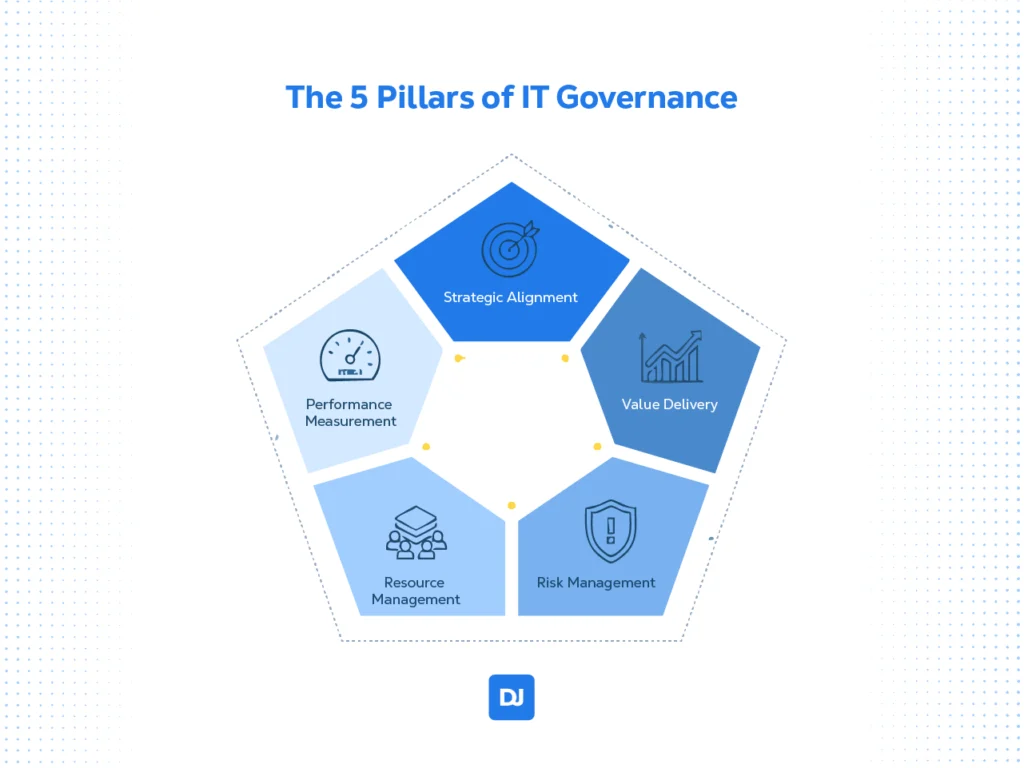
IT Governance operates on five principles to ensure that technology is a strategic differentiator for the company. The five main pillars are:
1. Strategic Alignment
This principle ensures that the IT strategy supports the overall business objectives and goals. Investment in technology should drive the organization’s success. The I&T’s goals support the company’s goals.
2. Value Delivery
IT investments and projects must deliver the promised benefits and value to the business, optimizing Return on Investment (ROI).
3. Risk Management
Identifying, assessing, and mitigating risks associated with the use, operation, and security of IT (such as system failures, cyberattacks, and data loss).
4. Resource Management
Optimizing the use of IT resources (human, financial, and technological) to ensure they are applied effectively and efficiently.
5. Performance Measurement
Monitoring and evaluating IT performance (through KPIs) to ensure that it is achieving objectives and complying with established policies.
Benefits of IT Governance
Considering the pillars, the benefits of IT Governance enable both cost reduction and better IT usage. IT resources are no longer mere support, but an asset that drives both innovation and business strategy effectiveness. In essence, IT becomes a competitive advantage and is the backbone of a successful distributed workforce.
Better Decision-Making
IT Governance provides a structured framework for evaluating, prioritizing, and investing in technology, ensuring that resources are allocated to initiatives that generate the highest Return on Investment (ROI).
Innovation and Competitiveness
With structured processes and optimized resources, the company can adopt new technologies more quickly and safely, driving Digital Transformation and maintaining market competitiveness.
Risk Mitigation
Proper IT Governance proactively identifies, assesses, and addresses IT-related risks (such as system failures, downtime, and cyberattacks), ensuring business continuity and reliability.
Enhanced Information Security
A good IT Governance establishes rigorous security policies and controls to protect critical and sensitive data, minimizing the likelihood of leaks or breaches.
Compliance
IT Governance ensures that data complies with laws, regulations, and industry standards (such as GDPR in Europe or the California Consumer Privacy Act in the U.S.), avoiding fines and reputational damage.
Cost Reduction and Resource Optimization
IT Governance allows resource optimization (hardware, software, and personnel) by eliminating redundancies, avoiding unnecessary investments, and reducing costs associated with rework.
Operational Efficiency and Increased Productivity
Building IT governance promotes process standardization and task automation. It results in greater operational efficiency and increased productivity. It also enables more effective management of IT services and incidents, improving service quality and satisfaction for both internal users and customers.
Better Accountability, Communication, and Trust
It establishes who is responsible for each decision and action in the IT area, promoting accountability at all hierarchical levels. Finally, IT governance facilitates communication between the IT area and the rest of the business, translating technical requirements into value. It also raises transparency in operations and data security, strengthening the stakeholders’ trust in the company.
Why IT Governance Matters for Remote Teams
IT Governance connects directly to the challenges of remote work, such as Shadow IT, BYOD, and decentralized data. Keeping it away from your company would miss a critical opportunity to solve big business problems. Remote work changes the IT risk landscape, and IT Governance is the framework used to manage and mitigate those new risks while still achieving business objectives.
1. Shadow IT (Unauthorized Systems)
Shadow IT (employees using unapproved applications or cloud services) explodes in remote environments because IT teams lose visibility and employees seek convenient, fast solutions.
For instance, you can use IT Procurement Policies to streamline the process for employees to request and for IT to vet new tools quickly, reducing the need for ‘shadow’ solutions. Your company can also establish Acceptable Use Polices (AUP). AUPs clearly define which cloud services and software are approved (or banned) for company data, making unapproved usage a governance issue.
And for risk management, IT governance can monitor the use of Cloud Access Security Brokers (CASBs) and other tools to identify unapproved cloud services and bring them under IT oversight.
| Governance Domain | Remote Work Focus | IT Governance Solution |
| Value Delivery | Ensuring all IT spend adds value and is efficient. | IT Procurement Policy |
| Strategic Alignment | Ensuring IT supports overall business goals (e.g., security, compliance). | Acceptable Use Policy (AUP) |
| Risk Management | Identifying and mitigating risks from unknown systems. | Discovery & Monitoring Tools |
2. BYOD (Bring Your Own Device)
BYOD (employees using personal laptops, phones, and tablets for work) is a huge decentralization factor. IT loses control over the security posture of the endpoint accessing sensitive data.
A potential IT Governance solution is to define minimum security standards. For example: enforce encryption and usage of up-to-date OS, mandatory MDM/MAM agent installation, and legal clauses for remote wipe.
To maintain the security and availability of systems, governance can require technical controls, such as Multi-Factor Authentication (MFA) and endpoint detection/response (EDR), on any device accessing corporate resources.
And to keep compliance even in a BYOD environment, the governance can ensure that devices meet compliance requirements before access is granted, mitigating the risk of malware or data leakage.
| Governance Domain | Remote Work Focus | IT Governance Solution |
| Resource Management | Optimizing use of personal vs. company-owned assets. | Formal BYOD Policy |
| Performance Management | Maintaining the security and availability of systems. | Device Security Controls |
| Risk Management | Protecting company data from device loss or compromise. | Compliance Checks in Personal Devices Access |
3. Decentralized Data and Compliance
Data, which used to be centrally stored on office servers, is now scattered across home computers, personal cloud accounts, and various communication apps. It can be hard to track and follow all the data needed without strong governance to keep all resources mapped.
It’s no wonder that a subset of IT governance, Data Governance, is key to success in this situation. Data governance can create polices for sensitive data, making it stored only in approved, secure, and encrypted cloud locations (e.g., OneDrive, corporate SharePoint, on-prem Data Centers) and never locally on a personal device.
For example, IT governance can also require logging and auditing of all remote data access and transfer activities to ensure compliance with regulators and detect anomalous accesses. Moreover, it can also establish policies for secure and regular backups of all corporate data, even that generated remotely, to ensure business continuity, manage risks, and ensure rapid disaster recovery.
| Governance Domain | Remote Work Focus | IT Governance Solution |
| Data Governance (Subset of IT Gov) | Ensuring data integrity, privacy, and compliance (e.g., GDPR, CCPA). | Data Classification and Storage Policy |
| Compliance and Audit | Adhering to legal and regulatory requirements. | Monitoring and Audit Logs |
| Risk Management | Protecting data confidentiality and availability. | Data Backup and Recovery Policy |
IT Governance vs. IT Management: What’s the Difference?
IT Governance ensures the I&T is strategically aligned with, and actively drives, corporate objectives, goals, and performance indicators through continuous evaluation and monitoring. Meanwhile, the IT management team seeks efficiency and effectiveness, reaching IT governance’s set expectations.
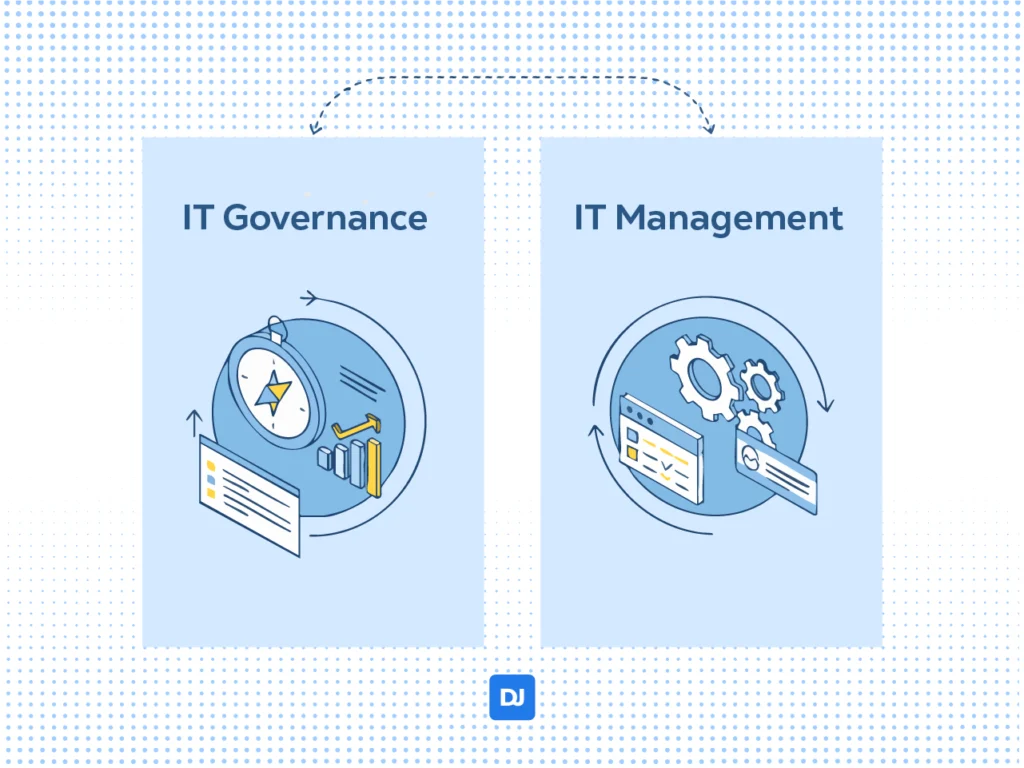
In fact, there is no IT Governance without IT Management; they work together in the same company to drive the company’s OKRs.
| Feature | IT Governance | IT Management |
| Primary Focus | Strategic: Aligning IT with the overall business strategy and goals. | Operational/Tactical: Planning, building, running, and monitoring IT services. |
| Key Questions | What should IT achieve? Why are we investing in this technology? | How will we deliver the IT service? When will a project be completed? |
| Time Horizon | Long-term (Future-oriented, 3-5+ years strategic planning). | Short-term (Day-to-day operations and near-term project execution). |
| Level | Senior/Executive Level (Ensures IT investments deliver value). | Managerial/Operational Level (Ensures effective service delivery). |
| Responsibilities | Directing & Monitoring (EDM – COBIT framework): Setting policies, strategic decision-making, risk tolerance, and value creation. | Planning, Building, Running (PBRM – COBIT framework): Managing infrastructure, applications, service desk, and daily tasks. |
| Accountability | Accountable for Alignment and Value: Board of Directors and senior executives (e.g., CIO/CEO). | Accountable for Service Delivery and Efficiency: IT managers and operational staff. |
| Key Metrics | Return on IT Investment (ROIT), Business-IT Alignment Score, Risk & Compliance Reports. | System Uptime, Incident Resolution Time, Service Level Agreement (SLA) adherence, and User Satisfaction. |
| Related Frameworks | COBIT, ISO/IEC 38500 | ITIL (IT Service Management), DevOps, Agile |
Difference between IT Governance and Corporate Governance
The relationship between Corporate Governance and IT Governance is one of parent and subset, or whole and part. Corporate Governance is the overarching framework that guides the entire organization, while IT Governance is the specific mechanism for directing and controlling the IT resources within that framework.
Think of the relationship as Parent and Child. Corporate Governance asks, “Are we doing the right things for the entire company?”, while IT Governance asks, “Are we doing the right things with our technology to support the company’s goals?”
| Feature | Corporate Governance (The Whole) | IT Governance (The Part/Subset) |
| Scope | Entire Organization: Encompasses all functions, including finance, legal, HR, operations, and IT. | Specific to IT: Focuses solely on the direction, control, and performance of Information Technology. |
| Primary Focus | Overall Organizational Success: Creating long-term value, protecting stakeholder interests, ensuring legal/ethical compliance. | IT Value and Risk: Ensuring IT sustains and extends the organization’s strategies and objectives while managing IT-related risks. |
| Decision-Making | Strategic decisions affecting the entire business | Strategic decisions affecting IT resources |
| Governing Body | Board of Directors, Shareholders, CEO, and Senior Executives. | IT Steering Committee/Governance Body, CIO, and senior business executives (reports to the Board of Directors). |
| Key Objectives | 1. Transparency | 1. Strategic Alignment |
| 2. Accountability | 2. Value Delivery (from IT investments) | |
| 3. Fairness (to stakeholders) | 3. Risk Management (IT-specific risks) | |
| 4. Corporate Responsibility | 4. Resource Management (IT resources) | |
| 5. Performance Measurement | ||
| Related Frameworks | OECD Principles of Corporate Governance, Sarbanes-Oxley Act (SOX) | COBIT, ISO/IEC 38500 (Specifically for IT Governance) |
| Relationship | The Parent: Provides the fundamental rules and objectives for the entire company. | The Child/Enabler: Must align with and support the Parent’s (Corporate Governance) overall goals and risk tolerance. |
So is IT Governance about IT Department Integration?
Not quite. The term “IT governance” used to be associated with governance within the IT department. However, the more recent view in COBIT emphasizes “Information and Technology” (I&T). In short, governance is no longer just an “IT department”, but rather corporate governance.
Technology and information are no longer centralized solely within the IT department. I&T (or IT) resides outside of traditional IT departments. Nowadays, all business areas within a company utilize their own technologies, systems, and information for decision-making, such as pen drives and cloud computing.
All departments in your organization have their own technology. Therefore, this distribution of technology and information is an enterprise-level challenge. There are often squads or agile teams working within business areas; all these teams need IT governance’s guidance and orientation on how to use their technology to generate true value, using it as a strategic asset rather than a handy support to perform tasks.
International Law: Basel Accord and SOX Act
IT Governance specialists need to be familiar with these standards to align IT strategies and investments with international laws compliance and risk management. Non-compliance may result in sanctions against the company and loss of market credibility.
It’s worth noting that IT Governance is the system that a financial institution (or a publicly traded company) uses to demonstrate to regulators (and to its own board) its required capital reserves. Therefore, it’s the IT’s duty to effectively identify, measure, and mitigate the company’s exposure to technology-related operational risk.
For any modern financial institution, the majority of “systems” and “processes” are driven by IT. Therefore, IT-related failures are the single largest source of potential operational risk loss for a bank.
Basel Accord
In short, the Basel Accord demands that financial institutions keep capital reserves proportional to the risks they assume (credit, market, and operational) to guarantee the global financial system’s stability.
Operational risk, as defined by Basel, is “the risk of loss resulting from inadequate or failed internal processes, people and systems, or from external events.”
This creates a direct, regulatory imperative for robust IT Governance:
| Basel Requirement | IT-Related Operational Risk | IT Governance Response |
| Minimize Operational Failures | System outages, data corruption, processing errors, flawed models. | Value Delivery & Performance Measurement: IT Governance must ensure high availability, data quality, and strong Service Level Agreements (SLAs). |
| Protect from External Events | Cyberattacks, external fraud, data breaches, unauthorized access. | Risk Management & Enhanced Information Security: Governance establishes security policies, directs investments in cyber defenses, and enforces mandatory controls (e.g., access management, patch management). |
| Ensure Internal Process Integrity | Uncontrolled changes, human error, and segregation of duties failures. | Resource Management & Accountability: Governance mandates frameworks (like COBIT’s control objectives) to enforce rigorous change management, incident response, and defined roles and responsibilities. |
SOX Act
The Sarbanes-Oxley Act imposes rigorous internal controls to ensure the accuracy, reliability, and transparency of publicly traded companies’ financial reports and holds their executives accountable for failures.
IT Governance is the formal structure that directs the implementation and operation of these mandatory ITGCs. The key governance pillars (Risk Management and Compliance) are activated by SOX:
| SOX Compliance Requirement | IT Governance Pillar Enforced | Concrete IT Control (ITGC) |
| Section 302/404: CEO/CFO must certify financial statement accuracy and control effectiveness. | Accountability & Compliance: Executives must prove that systems generate accurate data. | Access Controls: Ensuring only authorized personnel can post or modify financial data in the ERP/GL system (Segregation of Duties). |
| Section 404: Management must document and test internal controls over financial systems. | Performance Measurement & Strategic Alignment: Mandating the use of a framework (like COBIT) to test controls. | Change Management: Requiring all changes to financial applications (code, configuration) to be documented, tested, and approved by both IT and the business/finance owner. |
| Section 802: Requires retention of financial records and documents for a minimum of seven years. | Resource Management & Risk Management: Directing the policies for data retention, backups, and data security. | Data Backup & Disaster Recovery: Regularly backing up financial data and testing the restoration process to prove data availability and integrity. |
The failure of a single IT General Control (e.g., an unlogged change to the general ledger system) can lead to a material weakness in financial reporting, potentially causing fines, reputational damage, and a loss of investor confidence.
Top 3 IT Governance Frameworks
A company that applies IT Governance in its I&T utilizes COBIT to establish the level of control, alignment, and metrics that IT must meet, and then uses ITIL to design and execute the detailed processes (such as Service Desk, Change Management, and Problem Management) that will satisfy these governance requirements. Everything must be aligned with the ISO/IEC 38500 standards.
ISO/IEC 38500
ISO/IEC 38500 is an international standard for corporate governance of information technology. The standard provides a framework of principles and guidelines for governing bodies (such as the Board of Directors, CEOs, etc.) to evaluate, direct, and monitor the use of IT in their organizations. The main goal is for IT to contribute positively to the company’s performance, managing risks effectively, and aligning itself with business objectives.
Six Principles (EDM)
The standard establishes six principles of good IT governance. Senior management must Evaluate, Direct, and Monitor (“EDM”) the use of IT based on these principles:
- Responsibility: Individuals and groups understand and accept their responsibilities in the supply and demand for IT.
- Strategy: Business strategy must consider current and future IT capabilities.
- Acquisition: IT acquisitions are made for valid reasons, based on appropriate analyses, with clear and transparent decisions.
- Performance: IT must meet the business needs.
- Compliance: A company’s I&T complies with all applicable laws, regulations, and contractual obligations.
- Human Behavior: IT policies and practices demonstrate respect for Human Behavior (people’s needs and involvement). The IT governance challenge is more organizational and cultural than technical.
COBIT
COBIT is an IT Governance and Enterprise Management framework created by ISACA (Information Systems Audit and Control Association). Its main focus is on Governance, Control, and Strategic Alignment.
COBIT provides a comprehensive model to help companies achieve their IT objectives and ensure that technology aligns with business objectives.
This framework is based on five key principles, which establish guidelines for good IT governance. It also uses a system of governance and management objectives that cover the company end-to-end (E2E).
Governance Domain
Evaluate, Direct, and Monitor (EDM) is the sole governance domain. It focuses on evaluating strategic options, directing senior management on strategic choices, and monitoring the strategy’s achievement to ensure IT is aligned with enterprise objectives and delivers value.
Management Domains
- Align, Plan, and Organize (APO): APO deals with the overall strategy for enterprise IT. It involves planning and organizing resources, policies, and risk management to align with business goals.
- Build, Acquire, and Implement (BAI): BAI addresses the creation and deployment of IT solutions. It includes building, acquiring, and integrating new systems and services into the business.
- Deliver, Service, and Support (DSS): DSS focuses on the operational running of IT services after they have been deployed. This domain ensures services meet agreed-upon levels, manages operations, and provides support and security.
- Monitor, Evaluate, and Assess (MEA): MEA emphasizes continuous improvement by monitoring IT performance, evaluating controls, and assessing compliance with internal and external requirements.
ITIL
ITIL is a set of detailed practices for IT Service Management (ITSM) rather than IT Governance, focused on aligning IT services with business needs and continuous improvement. That being said, IT Governance and IT Management are tied, and it’s necessary to be at least familiar with both COBIT and ITIL.
ITIL provides a framework of processes and functions for managing IT service delivery, from strategy to operation and continuous improvement. The goal is to optimize service delivery, increase customer satisfaction, reduce incidents, and manage infrastructure.
ITIL 4 focuses on Value Creation and utilizes the Service Value System (SVS), which includes:
- Guiding Principles: Recommendations that guide the business in all circumstances (e.g., Focus on Value, Collaborate, and Promote Visibility).
- Governance: Where COBIT connects with ITIL.
- Service Value Chain: An operational model that describes the key activities necessary to meet demand and facilitate value creation through the delivery and management of products and services.
- Practices: A set of organizational resources designed to perform a task or achieve an objective (e.g., Incident Management, Change Management, Service Level Management).
- Continuous Improvement.
The Talent Gap: Who Runs IT Governance?
Implementing these frameworks requires specialized talent. It is not just about hiring a coder; it is about hiring a leader with governance experience.
Executive Level (The Architects)
- CIO (Chief Information Officer): Accountable to the Board for the effectiveness of the framework.
- IT Steering Committee: A mix of business and IT leaders who make investment decisions.
Operational Level (The Builders)
- IT Governance Manager: The dedicated role responsible for documenting policies, mapping goals, and tracking KPIs.
- IT Auditor: The professional who tests the controls (using COBIT) to ensure they actually work.
- Compliance Officer: Ensures the tech stack aligns with GDPR, HIPAA, or SOX.
In summary, while “IT Governance Manager” or “IT Governance Analyst” are the most literal titles, the function of IT Governance is a shared responsibility spanning from the Boardroom (Oversight) to the CIO (Accountability) and the IT Auditor (Assessment).
Conclusion
IT Governance is not a technical checklist; it is the strategic compass that guides companies to extract the best value from their technological assets. A company can transform its IT operations from a business support into a powerful engine for competitive advantage.
Stop treating IT as a cost, and start governing it as your most valuable asset.
Are you looking for the leaders who can secure your business infrastructure? At DistantJob, we specialize in headhunting the top 5% of global IT talent. From Governance Managers to Senior Security Engineers, we find the experts who fit your culture and your stack.