Most companies hire engineers in one of three ways: locally, halfway across the world, or somewhere in between. That third option is nearshore software development, and for a lot of US and European companies, it has quietly become the default model for product engineering.
The setup is straightforward. A US company hires developers in Latin America. A German or UK company hires developers in Eastern Europe or Portugal. The team works in the same business hours, runs live meetings in English, and costs less than an in-house hire without the friction of a 10 to 12 hour time zone gap.
The benefits of nearshoring are many. It is 46 percent cheaper than onshore staffing (good news for North American companies, 80 percent of which work with nearshore company partners).
At DistantJob, we’ve spent 18 years placing remote developers, including tens of LATAM placements in the past 12 months. The advice here is shaped by what works on real hiring calls, not by what looks good in a sales deck.
Let’s dive in.
What is nearshore software development?
Nearshore software development is the practice of hiring software engineers in countries that are geographically and culturally close to the hiring company, usually within two to four time zones. For US clients this typically means Latin America. For European clients it usually means Eastern or Southern Europe. The model gives companies lower costs than local hiring with the working-hours overlap that offshore models lack.
The defining feature isn’t geography on its own. It’s overlap. A nearshore engineer can join your daily standup at the time you actually run it, push code while your product manager is online, and ship a fix the same day a problem comes up.
Onshore means hiring in your own country. Offshore usually means hiring in a region eight or more hours away (typically India, the Philippines, or parts of Southeast Asia for US companies). Nearshore sits between them.
Quick comparison
| Model | Example for US client | Time zone overlap | Typical senior rate range | English level |
|---|---|---|---|---|
| Onshore | US-based hires | Full | $100 to $200/hr | Native |
| Nearshore | Argentina, Mexico, Brazil | 4 to 8 hrs/day | $45 to $80/hr | Working proficiency, often high |
| Offshore | India, Philippines | 0 to 3 hrs/day | $25 to $55/hr | Variable |
Rates above are approximate ranges for senior engineers via agencies in 2025 to 2026, drawn from industry salary surveys. They vary with stack, seniority, and engagement model.
Nearshore vs offshore vs onshore: full comparison
The three models trade off the same three things in different proportions: cost, working-hours overlap, and coordination friction.
Detailed comparison
| Factor | Onshore | Nearshore | Offshore |
|---|---|---|---|
| Hourly cost (senior) | High | Mid | Low |
| Time zone overlap | Full | 4 to 8 hrs/day | 0 to 3 hrs/day |
| Live collaboration | Easy | Easy | Hard |
| Cultural alignment | Highest | High | Variable |
| Travel for in-person meetings | Same-day | Same-day or one flight | Multi-leg trip |
| Talent pool size | Smaller | Large | Largest |
| Typical contract model | FTE | FTE or contract | Contract or BPO |
| Best for | Sensitive IP, regulated work | Core product engineering | Maintenance, well-scoped backlogs |
When onshore makes sense
You’re hiring for highly regulated work, like US defense, classified healthcare data, or certain financial services where vendor location is non-negotiable. You need someone in your office. The premium is part of the cost of the work.
When nearshore makes sense
You’re building or scaling a product team. You want engineers who can attend live design reviews, pair on incidents, and talk to product managers in real time. You’d hire onshore if it weren’t for the budget.
When offshore makes sense
You have well-scoped, queue-able work: a maintenance backlog, a support tier, a structured QA pipeline. The work doesn’t depend on live conversations. The cost saving justifies the friction.
Most product companies that try offshore for core engineering eventually move to nearshore. Not because offshore engineers can’t do the work, but because the coordination cost is higher than the rate saving once you factor in PM time, missed deadlines, and async loops on decisions that should take five minutes.
For a deeper rate comparison between the two models, see our breakdown of offshore developer rates.
Why companies choose nearshore software development
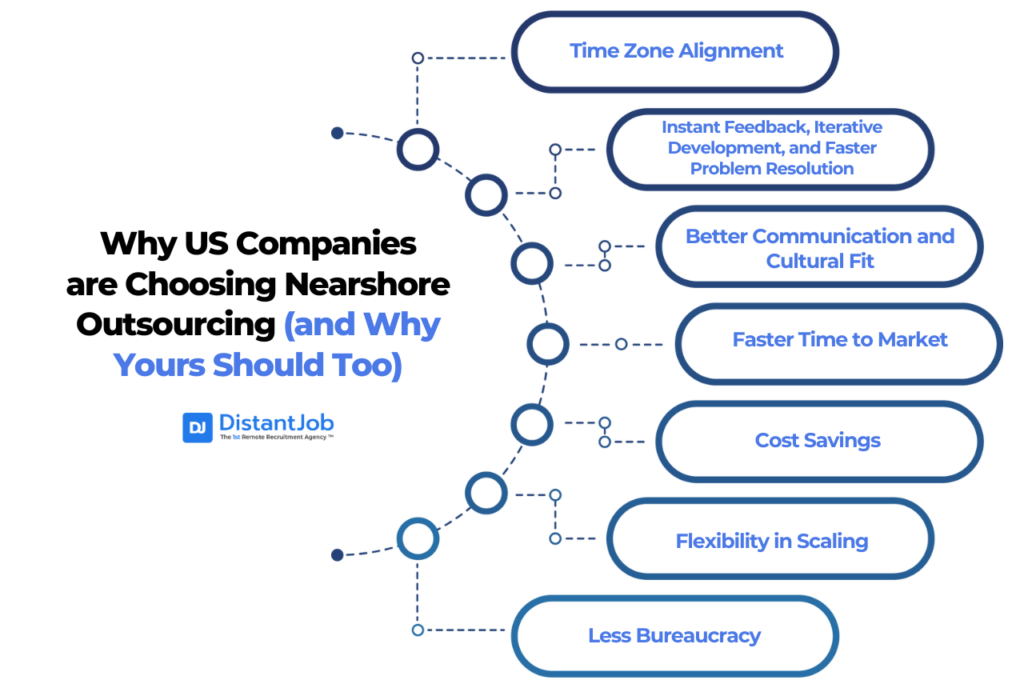
Key benefits include overlapping time zones, English-speaking talent, flexible team scaling, and simplified legal frameworks compared to hiring across distant regions. For US startups and mid-sized companies, nearshoring is the most cost-effective path to a high-functioning remote engineering team.
Time zone overlap is the real reason
Every other benefit follows from this one. When your engineer works between 9am and 5pm and yours does too, you can run a normal product team. Standups happen live. Design reviews happen live. When prod breaks at 3pm your time, someone is awake.
Compare that to a 10 to 12 hour gap. A typical decision loop becomes: question Monday afternoon, answer Tuesday morning your time, clarification Tuesday afternoon, resolution Wednesday morning. What should have been a 15-minute Slack thread eats two days.
Instant Feedback, Iterative Development, and Faster Problem Resolution
This is a clear result from the previous one. When everyone is working basically the same business hours, there are little to no delays in communication. And what happens, then, is you can get feedback instantly, solve problems that may arise faster, and make sure your development is iterative.
Cultural and language proximity
LATAM and Eastern European engineers tend to share more reference points with US and EU teams than fully offshore hires: same software stacks, same agile vocabulary, same expectations about how meetings run. English is widely spoken at a working level, particularly in tech hubs like Buenos Aires, São Paulo, Mexico City, Warsaw, Bucharest, and Lisbon.
This isn’t about engineers being “more like you.” It’s about coordination friction being lower, which matters far more than people expect.
Travel feasibility
For US clients, most LATAM capitals are a single direct flight. Buenos Aires, Mexico City, São Paulo, Bogotá, San José: all reachable in a normal travel day. For European clients, Eastern European capitals are a one to three hour flight from London, Berlin, or Paris.
Quarterly onsites are realistic. So is flying a candidate in for a final interview round.
Cost vs onshore
A senior US developer typically costs $150,000 to $220,000 fully loaded. The same seniority hired through a nearshore agency or recruiter usually lands in the $80,000 to $130,000 range, depending on country and stack.
That’s not a 10 percent saving. It’s enough to hire two engineers for the budget of one, while still paying the nearshore engineer well above their local market rate.
Regulatory and data residency
For European companies, hiring in EU countries (Poland, Romania, Portugal) keeps data inside EU jurisdiction and avoids the GDPR friction of US- or Asia-based vendors. For US companies hiring in LATAM, the regulatory picture is generally simpler than offshore: stable trade relationships, well-understood contractor structures, and IP law that maps closely to US norms.
Where do nearshore developers come from?
The answer depends on where you’re hiring from.
For US clients: Latin America
| Country | Talent depth | English proficiency | Typical senior rate (agency) | US time zone overlap |
|---|---|---|---|---|
| Argentina | Very deep, especially senior | High in tech | $50 to $80/hr | Full overlap with EST/CST |
| Brazil | Largest LATAM pool | Mid to high in tech hubs | $45 to $75/hr | Full overlap with EST |
| Mexico | Deep, near-shore advantage | High, especially Mexico City | $50 to $80/hr | Full overlap |
| Colombia | Growing, strong mid-level | High | $40 to $70/hr | Full overlap with EST |
| Costa Rica | Smaller pool, very strong English | Very high | $55 to $85/hr | Full overlap |
| Uruguay | Small pool, very strong English | Very high | $50 to $80/hr | Full overlap with EST |
Argentina and Uruguay are particular standouts for senior engineering talent, due to a long tradition of public computer science education and a tech labor market that has been exporting engineers for over a decade. Chile and Peru round out the region for specific stacks, though the pools are thinner.
For European clients: Eastern and Southern Europe
| Country | Talent depth | English proficiency | Typical senior rate | EU time zone overlap |
|---|---|---|---|---|
| Poland | Very deep | High | €50 to €85/hr | Same time zone |
| Romania | Deep | High | €40 to €70/hr | Same time zone (CET/EET) |
| Ukraine | Deep, with continuity caveats | High | €35 to €65/hr | Same time zone |
| Portugal | Mid | Very high | €45 to €75/hr | One hour from CET |
| Czech Republic | Mid | High | €50 to €80/hr | Same time zone |
| Bulgaria | Growing | High | €35 to €60/hr | Same time zone |
Ukraine remains a major source of engineering talent, but the war has created real continuity considerations. Many companies now split risk by hiring across two or three countries rather than concentrating in one.
At DistantJob we’ve sourced engineers from LATAM countries in the past 24 months. The “right” country depends less on average rates and more on the specific stack and seniority you need. The market for senior Rust engineers in Buenos Aires looks nothing like the market for senior data engineers in Mexico City.
How much does nearshore software development cost?
Three numbers matter: the engineer’s pay, the agency or recruiter fee, and the total cost to your business.
Typical agency rates by country (senior engineer, 2026)
| Country | Hourly | Annual full-time |
|---|---|---|
| Argentina | $50 to $80 | $90k to $140k |
| Brazil | $45 to $75 | $80k to $130k |
| Mexico | $50 to $80 | $90k to $140k |
| Colombia | $40 to $70 | $75k to $120k |
| Costa Rica | $55 to $85 | $100k to $150k |
| Poland | €50 to €85 | €90k to €155k |
| Romania | €40 to €70 | €75k to €130k |
| Portugal | €45 to €75 | €80k to €135k |
These are typical ranges for senior engineers (5+ years, in-demand stacks) hired through agencies or staffing firms. Junior and mid-level rates are 30 to 50 percent lower. Specialised roles (ML engineers, senior DevOps, embedded systems) sit 15 to 30 percent higher.
Agency fees vs direct hiring
Two pricing models dominate, and the difference matters for total cost.
Platform markup model. The agency charges the client an hourly rate (say $80/hr), pays the engineer a fraction of that (say $45/hr), and keeps the spread for as long as the engagement runs. The longer the engineer stays, the more the agency makes.
Finder’s fee model. The agency does the search, places the engineer, and charges a one-time fee (typically 15 to 25 percent of first-year salary). After that the engineer is on your books or contracted directly. The agency makes nothing from the ongoing engagement.
The first model is friendlier to short-term staff augmentation. The second is friendlier to long-term hires. Over a two- or three-year horizon, the finder’s fee almost always costs less.
Nearshore staff augmentation vs nearshore agencies vs bespoke recruitment
Three different things are often called by the same names. They’re not interchangeable.
| Model | What you get | Speed | Cost shape | Best for |
|---|---|---|---|---|
| Staff augmentation | Pre-vetted engineers from a bench, billed hourly | Fast (days to weeks) | Ongoing markup | Short engagements, bursts, fixed-scope work |
| Nearshore agency / dev shop | A team or partial team that owns part of a project | Fast | Ongoing markup, sometimes fixed-bid | Outsourced product or feature builds |
| Bespoke recruitment | Custom search per role, engineer joins your team direct | Slower (3 to 8 weeks) | One-time fee or ongoing fees for HR services | Long-term hires, niche stacks, culture-sensitive roles |
Staff augmentation is fastest because the engineer already exists on a bench. The trade-off: you pick from who’s available, not who’s best for the role. For generic stacks (React, Node, standard backend) that’s often fine. For niche stacks (Rust, Elixir, embedded, ML infrastructure) the bench rarely contains the engineer you actually need.
Bespoke recruitment is slower because the search is custom: write the job description, source against it, screen, technically assess, present a shortlist. But for a senior hire you’ll work with for three years, two extra weeks at the start is irrelevant.
The honest framing: pick staff augmentation when speed is the constraint and the role is standard. Pick bespoke recruitment when fit is the constraint and the role is specialised or senior.
For a closer look at how this stacks up against vetted-marketplace platforms, see our comparison of Toptal alternatives.
How to choose a nearshore software development partner
A 7-point checklist, in order of how often it actually matters.
1. Engagement model fit. Are you trying to hire long-term or staff a project? Make sure the partner’s pricing model rewards the same outcome you want.
2. Technical screening depth. Ask exactly how engineers are assessed. “We have a coding test” is not enough. Look for live technical interviews with senior engineers, not just automated tests.
3. Country and stack track record. A partner that has placed 200 React developers from Mexico knows the market. A partner that has placed three is guessing. Ask for specifics on the stack and country you actually need.
4. Replacement guarantee. What happens if the hire doesn’t work out at 60 days? A 90-day replacement guarantee is the baseline you should expect. No guarantee, or a heavily caveated one, is a red flag.
5. Payment and contract structure. Will the engineer be your employee, your contractor, or the agency’s contractor billed to you? Each has different tax, IP, and management implications.
6. Pricing transparency. Ask for a full cost breakdown. If a partner won’t tell you what the engineer is being paid versus what the markup is, you’re being managed.
7. Real references. Not “case studies.” Two phone numbers of clients who hired through them in the last 12 months in your stack. A confident partner provides this without friction.
Red flags
- Promising senior engineers in your stack at junior rates.
- A “bench” of 500+ engineers across every imaginable technology.
- No live technical interview as part of screening.
- Vague replacement guarantees.
- Inability to name specific clients on a call.
How DistantJob delivers nearshore developers
We run a custom search for every role. There is no bench. Every engineer we present has been sourced and screened specifically against your job description, your stack, and your team.
The screening process has seven stages: profile review, English assessment, live technical interview with a senior engineer in the same stack, take-home or pair-programming exercise, behavioural interview, reference checks, and final shortlist review with the client. Engineers who don’t pass each stage don’t move forward.
Median time from kickoff to first qualified shortlist is {{TIME_TO_FILL}} days. Most clients hire from the first or second shortlist.
Every placement comes with a 90-day replacement guarantee. If the engineer doesn’t work out for any reason in the first 90 days, we re-run the search at no additional fee.
If you’re hiring for a specific stack, our tech-specific hiring pages cover the search process and typical candidate profile for each one.
Where to start
The companies that get the most out of nearshore are the ones that treat it as hiring, not outsourcing. They write a real job description. They run a real interview process. They pick a partner whose incentives match theirs. The engineer joins the team and works on the same Jira board as everyone else.
The rest is execution.
If you want to start a search, tell us what you’re hiring for. We’ll come back within a business day with a sense of timeline, country options, and rate range for your specific role.
FAQ
Nearshore software development means hiring software engineers in countries that are geographically close to your own, typically within two to four time zones. For US companies it usually refers to Latin America. For Western European companies it usually refers to Eastern or Southern Europe. The defining feature is overlap in working hours, which lets the engineer participate in live meetings and same-day decision cycles.
Nearshore engineers are within a few time zones of the hiring company and overlap with the client’s working day. Offshore engineers typically work eight or more hours away, with little or no live overlap. Offshore is usually cheaper. Nearshore is usually faster to coordinate with and produces less rework, especially for product engineering where decisions need to happen quickly and live.
For US companies, top nearshore software development countries often include Mexico, Colombia, and Argentina. These markets offer strong developer talent, good time-zone overlap, and cost savings.
Hiring a nearshore developer usually takes 2 to 4 weeks through a specialized staffing or recruitment partner. Timing depends on the role, tech stack, and candidate availability.
A nearshore engineer is a software developer working for a client in a nearby country, typically within a few time zones. The engineer is usually employed locally or contracted through an agency, but works full-time on the client’s team, attending the client’s meetings and using the client’s tools. Functionally they operate as a remote member of the client’s engineering team.
No. Outsourcing usually means a vendor manages project delivery. Nearshore development often means hiring developers in nearby countries to work directly inside your team and processes.