There is a reason why companies are shifting from hiring local in-house developers to IT staff augmentation. While an in-house hiring solution can provide a long-term cultural continuity, it now carries a stability tax that can inflate your company’s burn rate by up to 50% over the base salary. But the cost is not the only factor you should consider.
Most people decide what type to hire based on cost. And cost is a big issue, but it’s not the only one. A $4000/month augmented employee with a 2-week ramp-up can be less costly than an employee that costs $6K per month but takes 3 months to hire, train, and fully ramp up. On the other hand, when you want to build knowledge on your code, there could be huge value in having an in-house employee who stays with you for three years vs. rotating augmented workers. So, it’s not necessarily about which type of employee is cheaper, but which type in your current stage will provide you more value for your money.
The following analysis breaks down the real-world financial and operational impact of these two models in the current 2026 market.
How Much Does an In-House Developer Cost?
In the U.S., a software engineer’s median annual salary peaked at $133,080 in May 2024 (according to the BLS), driven by the intense demand for engineers capable of integrating AI and machine learning into core business products. It’s a 10.7% increase for certain high-tier roles compared to previous cycles.
In Silicon Valley-adjacent markets (notably the San Francisco Bay Area), the 2025 Bay Area salary guide from DeWinter reports that Software Developers have even higher compensation. It shows a 1st quartile of $159,234, a mean of $174,514, and a 3rd quartile of $189,304.
In the meantime, Level.fyi reports a median of US$190,000/year for software engineers in the United States.
Moreover, according to the Work Institute, in-house developers have 40% turnover in year one.
In 2025, the United States was the undisputed leader in software engineering compensation. While Switzerland was the highest-paying country in Europe, its salary for software engineers remains generally lower than in the United States, placing it second globally.
In other words, in-house developers are fine as long as you have the money and don’t have attrition inside your company.
The True Cost of In-House Hirings
Salary is the largest single line item, but it typically represents only 65–70% of what you’ll actually spend on a full-time employee in the United States. Here’s the full breakdown.
| Cost Category | % of Base Salary | Dollar Amount (at $155K base) | Notes |
| Base salary | 100% | $155,000 | — |
| Benefits (health, dental, vision, life, disability) | 18–25% | $27,900–$38,750 | BLS June 2025: benefits = 29.8% of total comp for private industry; insurance alone = ~7.5% of total comp |
| Employer payroll taxes (FICA, SUTA, FUTA) | 7.65–10% | $11,858–$15,500 | FICA = 7.65% (Social Security caps at $168,600 in 2025); SUTA varies by state |
| Retirement/401(k) match | 3–6% | $4,650–$9,300 | Average employer match is 4.7% per Fidelity |
| Paid time off (vacation, sick, holidays) | 8–12% | $12,400–$18,600 | BLS: paid leave ≈ 7.5% of total comp; tech companies trend higher with unlimited PTO policies |
| Equipment and software | 1–3% | $2,000–$5,000 | Laptop ($1,500–$3,000), monitors, licenses (JetBrains, GitHub, cloud sandboxes), home office stipend |
| Recruiting fees | 15–25% | $23,250–$38,750 | External recruiter one-time fee; internal recruiting cost averages $4,100–$7,600 per SHRM |
| Onboarding and training | 3–5% | $4,650–$7,750 | Mentor time, documentation, initial code review overhead, HR processing |
| TOTAL (Year 1) | 156–186% | $241,708–$288,650 | Recruiting fees are one-time; Year 2+ drops to ~138–161% |
| TOTAL (Year 2+) | 138–161% | $213,900–$249,550 | Ongoing costs without recruiting |
The Bureau of Labor Statistics reports that private industry employer costs averaged $45.65 per hour worked in June 2025, with wages accounting for 70.2% and benefits accounting for 29.8%.
For a developer earning $75/hr in wages, this implies a total employer cost of approximately $107/hr. The total is a 42.5% benefits load when accounting for all categories, including paid leave and supplemental pay. The 29.8% figure is the national average across all private industry; tech companies with generous benefits packages often land in the 35–45% range above base salary.
How Much Does IT Staff Augmentation Cost?
When shifting from local in-house hiring to global remote hiring models, the 2025 Remote Engineer Salary Report Salary Insights shows experience-level median salaries in Mexico (e.g., Mid: $77,565; Senior/Lead: $91,318) and Poland (e.g., Mid: $94,497; Senior/Lead: $110,737), alongside aditional employment cost percentages attributable to mandatory benefits and taxes (e.g., Mexico: 25%, Poland: 22%).
In contrast, the median annual salary for a U.S. remote software engineer remains $182,500, and in the San Francisco Bay Area, the median is $260,000.
Therefore, when you leverage global remote talent, offshore or nearshore, your costs decrease significantly.
The True Cost of IT Staff Augmentation
Staff augmentation agencies charge a bill rate to the client. It includes the developer’s pay, the agency’s operating costs (recruiting, payroll, compliance, insurance), and the agency’s margin. Understanding the markup structure is essential to comparing In-House vs Staff Augmentation fairly.
| Component | Typical Range | Notes |
| Developer pay | 50–65% of the bill rate | The developer’s actual take-home |
| Statutory costs (payroll taxes, insurance, compliance) | 12–18% of developer pay | FICA, workers’ comp, state unemployment, professional liability |
| Operating overhead (recruiting, account management, HR) | 10–18% of the bill rate | Vetting, onboarding support, and ongoing account management |
| Agency profit margin | 3–8% of the bill rate | Net margin after all costs |
| Total markup on developer pay | 25–75% | Varies by engagement type |
Markup ranges by engagement type:
| Engagement Type | Typical Markup Range | Why |
| Long-term staff augmentation (6+ months) | 25–40% | Lower risk, predictable revenue, higher retention |
| Short-term/project-based (< 6 months) | 40–60% | Higher recruiting cost per placement, less guaranteed revenue |
| Specialized/niche skills (AI, security, DevOps) | 50–75% | Smaller talent pool, longer search time, skill scarcity premium |
| Emergency/rush placement | 50–200% | Speed premium, often short-duration, high agency risk |
For a senior developer in Latin America earning $65,000 base, with a 35% long-term augmentation markup:
- Developer pay: $65,000/year
- Bill rate to client: $87,750/year ($65K × 1.35)
- Effective hourly bill rate: ~$42/hr
For comparison, here are typical bill rate ranges by region for senior developers through augmentation agencies:
| Region | Developer Pay Range | Client Bill Rate Range | Effective Annual Cost to Client |
| US-based | $120K–$180K | $85–$130/hr | $176,800–$270,400 |
| Latin America | $54K–$80K | $40–$70/hr | $83,200–$145,600 |
| Eastern Europe | $48K–$77K | $40–$65/hr | $83,200–$135,200 |
Break-Even Analysis: When Does In-House Become Cheaper?
This is the question everyone asks, and the answer depends on which region you’re comparing. Let’s model three scenarios.
Scenario 1: US In-House vs. LATAM Staff Augmentation
Assumptions:
- US in-house senior dev: $155K base salary
- Total Year 1 cost (in-house): $265,000 (including recruiting, benefits, and onboarding at ~171% of base)
- Total Year 2+ cost (in-house): $232,000/year (ongoing at ~150% of base)
- LATAM augmented senior dev: $65K base, 35% markup = $87,750/year to client
- Knowledge transfer cost per rotation: $5,000 (team time)
- Augmented dev turnover: 1 rotation per 18 months (average)
| Time Period | Cumulative In-House Cost | Cumulative Augmentation Cost | Augmentation Savings |
| Month 6 | $132,500 | $43,875 | $88,625 (67%) |
| Year 1 | $265,000 | $92,750 | $172,250 (65%) |
| Year 2 | $497,000 | $185,500 | $311,500 (63%) |
| Year 3 | $729,000 | $283,250 | $445,750 (61%) |
| Year 5 | $1,193,000 | $478,750 | $714,250 (60%) |
Break-even: Never. When comparing the US in-house to LATAM augmentation, the cost gap is so wide that in-house never catches up. Even after 5 years, the augmented model saves around 60%. The gap does narrow slightly over time as recurring in-house costs stabilize, but the absolute savings per year continue to increase.
Scenario 2: US In-House vs. US-Based Staff Augmentation
Assumptions:
- US in-house senior dev: $155K base, Year 1 total $265K, Year 2+ $232K
- US augmented senior dev: $155K base, 30% markup = $201,500/year to client
- Knowledge transfer cost per rotation: $5,000
- Augmented dev turnover: 1 rotation per 18 months
| Time Period | Cumulative In-House Cost | Cumulative Augmentation Cost | Delta |
| Month 6 | $132,500 | $100,750 | Augmentation saves $31,750 |
| Year 1 | $265,000 | $206,500 | Augmentation saves $58,500 |
| Year 1.5 | $381,000 | $307,250 | Augmentation saves $73,750 |
| Year 2 | $497,000 | $413,000 | Augmentation saves $84,000 |
| Year 3 | $729,000 | $619,500 | Augmentation saves $109,500 |
Break-even: Never at these rates either. This might seem counterintuitive, but the key insight is: in-house costs include benefits loading (29.8% per BLS), employer payroll taxes, equipment, PTO, and 401(k) match; all of which are already baked into the agency’s bill rate. The agency’s 30% markup is comparable to (or less than) the total benefits load the employer pays directly for in-house staff. In-house only wins if:
- The developer stays 3+ years (amortizing Year 1 recruiting costs), AND
- You negotiate augmentation markups below 20%, AND
- You don’t factor in the failed hire risk or vacancy cost.
Scenario 3: In-House (Any Region)
The break-even equation simplifies to:
In-house becomes cheaper when:
Amortized recruiting cost + benefits load < agency markup
Let’s express this differently. For Year 2+ (once recruiting is paid off), in-house costs are roughly 138–150% of base salary (benefits, taxes, PTO, equipment). Staff augmentation costs are 125–175% of the developer’s base salary (depending on markup).
| Agency Markup | Augmentation Effective Rate | In-House Effective Rate (Year 2+) | In-House Cheaper? |
| 25% | 125% of dev pay | 140–150% of dev pay | ❌ No; augmentation is cheaper |
| 30% | 130% | 140–150% | ❌ No; roughly break-even |
| 35% | 135% | 140–150% | ⚠️ Marginal; depends on the benefits level |
| 40% | 140% | 140–150% | ✅ Yes; starts breaking even at 12–18 months |
| 50% | 150% | 140–150% | ✅ Yes; in-house cheaper from Year 2 onward |
| 60%+ | 160%+ | 140–150% | ✅ Yes; in-house is clearly cheaper long-term |
The critical finding: If your augmentation agency charges more than ~35–40% markup, in-house hiring becomes cheaper after 12–18 months (once recruiting fees are amortized and the developer reaches full productivity). Below 35% markup, augmentation stays competitive indefinitely, especially when you factor in flexibility and failed-hire risk avoidance.
But the Real Question Isn’t Just Cost
The break-even analysis above compares apples to apples on pure cost. In practice, the decision involves at least three additional factors:
Speed to productivity: Augmentation agencies can typically place a vetted developer in 2–4 weeks. Internal hiring averages 41 days to offer acceptance, plus a 2–4 week notice period, plus onboarding. That’s 10–14 weeks from decision to first commit. If time-to-market matters, augmentation’s speed advantage has real dollar value.
Flexibility: If your needs change—project gets cancelled, pivot to a different tech stack, funding round falls through—terminating an augmented engagement is contractually simple (typically 2–4 weeks’ notice). Terminating an in-house employee involves severance, unemployment insurance impact, potential legal exposure, and team morale consequences.
Institutional knowledge: For core product work that requires deep domain expertise built over years, in-house developers create compounding value that augmented developers cannot replicate. The cost savings of augmentation are partially offset by the knowledge deficit created by rotation. For peripheral or project-based work, this factor matters less.
IT Staff Augmentation vs In-House Hiring: Key Differences
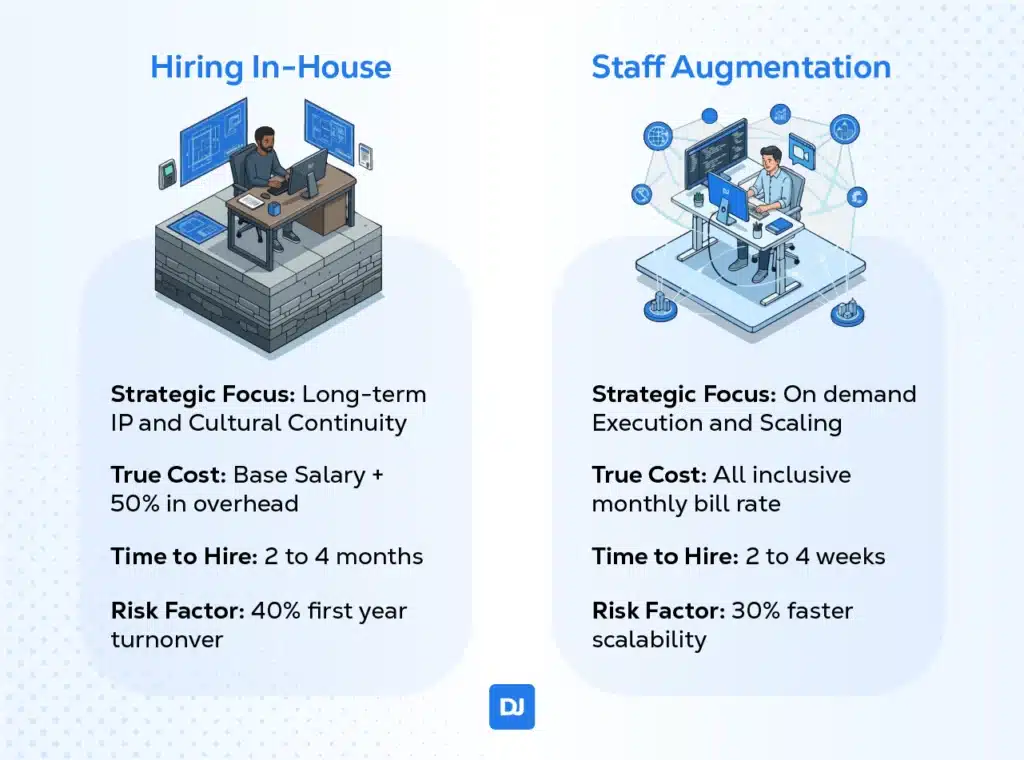
Here are the biggest differences between in-house and staff augmentation. There are many factors to consider, such as cost structure, time to hire, commitment length, IP control, and management overhead. Other important factors are: scalability, knowledge retention, legal complexity, cultural integration, and replacement risk.
| Factor | In-House Hiring | Staff Augmentation |
| Cost Structure | Fixed salaries + benefits + taxes + office + long-term overhead | Pay-as-you-go hourly or monthly rates, all-inclusive; lower long-term overhead |
| Time to Hire | Slower, from 30 to 90 days on average for technical roles | Faster, achieved within 2 to 4 weeks |
| Commitment Length | Long-term or permanent employment with ongoing financial liability | Flexible; project-based or rolling contracts, without long-term obligations |
| IP Control | Direct ownership; governed by employment agreements | Direct management control over daily tasks while experts remain, and employees of a third-party provider |
| Management Overhead | Significant internal burden for HR, payroll, performance reviews, and career development | Task-level management only; vendor handles recruitment, vetting, and administrative compliance |
| Scalability | Low; difficult to adjust team size quickly without legal risk or layoffs | High; companies report up to 30% faster scalability to meet fluctuating demand |
| Knowledge Retention | High; builds deep institutional memory and long-term product understanding | Moderate; carries risk of knowledge loss once temporary specialists exit a project |
| Legal Complexity | High; requires management of visa processing, local labor laws, and statutory taxes | Low; vendor acts as official employer, absorbing legal risks and employment liabilities |
| Cultural Integration | Strong; developers are deeply aligned with the company’s vision and long-term goals | Potential for friction or integration challenges due to limited long-term culture buy-in |
| Replacement Risk | High; turnover happens 40% of the time and costs average 50% to 200% of the employee’s annual salary | Low; vendor maintains talent pools and offers quick resource replacement guarantees |
Speed to Hire: How Fast Can You Get a Developer Working?
Another factor to be aware of is the hiring speed. Despite in-house recruitment bringing a local hire to your company, the recruitment process can be quite slow, from job posting to onboarding, it can take from 2 to 4 months. On the other hand, an IT staff augmentation solution brings people from 2 to 4 weeks. Here is the breakdown:
| Stage | In-House Hiring | Staff Augmentation |
| Initial Definition | Job posting (1 week) | Requirement scoping (2–3 days) |
| Candidate Sourcing | Sourcing (2–4 weeks) | Candidate shortlist (1–2 weeks) |
| Evaluation Process | Interviews (2–3 weeks) | Selection (3–5 days) |
| Offer / Commitment | Offer + notice period (2–4 weeks) | Typically immediate availability |
| Onboarding | 2–4 weeks | 1 week |
| Total Time to Productive Output | 2–4 months | 2–4 weeks |
When Speed Matters (Choose Faster Model)
In short, when you need speed for product launches, an emergency scaling, or are backfilling departures, or solving seasonal demand spikes, an IT staff augmentation is your best solution.
| Scenario | Why Speed Is Critical | Recommended Model |
| Product launches | Strict deadlines & competitive pressure | Staff Augmentation |
| Emergency scaling | Sudden workload increase | Staff Augmentation |
| Backfilling departures | Avoid productivity gaps | Staff Augmentation |
| Seasonal demand spikes | Temporary capacity needs | Staff Augmentation |
When Speed Is Less Critical
On the other hand, if you are building an engineering team for life, or need to fill a strategic job position in your company, speed doesn’t overcome quality, and an in-house hiring could be the best option.
| Scenario | Why Speed Is Less Urgent | Recommended Model |
| Building a founding engineering team | Long-term vision, cultural foundation | In-House Hiring |
| Strategic long-term hires | Deep institutional knowledge required | In-House Hiring |
Staff Augmentation Fee Structures and Provider Markups
Here is an approximate fee structure of augmentation for a cost comparison. These fees are bundled into an all-inclusive hourly rate, which covers the professional’s salary, statutory coverages, and the agency’s service fee.
Staffing agency markups are commonly in the range from 15% to 100%, depending on the project’s complexity and the scarcity of the required skill set. For standard professional and technical roles, the most frequent markups fall between 25% and 50%.
| Provider Type | Fee Structure | Typical Rate/Fee |
| Traditional Staffing Firm | Hourly Markup | 25%–40% |
| Specialized Tech Agency | Project/Role Markup | 30%–50% |
| Talent Marketplace (Upwork) | Processing Fee | 5% Client Fee |
| Managed GCC (Databazaar) | Custom/Quote-Based | 40%–60% Cost Savings |
| Temp-to-Hire Conversion | Percentage of Salary | 8%–15% |
Hiring In-House vs IT Staff Augmentation Solutions: How to Decide?
It all breaks down to stability versus agility. In-house hiring is an investment in long-term intellectual property. However, it requires deep pockets and patience to weather long hiring cycles and high turnover risks. Staff augmentation excels when you need to bypass local talent shortages or hit aggressive deadlines. By leveraging regions like LATAM or Eastern Europe, companies can drastically reduce TCO while maintaining high-speed execution.
| Factor | Favors In-House | Favors Augmentation |
| Engagement length | 2+ years, indefinite | 3–18 months, project-based |
| Team function | Core product, domain-critical | Feature teams, scaling sprints, specialized skills |
| Budget certainty | Fixed headcount budget, well-planned | Variable or project-based funding |
| Talent availability | The local market has sufficient supply | Scant skill set, need global reach |
| Time to fill | Can wait 8–14 weeks | Need a developer in 2–4 weeks |
| Risk tolerance | Can absorb $50K–$100K failed-hire cost | Prefer pay-as-you-go, lower commitment risk |
| Cost sensitivity | Budget optimized for 3+ year retention | Optimized for 12–18 month TCO |
| Geographic target | US-based required for compliance/clearance | LATAM or EE acceptable (40–65% savings) |
Can You Combine Both Models? (Hybrid Approach)
What if a company could leverage staff augmentation speed and in-house loyalty? The most successful companies have moved away from deciding on just one. Instead, they leverage Staff Augmentation as a strategic bridge to build high-performing, permanent teams.
Here is how DistantJob brings this evolution to your company. We don’t just provide “temporary contractors” or freelancers. We specialize in augmented placement for dedicated, full-time roles.
| Feature | Staff Augmentation | DistantJob Hybrid Model |
| Commitment | Temporary / Project-based | Long-term & Dedicated |
| Culture Fit | Often ignored (skill-focused) | Primary vetting criterion |
| Management | Often managed by the agency | Managed directly by you |
| Transition | High buyout fees or lock-ins | Built-in path to permanent hire |
We build a global office for your company. Our recruiters headhunt the talent and handle the “boring” parts (global payroll, international compliance, and local benefits), while your developer works exactly as a member of your in-house team.
DistantJob’s Core Services
We provide a full-service infrastructure that allows you to treat remote specialists like local hires:
- Global Headhunting: We headhunt specifically for your tech stack and company culture across Latin America, Europe, and beyond.
- Technical Vetting: Every candidate undergoes multi-step vetting, including live coding challenges and system design reviews tailored to North American standards.
- Employer of Record (EOR) Services: We handle the complex legalities. You get a single invoice; we handle the international contracts, IP protection, and local labor laws.
- Retention & HR Support: We provide regular check-ins with your remote developers to ensure they are happy, productive, and integrated into your team culture for the long haul.
Conclusion
The decision between in-house hiring and remote staff augmentation is about balancing costs with talent retention. While in-house teams offer high cultural integration, the high costs and turnover rates in the U.S. create a significant financial burden.
Companies can realize cost savings of up to 45% without sacrificing technical quality, while simultaneously bypassing the headaches of local recruitment and benefits administration.
Finding world-class developers shouldn’t break your budget or add overhead to your HR. At DistantJob, we help you hire full-time, senior remote developers from global tech hubs at half the cost of local hires.
We don’t just read resumes; we headhunt for culture fit and technical excellence, then handle the heavy lifting of international payroll, compliance, and HR.
Ready to build your dream team? Schedule a free consultation with DistantJob today and see your first candidates in under two weeks. You only pay when you find your perfect global talent!
Frequently Asked Questions
While the base salary is the most visible expense, in-house hiring carries a stability tax or overhead. In the U.S., benefits and taxes typically add about 29.7% to the base pay. When you factor in recruiting fees (averaging over $5,000 per hire) and the equipment/office costs, a Bay Area developer with a $174,514 salary actually costs the company approximately $253,475 per year.
The cost difference is significant. For a mid-level engineer, the median salary in Mexico is $77,565 and in Poland is $94,497. Compared to the U.S. remote median of $182,500 or the San Francisco median of $260,000, companies can access high-tier global talent at a fraction of the domestic price.
When using a staff augmentation firm, the vendor adds a markup to cover the developer’s salary, statutory benefits, and their own service fee. This markup typically ranges from 25% to 70%. Even with this fee included, the total annual cost for a remote developer in a market like Mexico (approx. $136k–$165k) remains much lower than the total cost of a local U.S. hire ($253k+).
Yes. According to the Work Institute, in-house developers have a 40% turnover rate within their first year. This high attrition rate creates a massive financial burden due to repeated recruiting costs and lost productivity, making the remote staff augmentation model (where the agency often handles talent retention and HR) more financially predictable.
Absolutely. The data shows that companies can realize cost savings of up to 45% without sacrificing quality. By leveraging global tech hubs in regions like Latin America, Europe, and Asia, firms can find senior-level expertise for AI and machine learning integration while bypassing the local talent scarcity and high burn rates of Silicon Valley.