Have you already had negative experiences with offshore time zones or waterfall bureaucracy? Then you need someone who speaks your language, works your hours, and delivers quickly. Your hiring focus must be on nearshore agile development.
The American tech market is expensive and highly competitive. Instead, you can find senior software engineers in LATAM or Eastern Europe for the price of a junior in Silicon Valley. Moreover, it’s faster to hire a ready-made Squad via Nearshore than to spend six months recruiting onshore.
Here in this article, we will explore the benefits of nearshore agile development: Time Zone, Cultural Affinity, Feedback Cycles, Active Collaboration, Cost-effectiveness, and Scalability. Finally, we will also talk about how to staff augment your team.
What Is Agile Nearshore Development?
Agile nearshore development is a software delivery model where companies work with development teams in nearby countries (thus nearshore). These countries share similar time zones and cultural proximity, and also apply Agile frameworks such as Scrum, Kanban, or XP.
Nearshore locations typically include regions like Latin America for North America or Eastern Europe for Western Europe, where time zone overlap enables daily collaboration.
The Core Benefits of the Nearshore Model
- Distributed teams that collaborate in real-time
- Short feedback loops and frequent releases
- Agile ceremonies that actually work across borders
- Lower costs than onshore teams, without offshore friction
Why Agile and Nearshore Are a Natural Fit for Development
Agile wasn’t built for “set it and forget it” workflows; it was built for the heat of the moment. It demands transparency, rapid-fire feedback, and a shared sense of urgency. When your team is 12 hours away, Agile ceremonies often become a burden of late-night pings. With Nearshore, Agile becomes what it was meant to be: seamless.
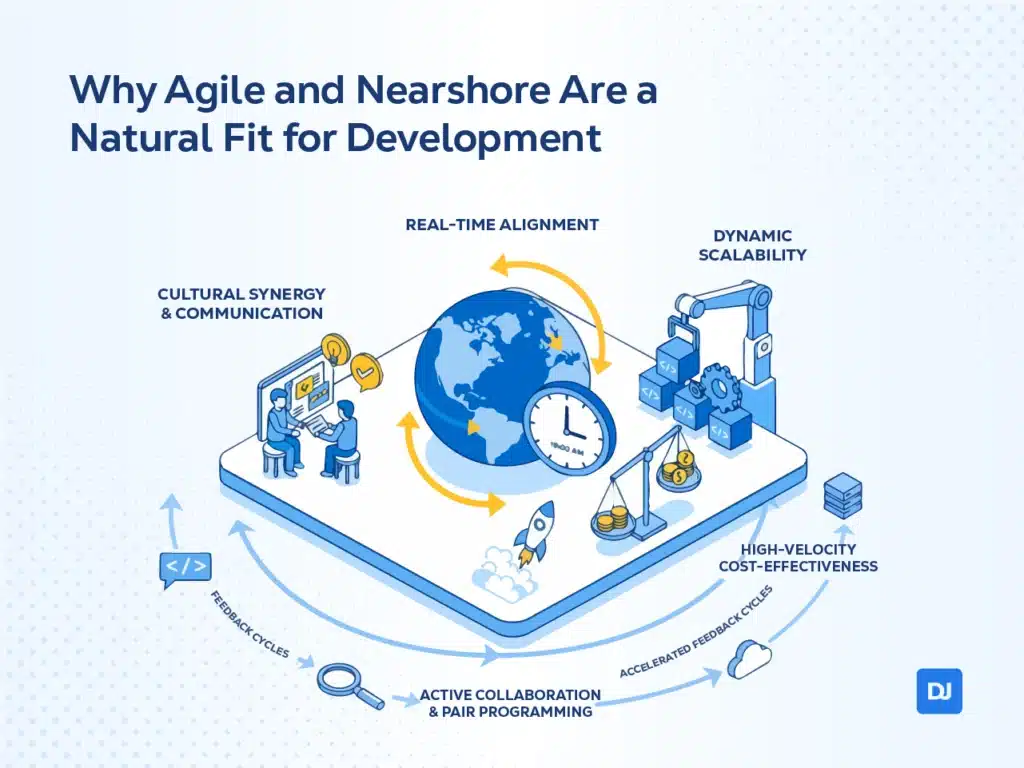
1. Real-Time Alignment (Time Zone)
Agile ceremonies like Daily Stand-ups, Sprint Planning, and Retrospectives lose their value if half the team is yawning at midnight. Nearshore ensures that your “core hours” are shared.
For example, when a blocker appears at 10:00 AM, it’s solved by 10:30 AM; not “tomorrow morning.”
Moreover, Product Owners and Developers can jump on a quick huddle without scheduling it three days in advance.
2. Cultural Synergy & Communication
Agile depends on developers who aren’t afraid to speak up and challenge a requirement if it doesn’t make sense. Nearshore teams share a proactive communication style that aligns with Western business norms.
Developers act as partners, not just “ticket takers.” The cultural proximity makes it easier to have the “hard conversations” necessary for a successful Retrospective.
3. Accelerated Feedback Cycles
In a Nearshore model, the “Review-Fix-Deploy” loop is continuous. Because the QA team and the Developers are working simultaneously, the feedback loop is measured in minutes, not days. It drastically reduces the “cost of carry” for bugs and ensures your Roadmap stays on track.
4. Active Collaboration & Pair Programming
Agile is a team sport. Nearshore allows for high-bandwidth collaborative techniques like Pair Programming and Mob Programming. These aren’t just buzzwords; they are the fastest way to ensure code quality and knowledge sharing. When you can jump on a screen-share in real-time, the “tribal knowledge” stays within the team.
5. High-Velocity Cost-Effectiveness
It’s not just about a lower hourly rate; it’s about Value per Dollar. Onshore, you pay a premium for local talent but struggle with a limited hiring pool. Meanwhile, with offshore, you save money on paper, but lose it to “communication debt” and rework. Finally, with Agile Nearshore Development, you get Senior-level talent at a fraction of Silicon Valley costs, with the efficiency of a local hire.
You’re paying for working hours, not waiting hours.
6. Dynamic Scalability
In the Agile world, your needs can change from Sprint to Sprint. Nearshore providers offer the “Elasticity” that local hiring lacks. Need to add a DevOps specialist or two Full-Stack devs by the next Sprint? Nearshore partners maintain a “bench” of pre-vetted talent, allowing you to ramp up (or down) in weeks, rather than months.
Agile Nearshore Development vs Offshore Outsourcing
Offshore outsourcing can work for well-defined, static projects. Agile nearshore development excels when requirements change, and they almost always do. While offshore outsourcing works for “set-it-and-forget-it” maintenance, it often buckles under the pressure of modern, fast-moving product development.
In an Offshore model, you are often paying for Management Debt; the time spent documenting every tiny detail to ensure nothing is lost in translation overnight. In a Nearshore model, you are paying for speed. Since the team is active while you are, they can pivot mid-day, clarify a requirement in a 2-minute Slack huddle, and push code before you log off.
| Aspect | Agile Nearshore Development | Traditional Offshore |
| Time-Zone Alignment | Full-day overlap | Graveyard shifts |
| Agile Ceremonies | Live, synchronous, and asynchronous participation | Recorded or “handover” style |
| Feedback Loop | Instant (Minutes/Hours) | Delayed (24-hour cycles) |
| Communication | Proactive partnership | Reactive / Task-based |
| Delivery Speed | Continuous (Daily releases) | Gated (Monthly milestones) |
| Hidden Costs | Low (High efficiency/minimal rework) | High (Management overhead/friction) |
4 Rules for Successfully Integrating Your Team
The difference between a high-performing nearshore team and a failed experiment usually comes down to integration. To treat a nearshore team like an extension of your own, follow these four non-negotiable practices.
1. Destroy the “Us vs. Them” Mentality
Agile dies in a vacuum. If your nearshore team feels like a “ticket factory” rather than a partner, your velocity will stall. To succeed, you must understand your employees as first-class citizens.
- Total Integration: They should be in the same Slack channels, attend the same “All-Hands” meetings, and have the same @company.com email addresses.
- Shared Decision Making: Don’t just hand them a finished architecture; involve them in the “how” and “why.” When developers understand the product vision, they build better code.
- Cultural Inclusion: If you’re celebrating a win or a milestone, include them.
2. Standardize the Digital Office
Friction is the enemy of Agile. If your nearshore team uses different tools or processes, you’re essentially building a wall between your developers.
- The Unified Stack: Standardize on Jira/Linear for the backlog, GitHub/GitLab for the repo, and Slack for the “watercooler” talk.
- Documentation as Truth: Since you aren’t in the same physical room, your documentation (Confluence/Notion) must be the Single Source of Truth. If it isn’t documented, it doesn’t exist.
Pro Tip: Set up a “Perpetual Zoom” or “Huddle” room during core overlapping hours. It mimics the “shoulder-tap” environment of a physical office.
3. Empower the Product Owner (PO)
Nearshore development is fast. If your PO is a bottleneck, the whole machine grinds to a halt. A strong Nearshore Agile setup requires:
- High Availability: The PO must be reachable during the overlapping time zone window to answer questions instantly.
- Crystal Clear Requirements: “Nearshore” isn’t magic; it still requires a well-groomed backlog. Ensure every ticket has a clear Definition of Done (DoD) and explicit Acceptance Criteria.
- The “Bridge” Role: The PO acts as the translator between business goals and technical execution across borders.
4. Optimize for Throughput, Not Activity
The old-school sweatshop model focuses on time-tracking and hours logged. Agile focuses on value delivered. If you spend your time micromanaging their 8-hour day, you’ll lose the senior talent you hired them for.
- Key Metrics to Watch:
- Velocity: Is the team’s output stabilizing or increasing?
- Cycle Time: How long does it take for a feature to go from “In Progress” to “Production”?
- Escaped Defects: Is the code quality meeting your standards?
- Trust over Surveillance: Evaluate your nearshore partners on their ability to hit Sprint goals, not on how many minutes they spent at their desks.
Conclusion
Agile nearshore development combines the best of both worlds: the flexibility of Agile and the practicality of nearshoring.
It allows companies to move fast, adapt continuously, and build strong engineering cultures, without the cost and rigidity of purely local teams or the friction of distant offshore outsourcing.
If your company’s serious about sustainable, scalable software delivery, agile nearshore development through DistantJob is your best option available.
DistantJob doesn’t just find remote agile nearshore developers. We headhunt elite, battle-hardened senior developers in LATAM and Eastern Europe who work your hours, crush your tickets, and challenge your requirements to make your product better.
Stop hiring juniors at high prices just because they’re local. We identify, vet, and deliver the Top 1% of global talent in the best time zone and perfect cultural fit. The only thing missing is your decision to move faster. Call us today!