We are in an AI-Augmented Developer era, where AI is becoming a world-class tactician and executioner. However, strategy is something that an AI can not do.
In 2026, AI has become the best junior engineer money can’t buy: It doesn’t get tired, it doesn’t have an ego, and it can squash bugs, write tests, and create deployment configurations with superhuman speed.
But there is a large gap between the tasks AI performs and the decisions it makes, and if there is any weak link in your operation, this is the gap where your system will break.
AI has become a top-notch tactician, much better than the average mid-level developer. The “how”, such as the appropriate syntax, patterns, and boilerplate templates, is done beautifully by artificial intelligence. But it’s the “why” and the “where” that stop the machine in its tracks. Strategies, architecture, and trade-off decisions are still uniquely human problems.
The distinction matters because businesses are making real hiring decisions under the wrong assumption: that AI tools can replace senior engineering judgment. They cannot. A recent study from Crossbridge found that AI-generated pull requests are 18% larger on average, with a 24% increase in incidents per PR, meaning AI produces more code that needs more senior review, not less.
This article breaks down exactly what AI can handle in your development workflow, and the five critical areas where only a senior developer can make the call.
What an AI Can Do in Software Development
AI has moved beyond simple autocomplete or writing code snippets. It now functions as a junior-to-mid-level “Digital Engineer” within a controlled environment.
Bug Hunting & Fixes
It can scan a codebase, identify a null pointer exception, and write the pull request to fix it. Other debugging tasks an AI can do:
- Detecting null pointer risks
- Spotting obvious race conditions
- Identifying unused variables
- Flagging insecure patterns (SQL injection, missing auth checks)
- Refactoring repetitive code
- Improving error handling
- Updating deprecated APIs
These are pattern recognition problems, and LLMs excel at pattern matching.
Automated Testing
An AI can look at a function and generate the unit tests required to reach 100% coverage. Tests follow structural patterns. AI understands those well:
- Generating unit tests
- Creating mock objects
- Increasing test coverage
- Producing happy-path + edge-case scenarios
Deployment
It can handle the “plumbing”, like writing the YAML for a CI/CD pipeline and pushing code to a staging environment. The infrastructure code is structured and predictable. AI thrives in predictable systems. Here are some examples of AI’s best use cases in deployment.
- Writing CI/CD YAML
- Creating Dockerfiles
- Generating Terraform snippets
- Suggesting Kubernetes manifests
Five Reasons Why AI Struggles with Complex Systems
The tasks AI can do (bug fixing, testing) are local tasks. They exist within the context of a specific file or function. The tasks an AI cannot do are global problems that require a mental model of how a thousand moving parts interact in the real world.
1. Performance Under Load
AI sees code, but it doesn’t “see” the hardware, the garbage collector spikes, or the noisy neighbor in a cloud environment.
Slowness is an emergent behavior. An AI can suggest a faster sorting algorithm, but it can’t feel the “friction” of a database lock that only happens when 10,000 users hit a specific endpoint simultaneously.
Performance issues are rarely visible in code alone. They require:
- Observability interpretation (metrics, traces, logs)
- Historical context
- Traffic patterns
- Organizational deployment knowledge
- Business usage patterns
AI can suggest hypotheses, but it cannot own a live, distributed system, observe its evolving behavior, and reason through non-deterministic production chaos, such as an experienced SRE.
2. The CAP Theorem (Consistency vs. Availability)
Choosing between CP (Consistency/Partition Tolerance) and AP (Availability/Partition Tolerance) isn’t a math problem; it’s a business value problem.
If you are building a banking app, you choose Consistency. If you are building a social media feed, you choose Availability. AI doesn’t understand the cost of a “wrong” tweet versus a “wrong” bank balance.
Don’t take me wrong. AI can explain CAP. But it can’t decide: “Should our payment system prefer consistency or availability during partitions?”
That is not a predictable decision. It is a decision that evaluates products, compliance, risk management, and business trade-offs. Only humans can define risk tolerance.
An AI does not understand your SLA obligations, regulatory exposure, brand risk, or revenue sensitivity to downtime. It can simulate reasoning. It cannot bear consequences.
3. Designing Scalable Architecture
Architecture is about predicting the future. AI is trained on the past.
Scaling requires understanding your specific growth trajectory. AI can suggest a “standard” microservices pattern that actually over-engineers a simple project into oblivion. It creates more “architectural debt” than it solves.
An AI can generate a microservices diagram, a “clean architecture” template, or a Kubernetes cluster layout. But this is not architecture. These are examples. But a real scalable architecture depends on many factors. For instance:
- Expected growth curves
- Hiring plans
- Team maturity
- Budget constraints
- Cloud cost tolerance
- Time-to-market pressure
AI does not understand organizational politics or budget runway. In fact, Anthropic ran an experiment of letting an AI run a vending machine as a business. It didn’t go well. If an AI can’t run a vending machine, would you let it run your business?
4. Debugging Microservices Networking
When Service A can’t talk to Service B, the code in both services might be perfect. The issue could be a misconfigured subnet, a dropped packet, or an expired TLS certificate.
AI thrives on static analysis (reading code). Network issues are dynamic and transient. AI can’t “ping” a router or sniff traffic unless it has deep, real-time integration into your entire infrastructure.
Distributed system debugging involves multi-layer, cross-system issues. For example, TLS misconfigurations, DNS propagation issues, and service mesh quirks.
AI can read logs if you paste them. It cannot decide whether to roll back a deployment, accept degraded performance, or ignore an innocuous alert as noise. An AI can’t balance uptime vs revenue risk, understand undocumented infra history, or correlate “we changed this 3 weeks ago”.
This requires contextual intuition built from production scars and experience.
5. Making Conscious Trade-offs
In engineering, there are no “best” solutions, only trade-offs. Every decision involves a sacrifice (e.g., “We will accept higher latency to ensure data integrity”).
AI is optimized to find an “answer,” but it lacks the consciousness to weigh human factors like team expertise, budget, or time-to-market.
Engineering at the senior level is not about code. It is about balancing trade-offs.
- Ship fast vs build robust
- Monolith vs microservices
- SQL vs NoSQL
- Self-host vs managed
- Staff Engineer hire vs DevOps automation
AI can list pros and cons. But an AI cannot take accountability, own long-term consequences, align decisions with executive strategy, or negotiate constraints between departments. That’s leadership for engineers with developed, mature seniority.
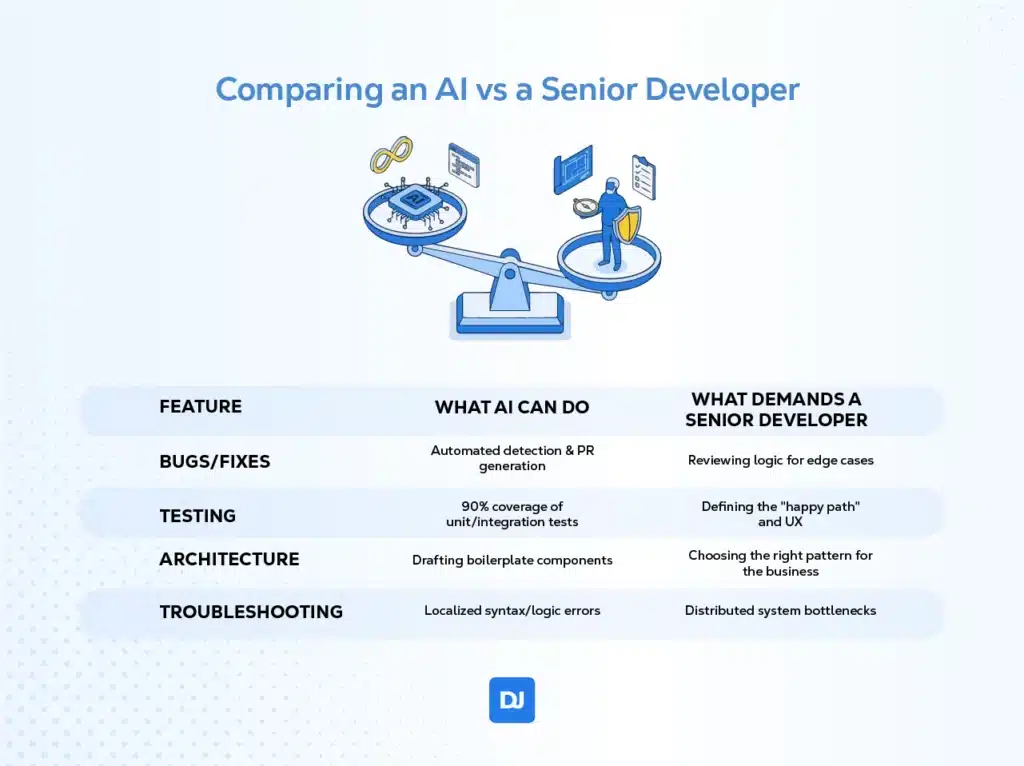
Comparing an AI vs a Senior Developer
AI is your co-pilot, not the architect. It brings an output from your prompt, but it doesn’t think or rationalize all your context. Therefore, only a senior developer can properly review and curate the code to know its effects on your system.
| Feature | What AI can do | What Demands a Senior Developer |
| Bugs/Fixes | Automated detection & PR generation | Reviewing logic for edge cases |
| Testing | 90% coverage of unit/integration tests | Defining the “happy path” and UX; usability tests |
| Architecture | Drafting boilerplate components | Choosing the right pattern for the business |
| Troubleshooting | Localized syntax/logic errors | Distributed system bottlenecks |
And this is why LeetCode is changing to incorporate AI curation into its tests.
The ability to write code from scratch is becoming less important than the ability to review, refine, and direct AI-generated code. Technical hiring is moving from “can you solve this algorithm?” to “can you evaluate whether this AI-generated solution is production-ready?”
For engineering managers, this changes what you should be hiring for. The most valuable developer in 2026 is not the fastest coder. Instead, it is the one who can look at an AI’s output and immediately identify the edge case it missed, the scaling bottleneck it introduced, or the security vulnerability it created. That is a skill built from years of production experience, not prompt engineering.
The Bottom Line: AI Executes, Senior Engineers Decide
AI is like a powerful junior engineer with infinite stamina. But it can not replace a Staff or a Senior Engineer. An AI can execute; however, it can not decide. The value of engineers is shifting upward. Junior “code writers” are increasingly augmented or replaced.
On the other hand, senior system thinkers, distributed systems experts, architecture decision-makers, platform engineers, and performance specialists are becoming more valuable, not less. Recognised experts are worth their weight in gold.
At DistantJob, we find the global talent that bridges the gap between AI execution and human strategy. You don’t need more code-writers; you need DistantJob to find you the 1% of pre-vetted global architects who know how to leverage AI’s best capabilities.
There’s no risk for your company: pay only when you find a cultural fit with a three-month guarantee.
Contact us now! Scale your team with elite remote talent that masters AI-augmented development!