In mid-January 2026, Trump issued an indefinite immigration ban policy for 75 countries, according to CNN. This measure applies to both immigrant visas and employment. For many companies, the traditional approach of hiring and relocating global talent through the immigration system has become a losing proposition in 2026, and likely for the rest of the decade.
However, this shouldn’t stop you from looking for the best all-star employees in the global workforce. In fact, this is an opportunity to hire cheaper, faster, and more reliably! Don’t hire and relocate global talent; hire them remotely instead.
American companies’ movement to hire through immigration was, above all, a strategic investment decision. However, the process was bureaucratic and expensive. Nowadays, it’s more rigorous than ever in 2026. Companies used to accept these challenges for reasons that directly impact their competitiveness and innovation.
With the enactment of the Presidential Proclamation 10998 and the suspension of immigration visa processing for several countries, U.S. companies are transitioning to remote work (borderless work).
Hiring remotely is not an emergency exit or a COVID-19 trend. Remote work is the best strategy for survival and efficiency. In this article, we will discuss why to hire remote workers and which is the best way to get them.
Why is the Trump Administration Halting Immigration?
The U.S. Government announced it will freeze visas to people from dozens of countries who wish to live in the United States permanently. The announcement takes effect on January 21 and will affect potential immigrants from Latin America, the Balkans, and several countries in South Asia, Africa, and the Middle East.
This move is part of a broader strategy to tighten legal immigration and follows a series of incremental bans issued throughout 2025. The Donald Trump administration’s stated reasons for the ban fall into three primary categories:
1. Preventing Public Charges
The most prominent justification given by the State Department is the concern that immigrants from these countries are likely to become a “public charge” (relying on government benefits).
2. Extreme Vetting
Many of the countries on the list (such as Afghanistan, Iran, Russia, and Somalia) were targeted due to what the administration describes as deficient screening and vetting procedures.
3. Non-Cooperation and Visa Overstays
The administration also used the ban to pressure foreign governments into compliance with U.S. policies. Some countries were included because they refused to accept the return of their citizens who had been ordered deported from the U.S. Nations with high rates of citizens overstaying their temporary (tourist) visas were placed under the immigrant visa freeze as a punitive measure.
Why Remote Work is the Best Strategy for 2026
In this new landscape, trying to hire and relocate global talent is no longer a viable business plan. With the temporary suspension of immigrant visa processing for 75 countries in January and the increase in security requirements and fees from USCIS, international remote hiring ceased to be a secondary alternative. Hiring global talent became the best strategy for American companies.
1. Company’s Borderless Continuity
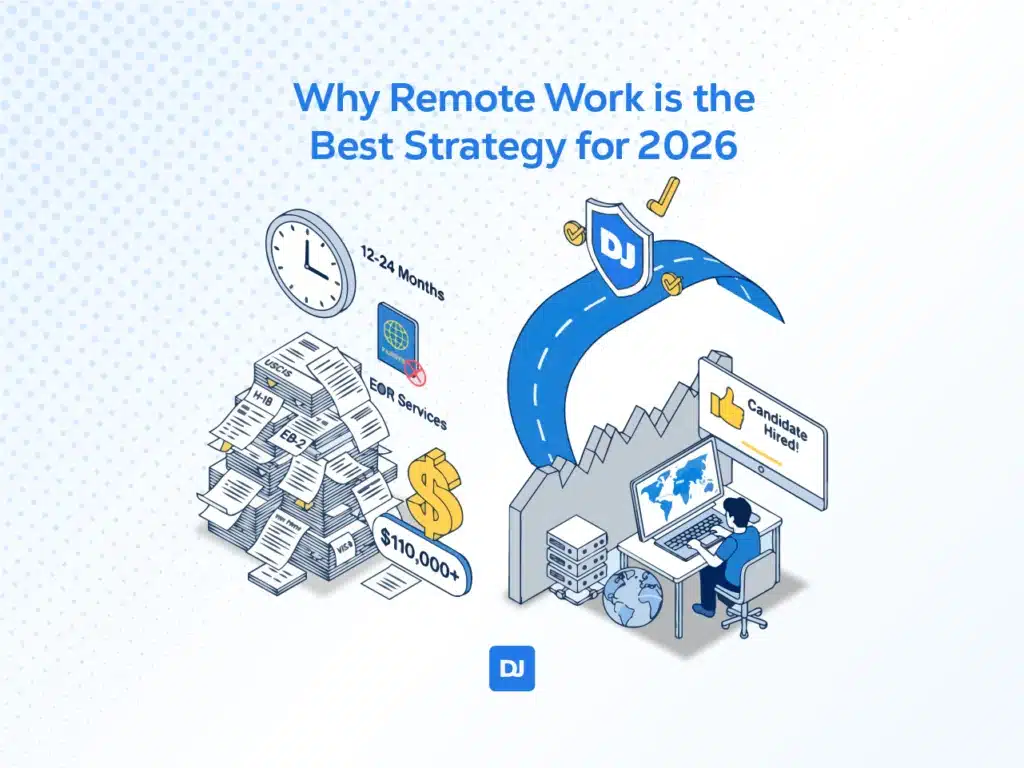
The remote work model’s major benefit is immunity to border policies. While visas (H-1B, EB-2) are subject to quotas, lottery, and sudden halts, remote contracts only rely on compliance and internet connection.
- Uninterrupted Access: Your company doesn’t lose months waiting for consular approval that could be denied for political reasons.
- Talent Retention: Professionals unable to renew their visas or enter the country can continue working from their homes.
If you attempt to hire and relocate global talent only to have their visa denied, you lose the candidate. Remote hiring keeps them on your team regardless of their passport.
2. Massive Lower Costs and Bureaucracy
Hiring through immigration is expensive. By 2026, the financial barrier to hire and relocate global talent has reached a breaking point.
By hiring remotely rather than through immigration (specifically the H-1B visa program), an American company can cut costs by $110,000+ per hire in the first year alone (considering Trump’s H1-B and government fees, excluding attorney fees).
Moreover, your company doesn’t need physical space in expensive offices in San Francisco or New York.
3. Best Time-to-Hire
Immigration processes to the U.S. can take from 12 to 24 months. Remotely, using DistantJob’s EOR (Employer of Record) services, an American company can hire offshore or nearshore in a few days. Moreover, you can bypass the need to hire and relocate global talent.
If a company needs a data engineer, it doesn’t have to wait for the visa cycle of 2027. The company can get it much faster.
4. Compliance Risk Mitigation
With stricter Department of Labor (DOL) scrutiny in 2026 regarding the impact of immigrants on local wages, remote work offers a simpler path. DistantJob acts as the legal employer (through EOR), dealing with taxes, benefits, and local compliance. Your company can focus on results without worrying if the employee will be stopped at the border or have a Green card denied.
How DistantJob Finds the Best Pre-Vetted Global Talents
DistantJob is a headhunting recruitment agency specializing in finding senior-level talent in IT. Our hiring process is structured to deliver high-quality candidates in a short timeframe, typically within two weeks. Here is how DistantJob headhunts the best talent for you:
1. Active Recruitment Strategy
Instead of waiting for applicants to come to them, DistantJob utilizes a direct headhunting strategy.
- Identification of Similar Companies: Our agency analyzes the client’s operations, tech stack, and culture to find comparable companies worldwide.
- Talent Outreach: We proactively approach high-performers at these similar companies, ensuring candidates already possess the necessary technical skills and cultural fit.
- Focus on Careers, Not Gigs: Unlike freelance marketplaces, DistantJob focuses exclusively on permanent, full-time remote positions, attracting professionals seeking stability and career growth.
2. Triple Approval Process (TAP)
To guarantee quality and save the client’s time, DistantJob applies a rigorous filtering system:
- Sourcing Stage: Search specialists select profiles that match the requirements and initiate contact.
- Recruitment Stage: Recruiters conduct one-hour interviews to evaluate hard skills, soft skills, and cultural fit.
- Account Management Stage: The Account Manager, who possesses a deep understanding of the client’s needs, performs a final evaluation of the candidates before presenting them.
- Filtering Volume: On average, our agency contacts approximately 3,000 people to filter down to just 2 to 5 final candidates for you.
3. Global Reach and Cost-Effectiveness
We are not restricted to a specific geographic region, allowing access to a much larger and highly qualified talent pool.
- Focus Regions: DistantJob searches concentrate primarily on Eastern Europe and Latin America, but also span Africa and South Asia.
- Cost Reduction: By hiring talent in countries with a lower cost of living, companies can save roughly 50% compared to North American salaries without compromising technical quality.
4. Service Guarantees
To mitigate client risk, DistantJob offers two primary guarantees:
- 2-Week Guarantee: If the first qualified resume is not delivered within 14 days, the client may receive commission waivers for the initial months.
- Satisfaction Guarantee: If the client is not satisfied with the hire within the first three months, the commission is fully refunded.
Breakdown: Immigration Fees Vs DistantJob Fees
With the introduction of the new National Interest surcharges and the Public Charge vetting fees, the financial barrier to entry for global talent has reached an all-time high. For many mid-sized tech firms, sponsoring a single immigrant in 2026 has become a high-risk gamble that can drain a quarterly budget before the employee even sets foot in the office.
| Expense Item | H-1B Sponsorship (2026) | Remote Hire (via EOR) |
| Mandatory H-1B Fee | $100,000 | $0 |
| Legal/Attorney Fees | $5,000 – $15,000 | $0 (Included in EOR) |
| Standard Gov. Fees | $10,000+ | $0 |
| Relocation Package | $5,000 – $20,000 | $0 |
| Salary Delta (US vs. Global) | High (Prevailing Wage in the U.S.) | Lower (Local Market Rate) + DistantJob’s Fee |
Conclusion
The 2026 immigration landscape is undeniably challenging, but it isn’t a dead end for innovation. While Presidential Proclamation 10998 and the subsequent visa freezes have effectively closed physical borders to 75 nations, the digital doors remain wide open.
If you continue to try to hire and relocate global talent using the old model, your innovation will be paralyzed by rising costs and political volatility.
The best developers, engineers, and data scientists in the world are still available; they just don’t need a visa to help you win.
Contact DistantJob today and have the best talent the world has to offer!