Spec-Driven Development (SDD) is a paradigm in which detailed specification replaces manual code writing as the central activity. In the age of artificial intelligence, code has become a commodity. Bottlenecks shifted from coding to the ability to plan, architect, and define clear contracts.
To avoid inconsistent systems resulting from vague instructions, the professional workflow now uses autonomous agents that operate under strict guidelines, called Constitutions, and terminal tools that integrate the project context.
Classic methodologies such as DDD and TDD gain new relevance, serving not as bureaucracy but as essential communication protocols for AI to deliver assertive results.
The developer’s role is evolving towards a high-level auditor and manager who uses objective metrics and automation pipelines to ensure the quality and security of the final software.
In this article, we will provide an overview of how Spec-Driven Development works, best practices, and tools.
How Spec-Driven Development Works?
At its core, SDD subverts manual coding. Instead of jumping straight into an IDE, the SDD workflow follows a rigorous, linear progression that treats the Specification Document as the “Source of Truth” rather than the code itself.
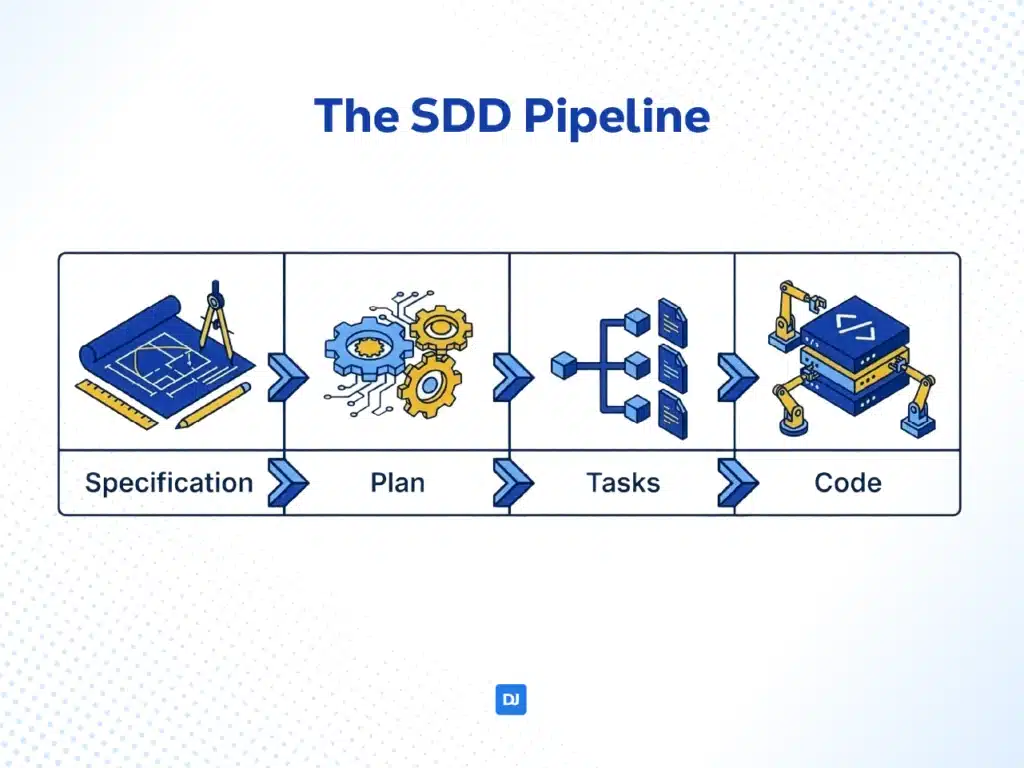
The SDD Pipeline
This pipeline has four distinct stages, ensuring vetting for architectural integrity at every single line of code generated.
- Specification: The human architect defines the what and the why. This is a contract that outlines requirements, constraints, and business logic.
- Plan: The AI or Agent analyzes the spec to propose a technical roadmap. It maps out dependencies, chooses libraries, and identifies potential edge cases before execution.
- Tasks: The plan is broken down into atomic, bite-sized units of work. Each task is self-contained and refers back to the specific requirement in the contract.
- Code: Autonomous agents execute the tasks. Since the context is narrow and the instructions are precise, the resulting code is highly accurate and adheres to the predefined architecture.
Is “Vibe Coding” dead?
Vibe Coding is the practice of giving an LLM prompts like “make it look professional” or “add a login feature” and hoping for the best. This inevitably leads to “hallucination debt” and inconsistent systems.
SDD eliminates this by using the Specification as a Strict Contract. Since the AI Agent is reading a structured document rather than guessing intent, the vibes are replaced by objective technical requirements.
Enhancing Agent Readability
For an AI Agent, a specification defines boundaries, explicitly stating what the code should not do. It also standardizes interfaces, using schemas (such as OpenAPI or Protobuf), so the AI understands data structures perfectly.
More importantly, specifications contain contextual guardrails, providing the Agent with enough project context to ensure the new code doesn’t break existing modules.
Spec-Driven Development Tools and Ecosystem
The AI ecosystem has evolved from isolated prompts in a chatbot to an agentic, structured environment in which terminal tools and specialized frameworks orchestrate the work.
Below are the main development tools in the Spec-Driven Development ecosystem.
Execution Engines
In 2026, traditional IDEs are losing ground to command-line interfaces (CLIs) that serve as execution engines for agents.
Claude Code (Pioneer, Favorite)
Anthropic’s Claude Code is widely recognized as a leader in agentic coding tools, with its “Agent Teams” feature specifically cited as a pioneering approach to control, orchestration, and parallel work for AI teams.
Codex (OpenAI)
OpenAI’s application of Codex (via CLI/agentic workflows) builds vast codebases (1M+ lines) with zero manual coding, leveraging 3-7 engineers to manage AI-driven generation. It relies on agent-to-agent code reviews, strict, self-governing repository truths, and deep contextual understanding (via tools like GitHits) to achieve extreme autonomy.
Gemini (Google)
AI on Google Search, powered by the Gemini family of models, is a major competitor in the agentic engine ecosystem. It can plan, browse, and execute tasks. Gemini 3 is a state-of-the-art model for autonomous collaboration, excelling in coding and reasoning.
Orchestration Frameworks
Modern SDD relies on frameworks that interpret the Specification to coordinate complex workflows. By managing state, memory, and tool usage, they ensure that AI agents not only generate text but also actively navigate the file system, run tests, and iterate until the requirements are met with precision.
AIOX/BMad (Agile Agent Teams)
BMad ties AI agents to your software development lifecycle. It enforces Agile (sprints, backlogs, reviews, deployments) so your AI doesn’t operate in isolation but follows the personas you configure.
AIOX, a Brazilian framework workflow, works differently. Instead of organizing around a single process, it groups AI agents into squads that mirror your company’s departments (Legal, Branding, Development, Finance). Each squad makes decisions using the heuristics and constraints specific to that department. They coordinate through a hierarchy, so a legal decision informs a branding decision, which feeds into development.
BMad keeps them honest to your workflow; AIOX keeps them specialized to your structure.
GitHub Spec Kit and Kiro (Constitution)
These are tools that popularized the use of a “Constitution,” a markdown file with non-negotiable rules (such as security standards and a defined stack) that the agent must follow. Think of the Specification as the “project blueprint” and the Constitution as the project’s “code of ethics and criminal law”.
MCP (Model Context Protocol)
The Model Context Protocol (MCP) is the open standard that connects AI models and your project. Before MCP, AI agents were often trapped within the context of the files they were currently editing. With this protocol, the Spec-Driven Development ecosystem gains a standardized way to feed real-world, live data into the AI’s reasoning engine.
MCP allows agents to move beyond just writing code; it enables them to interact with the entire project management and documentation stack
Linear
Agents can automatically read tickets to understand the “Why” behind a spec, update task statuses as code is committed, or flag blockers directly in the project roadmap.
Notion
This serves as the living repository for the Constitution and high-level architectural documentation. Through MCP, an agent can query your internal “Knowledge Base” to ensure a new feature aligns with long-term company strategy.
GitHub
Beyond just pushing code, MCP enables agents to manage PR reviews, analyze historical commit patterns to maintain style consistency, and orchestrate complex CI/CD pipelines.
Specification Context Configuration (Files .md)
Spec-Driven Development workflows utilize configuration files to maintain memory and context between chat sessions.
Local cloud.md
Contains the developer’s personal preferences, such as tone of voice and favorite tools.
Project cloud.md
Defines the architecture rules (e.g., Onion Architecture, DDD), testing patterns, and PR checklists specific to the project, ensuring that different agents maintain code consistency.
Skills
While the Specification defines the goal, Skills represent the how. These are instruction sets that grant AI agents specific capabilities. Instead of explaining how to write a unit test every time, the developer simply points the agent to a TDD.md skill file.
- Git Skill: Defines standard commit message formats (e.g., Conventional Commits) and branch naming conventions.
- Docs Skill: Instructs the agent on how to maintain the README, generate API documentation, or update the changelog.
- TDD Skill: Establishes the “Red-Green-Refactor” loop, ensuring the agent writes a failing test before generating functional code.
Constitution
Constitutions are non-negotiable rules and technical principles. This file serves as the ultimate guardrail, containing non-negotiable constraints that the agent must never violate, regardless of what a specific prompt might suggest. The Constitution typically governs:
- Security Standards: Forbidding the hardcoding of secrets or the use of deprecated, vulnerable libraries.
- Tech Stack Enforcement: Restricting the agent to specific languages and frameworks (e.g., “Only use TypeScript and Tailwind CSS; do not introduce external CSS libraries”).
- Logic Constraints: Principles like “Dry” (Don’t Repeat Yourself) or “YAGNI” (You Ain’t Gonna Need It) are codified here to prevent the AI from over-engineering solutions.
New Software Developer Role (Auditing)
The great advantage of acting as a code quality auditor instead of a line-by-line reviewer is scalability and efficiency in the AI age. Since AI generates massive volumes of code quickly, manually reviewing each change has become an unfeasible and slow task for humans.
The developer gains productivity by becoming a code auditor.
Automated Quality Metrics
Just as any human code, AI code can be put through automated tests that ensure quality. These tests verify rigorous code quality metrics and detect AI hallucinations that would cause havoc in production environments.
Cyclomatic Complexity (CCN)
Cyclomatic complexity is a software metric that measures the number of independent paths in a program’s control flow, indicating its logical complexity.
Developed by Thomas McCabe in 1976, it helps to determine code testability and maintainability. High values suggest greater risk and difficulty in understanding.
Based on the control flow graph. The formula is M = E – N + 2P. E is the number of edges, N is the number of nodes, and P is the number of connected components.
Complexity increases with decision and repetition structures, such as if, else, while, for, case, and catch.
| Number | Complexity |
| 1-10 | Simple code, low risk. |
| 11-20 | Moderate complexity, moderate risk. |
| 21-50 | High complexity, high risk. |
| >50 | Uncontrollable complexity, very high risk. |
For example, you can configure your CI/CD pipeline to stop Pull Requests based on a certain complexity. Let’s say, higher than 20. In that way, AI will only be able to pull simple and maintainable code.
Test Coverage and Mutation Testing
Not only ensure coverage, but also use mutation tests (like the mutmut tool) to verify that the tests actually detect flaws when the code is changed.
Mutation testing is a technique used to verify the effectiveness of a system’s tests. The process works by creating ‘mutations’ in the original code, such as swapping operators (e.g., > for <, + for -) or boolean values (true for false).
The goal is to identify whether existing tests can detect these changes. If the code is mutated and the tests don’t fail, it means some gaps need to be addressed in future sprints.
Dependency Analysis
Dependency structure analysis seeks to identify and prevent architectural flaws and detect problems related to excessive coupling between system modules.
For example, situations where one file imports another, which in turn imports the first, creating a cycle of dependencies. This is called circular injection.
The ultimate goal is to ensure that the system follows an organized structure, where functionalities between different parts of the code occur in a controlled manner.
God Files Avoidance
God Files are excessively large code files, reaching thousands of lines (3K+ lines). They make maintenance complex and difficult. To avoid them, you can establish strict size limits for modules in the CI/CD pipeline.
For example, it is possible to configure the system to block the merging of any file that exceeds a defined limit (such as 300 lines of code). It enforces better organization and modularization of the project.
What Are the Main Activities of Spec-Driven Development?
In the SDD paradigm, the developer must develop architectural skills. In SDD, the “seniority” of a developer is measured by their ability to decompose complex business problems into unambiguous technical requirements. Since AI handles the implementation details, the human’s value lies in preventing “garbage in, garbage out” by mastering systemic thinking and architectural design.
Specify
This is the creation of the “Source of Truth” for the LLM to follow. You design the initial Specification Document and the project Constitution. The developer must define the system boundaries, data schemas, and business logic that the AI agents must follow. Ensure that your agents receive a clear roadmap before the first line of code is ever generated.
Review
Developers now review AI’s output against the original Specification. The focus is on ensuring that the proposed solution adheres to the project’s long-term goals and doesn’t introduce technical debt. Reviewing in SDD is about confirming that the intent was captured and the contracts were respected.
Validate
Validation is the phase to analyze reports on Tests, such as Cyclomatic Complexity, Mutation Testing results, and Dependency Graphs. If the code passed the tests but is still not good enough, the developer rejects the work, forcing the agent to refactor until the code meets all non-negotiable standards defined in the Constitution.
Orchestrate
Orchestration is the high-level management of the development pipeline. The developer decides which Skills to deploy, configures the Model Context Protocol (MCP) to connect the agents to live data (like Linear tickets or GitHub history), and monitors the parallel workflows. It is the act of fine-tuning the AI ecosystem (for instance, adjusting the cloud.md files and professionalizing the prompts). This work ensures the entire machine operates at peak efficiency.
Spec-Driven Development Practical Workflow (Day-to-Day)
The daily life of a developer in an SDD environment looks less like a marathon of typing and more like the work of an air traffic controller. The workflow is a highly parallelized, automated stream of features.
Bypass Mode: Autonomy After Approval
Once a human architect approves the Plan and the Tasks, the agent enters what is known as Bypass Mode. In this state, the agent is granted the autonomy to execute the predefined tasks, run tests, and self-correct. It won’t need human intervention.
This removes two bottlenecks: coding and prompting time. The AI cycles through the Red-Green-Refactor loop at machine speed. The developer only steps back in if the agent hits a logical wall that contradicts the Constitution or the Specification.
Worktrees: Parallel work in multiple contexts
Worktrees allow agents to operate in multiple, isolated environments simultaneously. A developer can have multiple agents. For example, one agent team refactors a legacy module while another agent implements a new API feature. The project’s velocity is no longer limited by a single “active” file, but by the number of concurrent agents the developer chooses to orchestrate.
PR Stacks: Granular and Incremental Reviews
Since AI breaks down the Specification into atomic tasks, it submits code in small, logical increments that “stack” on top of one another. Each PR represents a single requirement from the Spec. The granularity makes auditing significantly easier for developers. Instead of reviewing a massive feature all at once, they can validate the logic step-by-step, ensuring that the foundation of the code is solid before the next layer is applied.
Specialist Agents: The AI Squad
A single, general-purpose model rarely handles the workflow. Instead, it involves a squad of Specialist Agents with distinct personas and restricted scopes. It allows a multi-layered vetting.
The Security Agent
Scans every line for vulnerabilities and ensures compliance with the Security Standards in the Constitution.
The Performance Agent
Analyzes the runtime complexity and suggests optimizations for high-traffic endpoints.
The Quality Reviewer
Acts as a “pre-human” auditor, checking other agents’ work against the project’s cloud.md rules and limits.
Conclusion
Spec-Driven Development is the inevitable evolution of software engineering in the era of high-density AI. It allows teams to scale without the traditional trade-offs of technical debt or “vibe-based” inconsistency. Moreover, it turns the developer into a master orchestrator, leveraging tools like MCP and specialized agents to build complex, secure, and highly maintainable systems at machine speed.
Specifications and human intervention address AI hallucinations, messy codebases, and architectural integrity. Instead of fighting the tools, SDD allows you to harness them through clear contracts and objective validation metrics.
However, moving to this model requires a new talent: software engineers who are architects first and coders second. DistantJob headhunts and pre-vets the best spec-driven developers in the world.
We specialize in finding remote experts who understand how to build robust specifications, manage agentic workflows, and audit code for peak performance.
Scale your engineering team with the architects of the future! Contact DistantJob today and find your next lead SDD developer.