There isn’t a leader who doesn’t value innovation. The problem is when “innovation” leads the company to “reinvent the wheel”, which means creating a poor solution when better ones already exist. This is why the Not Invented Here Syndrome is so widespread. It disguises bad processes, branding them as innovation and culture.
The good news is that the Not Invented Here mentality can be countered with incentives and openness. In this article, we will discuss whether this bias affects your company and how to open your company culture to true innovation.
What is the Not Invented Here Syndrome?
The Not Invented Here Syndrome is the tendency to reject ideas simply because they originated outside of the company. It’s a bias that leads companies to prefer internal solutions, even if it costs more time and resources. The result is detrimental to businesses, leading to losses in competitiveness, delayed delivery, stunted innovation, and rework. It’s the opposite of actual innovation.
Why Do We Fall for It? (Root Causes)
This mindset is a decision-making error and a simplistic mentality. Individuals tend to reduce their openness to thinking outside the box, introducing a strong negative bias. According to the article written by Julian Hannen and his team, there are five psychological reasons why managers cling to expensive internal methods:
- Ego-defensive: It protects one’s professional identity from the perceived threat of external solutions.
- Value-expressive: It rejects knowledge that challenges an individual’s core values.
- Social-adjustive: Rejection protects the identity of a social group by rejecting external knowledge.
- Knowledge function: Refusing to accept new concepts from outside helps individuals to keep their beliefs unchallenged.
- Utilitarian: It secures positive outcomes, such as the personal satisfaction of having a brilliant idea and defending it against external alternatives.
Not Invented Here Bias’s Main Problems
Due to the Not Invented Here attitude, individuals systematically reject external knowledge during innovation processes, even when that input is objectively beneficial to the task at hand. Not-Invented-Here Syndrome (NIHS) can cause significant structural, financial, and strategic damage to a company.
1. Breakdown of Innovation and Learning
NIHS is a barrier to external knowledge absorption. A company loses its ability to recognize, assimilate, and exploit knowledge from outside. By rejecting external input, your company suffers from a closed organizational mindset and a fragmented or constrained knowledge base. In short, it’s now impossible to renew and learn from emerging trends.
2. Failure of Strategic Initiatives
According to J. Hannen et al, an industrial association from VDMA (Association of German Mechanical and Plant Engineering) gathered “member companies to identify six unsolved technical challenges that were posted to solution providers in the machinery industry”.
Due to Not Invented Here Syndrome, the developers refused to integrate external solutions, and VDMA had to shelve its strategic initiative. Important technical opportunities remained unsolved, as developers insisted on creating their “own” in-house solutions rather than using feasible, well-thought-out external proposals.
3. Negative Impact on R&D Projects
The Not Invented Here Mindset has a direct, negative effect on the success of collaborative R&D projects. There are several project-level issues:
Reduced Project Success
NIHS is linked to a decrease in project efficiency and effectiveness. A well-known study from Katz and Allen from MIT Sloan Management Review analyzed 50 R&D groups. It revealed that group performance peaks between 1.5 and 5 years of interaction. After this period, communication with external sources drops drastically, and innovation productivity begins to decline. Such groups, affected by the Not Invented Here Syndrome, tend to ignore external information, leading to redundant efforts (the cost of “reinventing the wheel”).
Project Delays and Cancellations
Professionals interviewed by J. Hannen et al. reported that Not Invented Here bias frequently leads to project schedules being delayed or projects being cancelled entirely due to the rejection of necessary external input.
Worse Market Outcomes
According to Salge et al., companies affected by Not Invented Here Syndrome struggle with New Product Creativity (fit-to-market) and New Product Success (time- and cost-to-market) benchmarks.
4. Financial and Performance Costs
The Not Invented Here Syndrome leads to additional expenses because teams may waste resources “reinventing the wheel” rather than adopting easier external solutions. Quantitatively, according to J. Hannen et al, external knowledge absorption decreases by 6.12 percent for every one-standard-deviation increase in Not Invented Here Mindset.
This under-utilization of external knowledge ultimately undermines both the technological and commercial performance of the company.
5. Impeded Strategic Change
When Not Invented Here Syndrome becomes the rule, it can cause groups or powerful individuals to impede or alter the development of new processes, structures, and routines. This is especially problematic during extensive strategic changes, where leaders might resist new technologies or frameworks to protect their existing influence. However, the outcome stalls the company’s evolution.
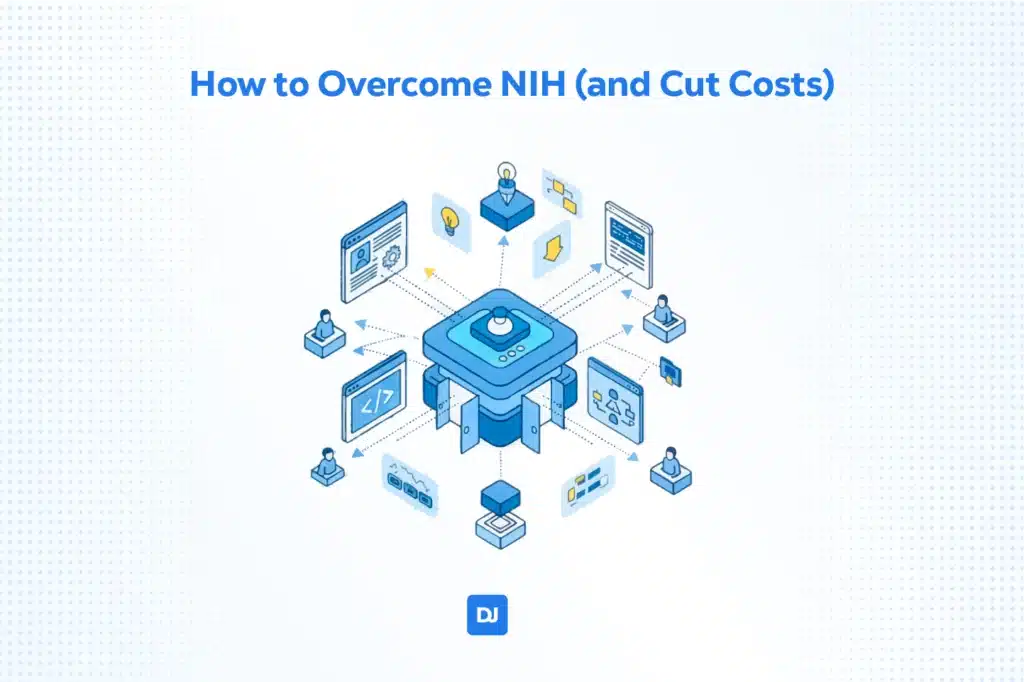
How to Overcome NIH (and Cut Costs)
To overcome Not Invented Here Syndrome, foster an open culture. Incentivize external ideas, open evaluation, and inspire empathy for outside solutions. Finally, incorporate external perspectives early in Innovation Capability (IC) processes to minimize resistance and leverage global knowledge.
According to Arias-Pérez and his colleagues in their article, while Not Invented Here Syndrome has a significant negative effect on companies, it becomes practically null once ICs are incorporated into the model.
1. Implement Innovation Capability Development Strategies
Innovation capability is a company’s ability to generate, develop, and implement new ideas, products, processes, or business models, leveraging internal resources (knowledge, creativity, culture) and external interactions to create sustained competitive advantage and value for stakeholders.
According to Arias-Pérez et al, managers can employ an Innovation Capability development strategy as a short-term intervention to obtain early innovation results.
These early wins create a feedback loop where the benefits of using external knowledge are quickly realized, leading to a shift in values and beliefs among the workforce.
For example, an IC development strategy could be to transform a traditional company into an agile, tech-enabled, and remote-first solution provider by building a decentralized innovation capability over 24 months.
As a real-world example, Fanuc (Fuji Automatic Numerical Control) transitioned its strategy by consciously forming a new development organization within the company. Instead of just relying on path-dependent routines (doing what they always did), they developed Strategic Innovation Capability by:
- Sensing: Identifying the shift toward NC (Numerical Control) technology early.
- Reconfiguring: Shifting engineering resources from mechanical systems to software and electronics.
- Leadership: Top management actively shielded the new electronics division from the mechanical division’s “status quo” influence.
An innovation capability strategy isn’t about the product you make; it’s about the system you build to make products better, faster, and more frequently.
2. Employ Digital Transformation Strategies
In the digital era, Not Invented Here Syndrome can be just the fear of being replaced by Artificial Intelligence. Therefore, a digital transformation strategy can be hindered by naysayers. Digital transformation is a key strategic shift for companies seeking to remain relevant in a constantly evolving market.
Nowadays, success depends on integrating new technologies with a profound reshaping of company culture and a focus on the user. For that, it’s necessary to implement key performance metrics, such as operational efficiency and customer experience, to monitor the progress of these initiatives.
To support the architecture of digital transformation, the alignment between people, processes, and technologies should not be seen as a linear project, but as an adaptive and continuous capability embedded in the company’s DNA.
Successful digital transformation is a process of developing organizational and technological capabilities that enable the constant improvement of customer experience and cost reduction.
In short, a strategy that pairs digital orientation with IC development is necessary to prevent Not Invented Here Syndrome from becoming a planned defense mechanism by employees against automation.
3. Adopt the ADKAR Framework for Remote Transition
If your leadership resists global talent, use Jeff Hiatt’s ADKAR model to manage the change.
The ADKAR framework is a practical model for effective change in businesses and communities and consists in:
- Awareness: Represents the understanding of the nature of change, why it is necessary, and the risks of not changing. It is the starting point for addressing the human need to know “why.”Show the data. “We are spending 40% more on payroll than necessary and shipping 20% slower.”
- Desire: Refers to the willingness to support and participate in change. Highlight the benefits. “Savings can be reinvested into marketing or bonuses.”
- Knowledge: Train managers on how to manage asynchronous teams.
- Ability: It’s the practical implementation and execution of new behaviors and skills. In a remote setting, you can implement the tools (Slack, Jira, Zoom) effectively.
- Reinforcement: Includes internal and external factors that support change, preventing individuals from reverting to old behaviors.
The ultimate goal of the model is to achieve the objectives of the change and maximize the total return on investment (ROI). This is achieved by managing the “human side of change,” ensuring greater proficiency and faster adoption.
It’s worth noting that one element cannot be effectively established before the previous one. For example, desire does not arise without awareness of need, and knowledge is not sought if there is no desire. When an initial element is weak or neglected, it becomes a “barrier point” where change begins to fail. If the company focuses only on training (Knowledge) without first building Awareness and Desire, employees may resist or fail to internalize the learning.
4. Lead the Change
In addition to the ADKAR framework, Kotter developed an eight-step model for leading change and overcoming resistance in his book “Leading the Change”. Inspired by Kurt Lewin’s (a pioneer in social psychology) Field Theory, Kotter designed the eight stages divided into three main phases. The first four aim to melt the hardened status quo; stages five through seven introduce new practices; and the final stage anchors the changes in corporate culture.
1. Establish a Sense of Urgency
This is the most critical step. Without a high sense of urgency, people are unwilling to make the necessary sacrifices, and complacency prevents the movement from starting.
2. Create the Management Coalition
No one can lead change alone in large companies. It is necessary to form a powerful group in terms of authority, experience, credibility, and, above all, leadership.
3. Develop a Vision and Strategy
The vision helps to direct and align actions, simplifying thousands of detailed decisions and motivating people to act in the right direction.
4. Communicate the Vision for Change
Communication must be simple, repeated exhaustively, and, above all, demonstrated by the example of the leaders (“walk the talk”).
5. Empower Employees to Take Action
Remove real obstacles, such as bureaucratic structures, a lack of training, or supervisors who block new ideas, so that people can act in accordance with the vision.
6. Generate Short-Term Wins
Long-term transformations lose momentum without visible and unequivocal evidence that the effort is yielding results within 6 to 18 months.
7. Consolidate Gains and Produce More Change
Don’t declare victory too early. Initial wins should be used to tackle larger problems and change interdependent systems and structures that have not yet been adjusted.
8. Anchor New Approaches in Culture
Change only becomes permanent when it becomes “the way things are done here,” embedding new behaviors in shared social norms and values.
Developing Internal Solutions is not Bad
The problem is not developing internal solutions. Allowing your employees to create their own solutions can lead to autonomy, self-organization, independence, and innovation. The problem is when a potentially good solution is discarded by default just because it came from outside the company.
Not Invented Here syndrome is a psychological bias where teams reject good ideas or products simply because they didn’t create them. Here is a deeper look at why internal development is valuable and where the true risks lie.
| Internal Innovation | Not Invented Here Syndrome | |
| Motivation | Solving a unique problem. | Protecting ego or territory. |
| Evaluation | “Is this the best tool for us?” | “Did we build it? If not, it’s bad.” |
| Outcome | Efficiency and progress. | Rebuilding the wheel (badly). |
The ideal environment is one of Open Evaluation. The source of the solution (internal vs. external) is irrelevant; only the utility matters. Another good rule of thumb is to build what is core to your business (your unique value) and buy or adopt what is context (standard utilities like email, HR systems, or basic infrastructure).
Conclusion
Overcoming Not Invented Here Syndrome is not about stifling internal creativity, but about dismantling the biases that prevent progress. When companies prioritize ego over utility, they face reinvented wheels, drained resources, and stalled strategic growth.
The antidote is simple: build what is core to your unique value, but remain humble enough to adopt external excellence for everything else.
Is your local talent pool drying up and costing you a fortune? DistantJob is here to help you! Book a call to share with us more about your troubles while dealing with Not Invented Here Syndrome, or even hire a pre-vetted employee from a global talent pool that drives innovation where they arrive!