LeetCode is dead, long live AI. HackerRank follows the tech industry’s trend that line-by-line has plummeted as a hiring signal. While the manual coding era isn’t entirely dead, AI can solve LeetCode problems in seconds.
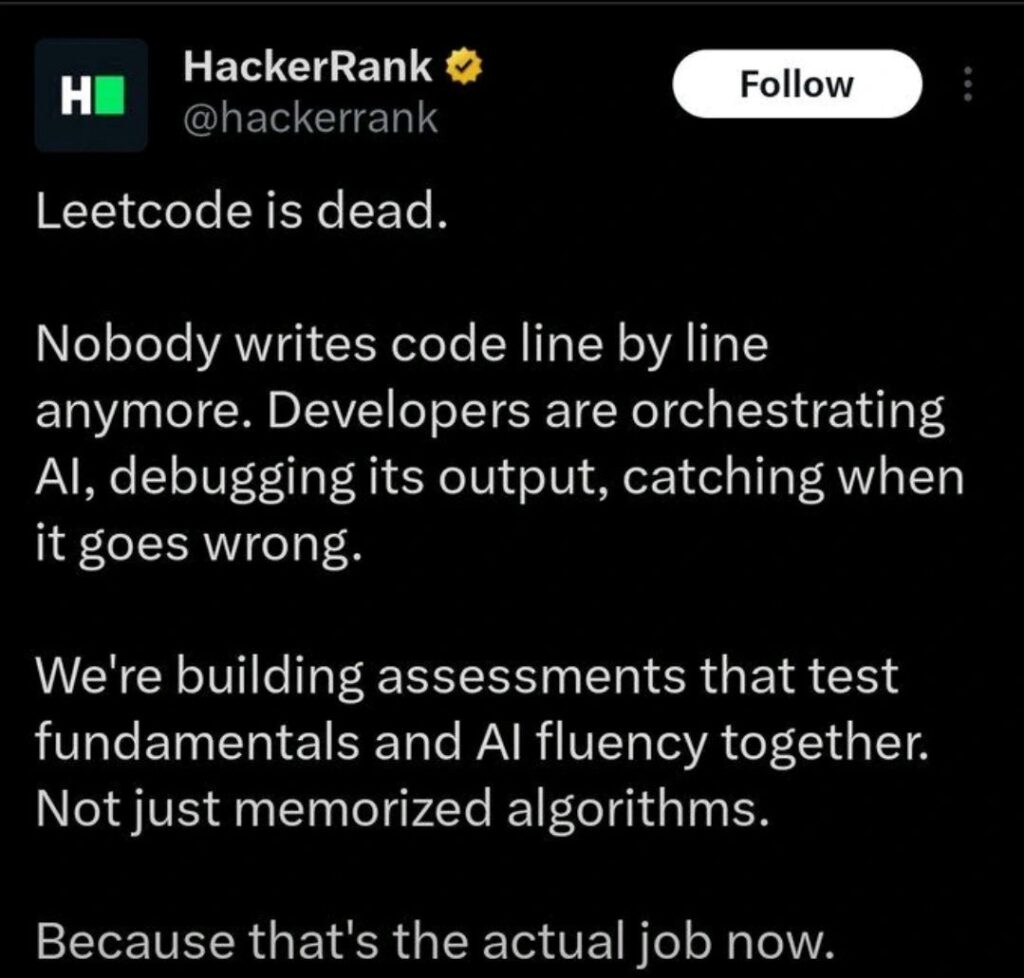
Therefore, testing humans on algorithms no longer measures their ability to build software; it measures their ability to memorize or to prompt.
In this article, we will explore how companies are evolving their evaluation of hard skills in this new landscape.
Algorithm interviews are obsolete, and here’s what replaces them.
From Code Writing to System Thinking
In 2026, the best developers are not those who memorize binary tree tricks or recall obscure patterns. The best developers are those who can do problem-solving, validate AI-generated code, and detect subtle bugs and security issues.
In short, software engineers’ role is to design maintainable systems, which demands a completely different evaluation model.
How Should Companies Evaluate Developer Hard Skills in 2026?
A company must measure a developer’s value not by their code, but by their judgment. In other words, a developer must think like an engineer. While programmers transform AI-generated snippets into code, engineers act at a higher level, questioning the AI’s output and defining architecture.
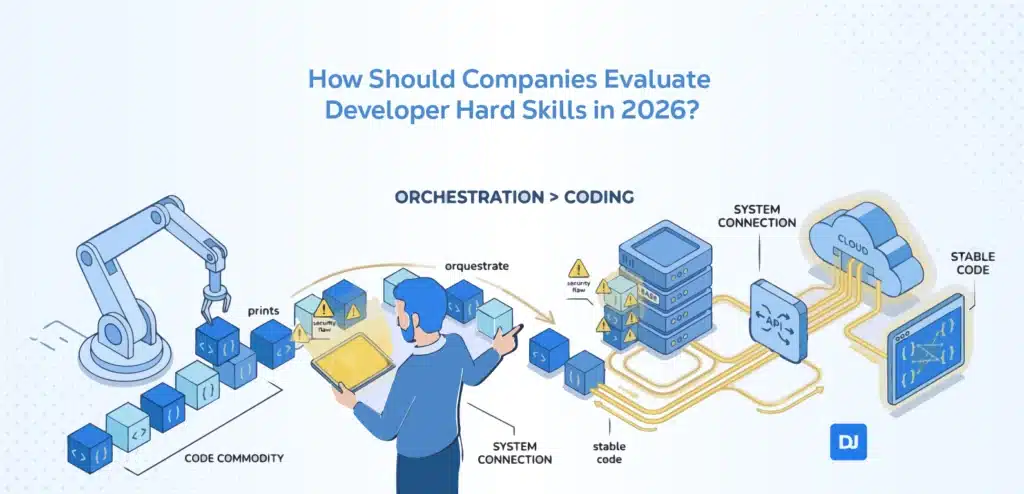
Since AI is commoditizing coding, developers and programmers are susceptible to automation. However, AI increases demand for engineers capable of governing and making complex decisions. Developers must mature into a strategic profile, rather than acting action-oriented.
1. From AI Generating to AI Verifying
In the AI era, the bottleneck isn’t writing code; it’s reading and validating it to avoid technical debt. Companies are shifting assessments toward a strategic review.
For instance, recruiters send candidates 500 lines of AI-generated code that mostly works. However, they write into it a subtle race condition, a security flaw (like an SQL injection), or an architectural mismatch.
Can the candidate spot why the perfect-looking AI code will actually crash in production?
2. Testing System Orchestration
Hard skills are moving up-stack. Evaluation now focuses on how a developer connects complex components rather than how they write a sorting algorithm.
For example, candidates must build a small, functional service (e.g., an API that integrates with a payment gateway and a database) using an AI-assisted IDE.
The recruiter must measure their ability to define data flows, handle edge cases, and ensure the AI-generated snippets actually form stable code.
3. Evaluation of Context Articulation
Prompt Engineering is a hard skill that requires a deep understanding of computer science to describe constraints to an AI.
Another example: candidates must guide an AI to solve a complex problem. If the candidate doesn’t know what a “Binary Tree” or “Idempotency” is, they won’t be able to prompt the AI to use them correctly. They need precision in technical communication and depth of underlying CS theory.
4. Real-Time “AI-Collaboration” Tracking
Platforms like HackerRank have introduced AI-Assisted IDEs for interviews. They don’t ban AI anymore; they watch how candidates use it:
- How they prompt
- What they accept/reject
- How they validate output
- How do they debug hallucinations
If a candidate blindly copy-paste code without reading it, fails to ask the AI to optimize for memory, or cannot explain what the AI just produced, then the candidate doesn’t have the actual hard skills required.
What Still Matters from the dead LeetCode?
Foundational CS knowledge is still important. A candidate must understand data structures, time complexity, and memory trade-offs. But their weight is shifting.
Instead of focusing on algorithm puzzles from the dead LeetCode that mostly don’t solve business problems, the new LeetCode will move towards fundamentals, system design, architecture, refactoring, security, AI collaboration, and code quality.
| Old Method (LeetCode Era) | New Method (AI Era) | |
| Primary Task | Writing logic from scratch | Architecting and Refactoring |
| Focus | Syntax and Algorithms | Code Quality and Security |
| Environment | Restricted (No Google/AI) | Realistic (Full AI access) |
| Key Result | Does the code pass tests? | Can the developer explain/fix the code? |
How DistantJob Tests Your Potential Candidates
DistantJob’s “Triple Approval Process” is a three-step procedure our company uses to ensure the quality of candidates presented to clients. The main goal of this process is to save the client time by performing rigorous vetting of candidates.
The process involves the following steps:
First stage: Sourcing Team
Sourcing and programming specialists headhunt profiles that may match the client’s needs and contact them. After an initial assessment, successful candidates are forwarded to the recruitment team.
Second stage: Recruitment Team
Recruiters evaluate and confirm whether candidates continue in the process. Those who qualify are interviewed for an hour, where technical and interpersonal skills are assessed, with cultural fit being crucial. Candidates who pass this interview are sent to Account Managers.
Final Stage: Account Management Team
Account managers are in constant contact with the client from the very beginning. They are the first to understand the client’s needs and the last to evaluate candidates against those requirements. They review the scores and evaluations of both earlier teams. If they find the candidates worthy, they share the evaluation summary and resume with the client.
This intensive process ensures that only one or two candidates are approved per week from a large number of profiles reviewed. We invest time and energy into this process so that our clients don’t have to.
60% of its clients hire after the first resume is submitted, and 80% after the second, because of this process. Additionally, we spend an extra hour vetting candidates already qualified within this process to minimize the client’s time spent.
Conclusion
LeetCode’s “death” by AI caused a paradox in the tech hiring market. The more AI generates code, the greater the need for engineers to govern the code. Without engineering governance, AI is like a soldier who can’t aim with a machine gun. It generates code snippets without stopping, but it can’t hit the target.
If you’re evaluating developers in 2026, stop asking “Invert a binary tree on a whiteboard.” Instead, ask:
- “How would you validate AI-generated production code?”
- “Where would this system fail at scale?”
- “What monitoring would you implement?”
- “How would you optimize AWS costs here?”
The job has evolved. Your interview process must evolve with it.
At DistantJob, we’ve already evolved our vetting process to identify high-level senior engineers worldwide. We don’t just find people who can write code; we find the remote experts who can architect your future.
If you need engineers who can navigate the AI landscape, govern complex systems, and lead your technical strategy, contact us!