At least three times, Dario Amodei, Anthropic’s CEO, predicted that AI Models would replace software engineers and that AI would write 90% of the code (October 2025, March 2025, and January 2026). However, as of February 2026, there are no records of Anthropic laying off any engineers due to automation. On the contrary, the company continues in a phase of aggressive hiring of senior developers.
Last year, Anthropic showed plans to triple its international staff and quintuple its applied AI team. The plan is ongoing, Anthropic continues its rapid global ascent, and establishes a significant physical presence in major tech hubs like Bengaluru, Seoul, Tokyo, Dublin, and London.
It’s plausible to assume that AI will write 90% of the code, but LLMs won’t replace senior engineers any time soon. In fact, the era of AI demands the hiring of senior developers more than ever.
In this article, we will understand why senior developers are the key to unlocking AI’s full potential for the times to come.
Why AI is No Silver Bullet?
To understand why AI is no substitute for senior engineers, we have to return to 1986’s article called “No Silver Bullet”, written by the renowned researcher Fred Brooks. According to him, software possesses four essential properties that distinguish it from other types of engineering:
- Complexity: Unlike hardware or bridges, software is extremely complex, with thousands of logical paths and interactions. Software is difficult to visualize and manage.
- Conformity: Software must conform to human interfaces, operating systems, hardware, and pre-existing regulations. Many of these are not consistent over time, which increases the development challenge.
- Changeability: Software is constantly modified to meet new needs, fix errors, or adapt to the environment. This ease of change creates constant pressure for evolution. Software that doesn’t change is a dead product.
- Invisibility: Software has no direct geometric or physical representation. It is conceptual, which makes it difficult to visualize its structure, flow, and dependency relationships.
Brooks argues that even by eliminating all accidental complexity (e.g., bugs, glitches, AWS or Cloudflare going down, etc.), these four properties cannot be eliminated by AI.
Fred Brooks says, “The hard thing about building software is deciding what to say, not saying it. No facilitation of expression can give more than marginal gains.” And the data support this claim.
Studies About AI Productivity: Senior Developers Still Win
Studies linked to Stanford indicate that generative AI provides modest productivity gains, generally between 7% and 20%. The technology accelerates code generation, but introduces errors and security vulnerabilities. It requires rework. The real impact depends on the task complexity and the developer’s experience. In other words, the senior developer you hire matters the most.
AI Slop: When AI-Driven Programming Generates Technical Debt
Reports from GitClear and Apiiro (from 2020 and 2024/2025) confirm concerning trends regarding the adoption of AI in software development. They discovered that production speed comes at a high cost to code quality. Here are the key points highlighted by the research:
- 8x Increase in Duplicate Code: An eightfold increase in the frequency of code blocks with 5 or more duplicate lines during 2024, compared to previous years.
- More Design Flaws and Technical Debt: AI has been prioritizing “local functionality” (making the code run) over “architectural coherence,” leading to code duplication and technical debt.
- Speed vs Risk: While Apiiro noted that AI can increase development speed, it also observed that teams using AI produced 10x more security vulnerabilities (such as design and authentication flaws).
- Decline in Maintainability: The percentage of moved/refactored lines dropped from 25% in 2021 to less than 10% in 2024, indicating that AI-generated code is less reusable.
Moreover, Cast Software’s 2025 State of Technical Debt found that it would take 61 billion days to refactor AI’s Technical Debt in all lines of code. The 2025 Veraricode Gen AI report reveals that 45% of AI-generated code contains critical vulnerabilities (OWASP Top 10), with the security failure rate in Java exceeding 70%.
AI helps developers write code faster, but it often bypasses the clean code practices that keep systems healthy and secure in the long run.
AI Speed Mileage Might Vary
According to a METR study published in July 2025, senior developers using AI tools were, on average, 19% slower at completing tasks compared to working without AI assistance. Despite decreased speed, these developers perceived themselves as being 20% faster when using AI. The phenomenon was described as a “productivity placebo”.
This shocking study contradicts previous research from 10 years ago, when Accenture forecasted a 40% improvement in software development speed with AI. This forecast is still used by analysts today.
Seniority Premium: Why Hire Senior Developers
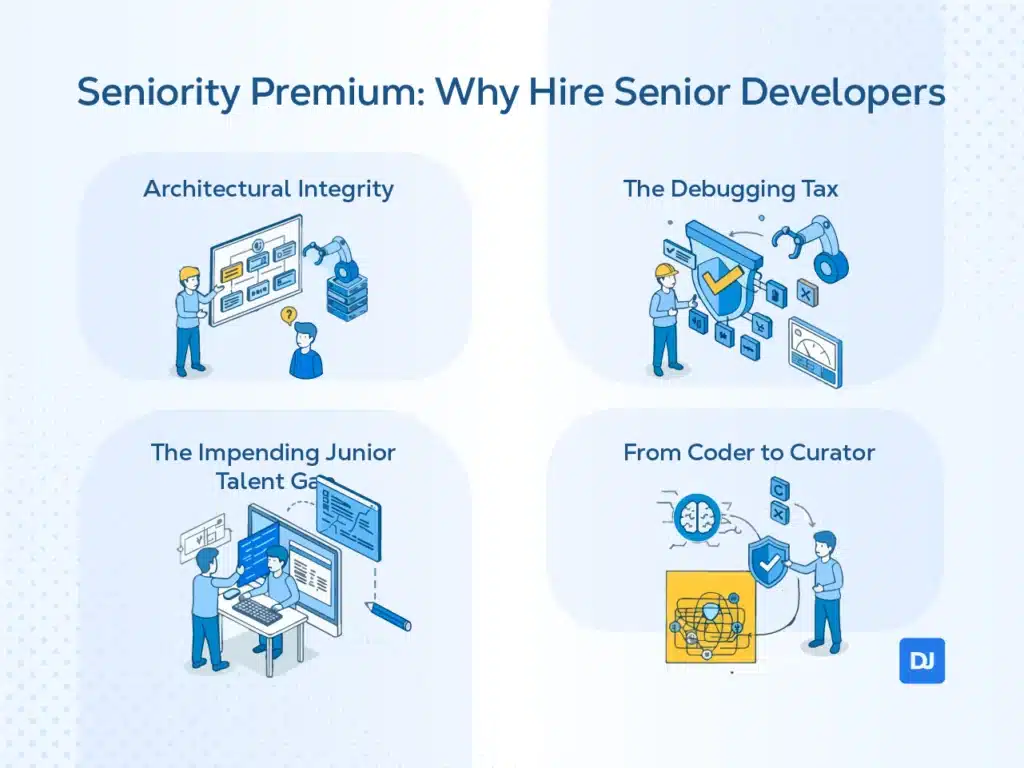
There is a critical paradox: as AI’s ability to generate code increases, Senior Developers’ value is actually skyrocketing. To elaborate further, we can break down the “Seniority Premium” in the age of AI into four key dimensions: Architectural Integrity, The Debugging Tax, The Junior Pipeline Crisis, and The Shift from Coder to Curator.
1. Architectural Integrity
AI prioritizes functionality over architectural coherence. LLMs predict the next most likely token. When asked to build a feature, they provide the shortest path to making that specific feature work. In other words, they ignore the bigger picture. For example, how will this new code interact with the existing 500,000 lines of legacy code?
On the other hand, seniors understand that code is read 10x more than it is written. While AI can write a function in seconds, a Senior Developer decides where that function should live, how it should be abstracted, and whether the code creates a circular dependency that will crash the system six months from now.
2. The Debugging Tax
It’s easier to write a clean paragraph from scratch than to edit a poorly written paragraph produced by someone else. When an AI generates slop, a Senior Developer must:
- Verify the logic.
- Check for subtle security hallucinations.
- Ensure it adheres to the company’s specific style and performance constraints.
This Debugging Tax can nullify code generation speed. As AI writes 90% of the code, the 10% that remains becomes the most expensive and high-risk part of the project.
On the other hand, if the senior developer establishes clear guidelines and policies for the LLM from the start and if the functionality is significantly smaller, the Debugging Tax becomes lower.
3. The Impending Junior Talent Gap
If AI takes over the easy tasks (90% of code), how do Junior Developers learn the skills to become Seniors? Historically, Juniors learned by doing the grunt work: fixing small bugs, writing unit tests, and boilerplate.
If AI does all the grunt work, the entry-level training ground disappears.
Senior Developers are Education Architects. Companies hire them not just to code, but to design internal mentorship frameworks that ensure the next generation of engineers can understand the systems that AI is helping to build.
4. From Coder to Curator
In the AI era, the Senior Developer’s job description is shifting. Before AI, seniors should write efficient syntax and master language quirks. They still have to do that, don’t take me wrong!
However, Seniority now means to manage Context and System Design even more than before. Seniors are Curators who translate business needs into both code and prompts.
How Seniors Use AI
The rise of AI hasn’t changed the what of software engineering as much as it has changed the how. AI is not a replacement but a sophisticated power tool. To maintain high standards while leveraging these tools, seniors divide their workflow into two categories: high-velocity delegation and high-stakes manual oversight.
| Leveraging AI | Avoiding AI |
| Boilerplate & Scaffolding: Generating repetitive structures, standard API endpoints, and setup files. | Architectural Decisions: Deciding how systems scale, how data flows, and how the overall design remains coherent. |
| Unit Testing: Rapidly generating test cases for various edge scenarios. | Ambiguous Requirements: Navigating the “gray areas” where business needs are poorly defined or contradictory. |
| Documentation: Drafting initial versions of README files or inline comments based on existing logic. | Root-Cause Debugging: Solving deep, systemic bugs that AI-generated “quick fixes” often overlook or exacerbate. |
| Refactoring Logic: Using LLMs to suggest more idiomatic ways to write a specific, isolated function. | Long-term Sustainability: Ensuring the code remains maintainable five years from now, not just “runnable” today. |
Conclusion
AI has made coding cheaper and faster, turning Software Engineering more valuable than ever. The prediction that AI will write 90% of our code may very well come true. However, as data from 2025 and early 2026 suggest, the tipping point is at the 10%.
As Fred Brooks noted decades ago, the hardest part of software is the deciding, not the saying. AI says faster than ever, but it lacks human wisdom to decide.
Don’t let AI slop compromise your system’s integrity! At DistantJob, we specialize in finding the top 1% of remote senior developers who navigate the complexities of the AI era.
Whether you need an architectural visionary or a seasoned curator to lead your team, we connect you with global talent that delivers quality over mere “local functionality.”
Ready to hire senior developers who will safeguard your business? Book a call today!