The distinction between mercenaries vs missionaries is the biggest difference between ordinary technology companies and high-performance ones. This idea, popularized by investor John Doerr, establishes that successful companies don’t need people who merely follow orders. Instead, the best companies nurture teams that truly believe in a vision and are committed to problem-solving. For that reason, your Upwork alternatives can’t be another freelancer marketplace, or else, you will just get more of the same.
A freelancer won’t likely commit to your project as much as your own employee. Unlike an employee, whose professional universe revolves entirely around your company, a freelancer is running their own business. Employees often have their skin in the game, while freelancers are paid for a specific output.
Moreover, employees absorb the company’s nuances and culture, while it is harder for freelancers to feel a sense of “ownership” over the company’s brand.
Here, we will discuss one of the biggest challenges in remote work: hiring an employee who is ready to be a missionary rather than a mercenary. Spoiler alert: it’s all about who you hire and where.
The Differences between Mercenaries vs Missionaries
Mercenaries vs. Missionaries describes two opposing mindsets, especially in business and tech. Mercenaries are motivated by money, quick wins, and personal gain, often just executing tasks for pay, lacking deep loyalty or belief in the why. Missionaries are driven by passion, purpose, and customer value, deeply committed to a vision (like spreading a faith or solving a core problem).
Although John Doerr originated the concept, Marty Cagan transformed it into one of the fundamental pillars of modern Product Management. Technological success depends on empowered product teams that passionately solve real problems, rather than just delivering features.
Here are the primary reasons why a freelancer’s commitment level is one of a mercenary, naturally different from that of an internal team member (missionary):
1. Focus on the Output vs Focus on the Outcomes
Mercenaries work in “feature factories”. Their success is measured by delivering outputs before the due date, as agreed beforehand with stakeholders. In short, they are ticket takers.
In the meantime, missionaries focus on business results and value for the client. They don’t feel free from obligation when they release a feature. Good employees only rest when a product solves a problem and reaches the desired results. They truly believe in your product.
In other words, hiring a freelancer on Upwork or another marketplace will bring someone who finishes up a task, while hiring an employee will bring someone who delivers value. The best Upwork alternative will always stay away from freelancers.
2. Command and Control vs Empowerment
Mercenaries operate under a command-and-control model, where leaders and stakeholders make significant decisions. Freelancer teams merely execute. As the project doesn’t belong to them, this results in low motivation and a lack of ownership.
In contrast, missionary teams are empowered. Internal hire employees solve problems instead of just building features. They are accountable for the product’s success, leading to autonomy, which fosters a deep sense of ownership and responsibility.
Hiring a freelancer from a marketplace will bring an executor. Hiring from an actual Upwork alternative, which means hiring employees, will bring an empowered problem-solver eager to show their potential.
3. The Role of Engineers
In the mercenary/freelancing model, engineers just code and are involved later in the process, usually only in sprint planning to estimate deadlines.
In the missionary model, engineers are deeply involved in product discovery. Since they deal daily with evolving technology, they are often the best source of innovation, as they know what is possible.
A freelancer marketplace will bring someone who codes by demand, while a true Upwork Alternative brings innovators who code by passion rather than more mercenaries.
4. Outsourcing vs Culture
Outsourcing is a common practice in mercenary models, treating technology as a necessary cost rather than a core competency or a competitive advantage. The result is a company full of mercenary teams by definition, who have no connection to learning or the company’s future.
The best product companies avoid outsourcing their core competencies, as they know that a small group of missionaries will always outperform a large group of mercenaries.
The risk of hiring freelancers is that you will have to hire more and more, even if they are cheaper. Leveraging an Upwork alternative and avoiding mercenaries will bring you a cost-efficient, smaller team that is passionate about your culture and brand.
Why DistantJob is the Best Managed Upwork Alternative
While Upwork is a marketplace where you browse for help, DistantJob acts as a specialized headhunter that manages the legal and cultural aspects of hiring. Here is the breakdown of your best Upwork Alternative.
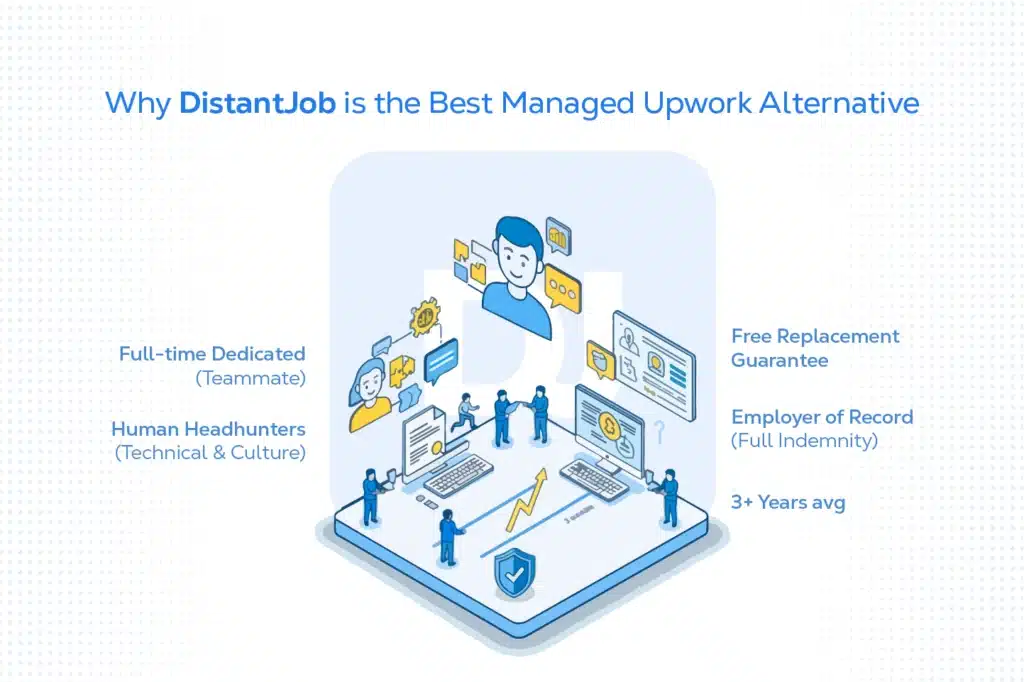
| Feature | Typical “Gig” Platform (Upwork) | The Managed Upwork Alternative (DistantJob) |
| Commitment | Project-based (Mercenary) | Full-time Dedicated (Teammate) |
| Vetting | Algorithm/Self-reported | Human Headhunters (Technical & Culture) |
| Replacement | Start over from scratch | Free Replacement Guarantee |
| Compliance | User beware (1099 risk) | Employer of Record (Full Indemnity) |
| Retention | ~3-6 months avg | 3+ Years avg |
1. Commitment: Mercenary vs. Teammate
Upwork (Mercenary): A freelancer usually juggles multiple clients. Their goal is to finish your task as quickly as possible so they can move on to the next billable project.
DistantJob (Teammate): You are not merely hiring. You are getting true stability with someone for a 40-hour-a-week, permanent role. We aren’t looking for other “gigs”; we focus solely on your company’s long-term success.
2. Vetting: Algorithm vs. Human
Upwork: You rely on reviews and an algorithm. You often have to spend hours sorting through hundreds of low-quality applications to find one diamond in the rough.
DistantJob: Professional recruiters do the work for you. Our experts don’t just check if the person can code; they use Human Headhunters to ensure the person fits your company’s specific culture and personality. No AI hallucination will fumble your success. Additionally, you find a professional with a long-term intent, rather than someone looking for a gig.
3. Replacement: Starting Over vs. Guarantee
Upwork: If a freelancer disappears, you have to post a new job, interview again, and hope for the best. Upwork is not legally accountable for the freelancer’s behavior, while they can provide financial safety nets depending on how you set up the contract.
DistantJob: We offer you a Free Replacement Guarantee. If the person doesn’t work out within a certain timeframe, our agency finds you a new one at no extra cost, removing the financial risk of a “bad hire.”
4. Compliance: Risk vs. Indemnity
Upwork: You are responsible for following tax laws (1099 vs. W-2). If you accidentally treat a freelancer like an employee, you could face legal or tax penalties (misclassification risk).
DistantJob: We act as an Employer of Record (EOR). This means we legally employ the person in their home country, handle all the international paperwork, and protect you from legal liability.
5. Retention: 3 Months vs. 3 Years
Upwork: Since the relationship is transactional, churn is high. Most gig relationships end as soon as the project is over or the freelancer finds a higher-paying gig.
DistantJob: Because these are full-time careers with benefits and stability, our average retention is significantly higher (3+ years). This saves you a massive amount of money on retraining and lost knowledge.
Conclusion
The choice between a mercenary and a missionary is a choice between maintenance and growth. While platforms like Upwork serve a purpose for quick, transactional tasks, they are not designed to build stability for a high-performance company.
A freelancer might help you clear a backlog, but only a dedicated employee will help you innovate your way to the top of your industry.
Choosing an Upwork alternative, such as DistantJob, moves your company away from the gig economy cycle. It means saying goodbye to constant rehiring and shallow engagement.
Don’t settle for someone who just checks boxes! Hire a missionary who shares your vision and has skin in the game to see it through! Contact us today and find your game-changing missionary!