After 15+ years running DistantJob and placing hundreds of developers with North American companies, I’ve watched the same pattern repeat: a company burns 3–4 months trying to hire on their own, fails, then comes to us. The hire closes in 3 weeks.
This guide explains exactly when an IT recruitment agency makes sense, what you actually get for the fee, and how to tell the good ones from the ones that just post your job on LinkedIn and call it a day.
What is an IT Recruitment Agency?
An IT recruitment agency is a firm that specialises in the end-to-end sourcing, screening, and placement of technology professionals for its clients. This includes candidate sourcing, multi-layer technical screening, package negotiation, and onboarding. The best agencies do more than just advertise jobs on job boards. They headhunt passive candidates, assess candidates technically, and handle post-hire compliance. They normally charge either a percentage placement fee ( 15%–30% of annual salary) or a fixed monthly fee.
7 Reasons IT Recruitment Agencies Deliver Better Hires
In today’s competitive tech landscape, collaborating with premier IT staffing agencies can give your company a significant edge. Here’s why partnering with top-tier tech recruitment firms is a game-changer:
1. They Reach Candidates Who Aren’t Looking
IT recruitment agencies do ~70% of their placements via passive candidates. These are developers who are currently employed and not browsing jobs on job boards. A headhunter approaching a senior developer quietly working for a stable company will reach a completely different tier of candidates than a job ad will. In DistantJob’s case, our sourcing team filters through ~3,000 candidates per open role, with only 2– 5 making it to the final shortlist.
2. Technical Vetting That Your HR Team Can’t Replicate
Most in-house HR teams can interview for soft skills, but they’ll have no clue if your candidate’s choices when designing a React architecture will stand up when under heavy load. By contrast, specialized agencies will have rigorous multi-layer technical testing, including live code challenges, architecture interrogation, and reference checks with past customers and managers that are also engineers. In DistantJob’s case, we conduct 4 layers of vetting, with only the top 5 out of hundreds of candidates advancing to a client interview.
3. Time-to-Hire Is 3–5x Faster
The average time-to-hire when recruiting IT roles internally is 42–58 days. Specialized IT agencies have ready pipelines of calibrated candidates that allow them to cut that time to 2–4 weeks.
This is important because for every week you leave a senior engineering role open, your costs include more than a recruiter’s salary: you’re also delaying your product, putting added stress on your team, and losing revenue that these features would be bringing in.
4. Cost Per Hire Is Lower Than It Looks
The sticker price of an agency fee, 15–30% of annual salary, or a fixed monthly retainer, feels expensive until you account for the full internal cost: recruiter time, job ads, technical assessment tools, interviewing hours from senior engineers, and the compounding cost of a longer vacancy. A bad hire at the senior level typically costs 1.5–2x the annual salary in replacement and productivity loss. Agencies that guarantee replacements shift that risk off your balance sheet.
5. Global Reach Without Global Compliance Headaches
In the US, an agency with Employer-of-Record capabilities can ensure there’s a local, legal entity in a developer’s country to handle local taxes and mandatory benefits. Without that capability, hiring a developer in Poland or Colombia requires that you either register an entity abroad, or hire them as a contractor, with all the risks that doing so entails. As for cost, DistantJob clients will often hire senior developers from Eastern Europe and Latin America at around half the price of the equivalent US hire while being fully compliant.
6. Cultural Fit Is Assessed Before You Interview Anyone
A technical hire who can’t communicate across time zones, align to async workflows, or integrate into your team culture is still a bad hire. The best IT agencies assess remote-work readiness, communication style, and cultural alignment before presenting candidates, not as an afterthought. This is why DistantJob developers average 4 years of tenure vs. the industry average of 1–2 years.
7. Post-Hire Support Extends the Value
A placement shouldn’t end when the developer starts. Leading IT recruitment agencies provide regular check-ins during the first 90 days, flag early engagement or performance signals, support retention conversations, and activate replacement guarantees when needed. This ongoing layer of support is what separates a staffing vendor from a long-term hiring partner.
How to Choose the Right IT Recruitment Agency
The right IT recruitment agency depends on three variables: the type of hire (full-time vs. contract), the geography (local vs. global), and whether they specialize in IT or cover all sectors. Ask any agency you evaluate these five questions before signing anything.
5 questions to ask before committing:
- What’s your fee model? Percentage-of-salary models create an incentive to inflate the candidate’s salary. Fixed-fee models don’t.
- What does your vetting process actually look like? Ask for the number of candidates screened per hire and the specific assessment steps. Vague answers (“we interview everyone carefully”) are a red flag.
- What’s your average time-to-shortlist? Anything over 4 weeks suggests they’re posting job ads, not actively headhunting.
- Do you offer a replacement guarantee, and what triggers it? The standard is 90 days; some agencies offer 6 months.
- How do you handle payroll and compliance for international hires? If they don’t have EOR capabilities and you’re hiring globally, you’re absorbing the legal risk yourself.
The Best IT Recruitment Agencies in 2026: Quick Comparison
| Agency | Best For | Model | Notable Stat |
|---|---|---|---|
| DistantJob | Remote-only global IT, full-time | Fixed monthly retainer + EOR | 60% of clients hire after the 1st candidate; avg. 4-year retention |
| Robert Half | Volume hiring across mixed roles, US-local | % of salary commission | 400+ locations worldwide |
| TEKsystems | Enterprise IT, contract-to-hire, high volume | Staffing markup | 95% client retention rate |
| Toptal | Elite freelance, speed-critical short-term | High hourly markup (top 3%) | Matches within 48 hours |
| Kelly Services | Full-service, multi-department SMBs | % of salary or staffing markup | ~500,000 workers placed weekly |
DistantJob vs. the field: DistantJob is the only agency on this list focused exclusively on full-time remote IT placements for North American companies, with EOR built in. If you need a contractor for 2 months, use Toptal. If you need a committed senior developer embedded in your team for the long term, use DistantJob.
The best IT recruitment agencies in 2026 are DistantJob, Robert Half, TEKsystems, Toptal, and Kelly Services. DistantJob leads for remote-only global IT hiring, placing senior developers at roughly 50% of US salaries with an average retention of 4 years. Robert Half suits companies needing volume across mixed roles, while Toptal delivers elite freelance talent within 48 hours.
1. DistantJob: Best for Remote-Only IT Global Specialist Headhunting
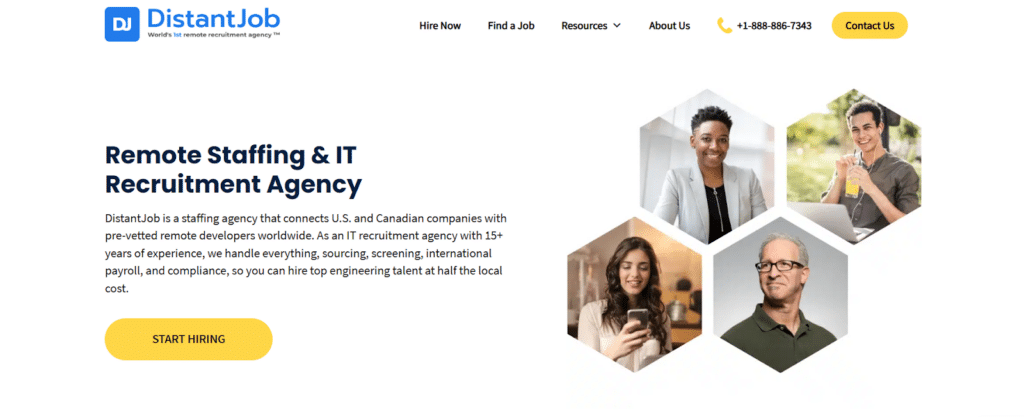
DistantJob stands out as a pioneer in remote IT recruitment, specializing in connecting businesses with top-tier tech talent worldwide. For an SMB looking to hire skilled developers or IT staff at a reasonable cost, DistantJob offers a full-service solution that finds you elite talent from around the globe and embeds them in your team. Unlike traditional staffing firms, DistantJob focuses exclusively on permanent remote placements, meaning you can hire a full-time developer from overseas who works remotely but is fully dedicated to your company. We combine the personalized, high-touch approach of a boutique recruitment agency with the speed and scale of a larger hiring platform.
End-to-End Recruitment
DistantJob handles end-to-end recruitment. They headhunt globally, rigorously vet candidates, and even act as the employer of record if needed, simplifying international hiring. Their vetting process is exceptionally thorough: candidates are filtered through three layers of technical and cultural screening, so you interview only the top 5 out of hundreds of applicants.
You get a dedicated team that actively headhunts and vets top-tier developers, not just browsing a generic database. This ensures even a small business with limited HR capacity meets only pre-qualified, high-caliber candidates.
SMB Benefits
You can hire experienced developers or IT specialists, often at cost-effective salaries (leveraging geographic wage differences), without compromising on quality. DistantJob also emphasizes cultural fit; they take time to understand your company’s culture and values, increasing the chances of a successful long-term hire. For an SMB, this means reduced risk of turnover and a new team member who integrates smoothly into your workflows.
Notable Feature
They don’t just staff positions; they provide ongoing post-hire support (e.g., handling payroll, compliance management, onboarding, and any replacement guarantee), which is a huge relief for small businesses new to remote global hiring.
2. Robert Half: Best for Hiring a Variety of Roles
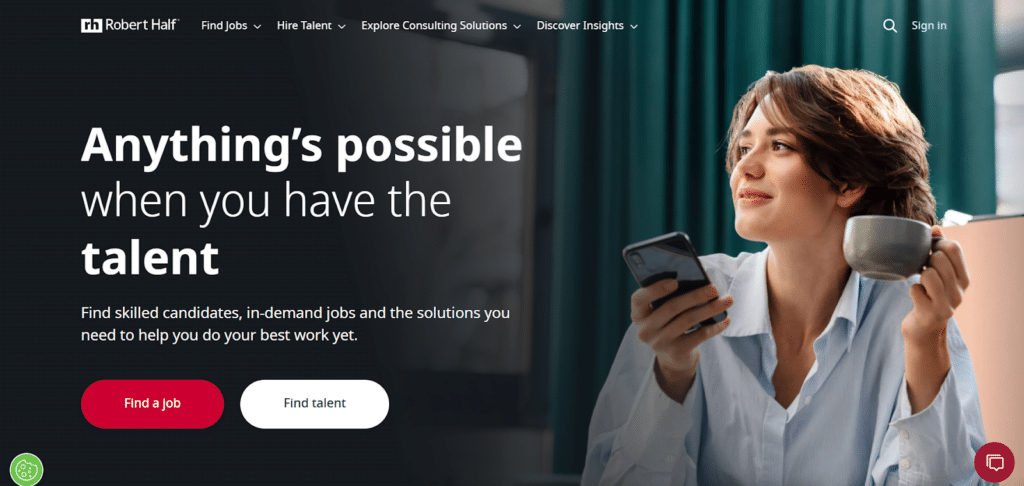
Robert Half is a household name in the staffing industry, with many years of experience recruiting across various fields, including IT. They have a strong U.S. presence (400+ locations worldwide) and a massive talent network. For SMBs, Robert Half offers reliability and a one-stop-shop approach to hiring: they can quickly fill tech positions (and others) by drawing from its extensive candidate database.
Experience and Scale
You can approach Robert Half for anything from a helpdesk technician to a senior software developer, and expect a shortlist of vetted candidates relatively fast. They also offer temporary, contract-to-hire, and permanent hires, giving small businesses flexibility in uncertain times.
SMB Benefits
Robert Half’s team often guides SMBs through the hiring process with expert advice. This consultative aspect (advising on market salary ranges, job description improvements, or even interview tips) can be invaluable for a business without a dedicated recruiting team. Also, their broad reach across industries means that if you’re an SMB in a niche industry or smaller market, Robert Half likely still has relevant IT candidates or can tap adjacent markets. Essentially, you get the support of an experienced recruiting powerhouse to compete with larger firms for talent
Cons
Because Robert Half is a general staffing firm (covering finance, admin, creative, etc., in addition to IT), the recruiters you work with may not be as specialized in tech roles as some niche agencies. However, they do have dedicated IT recruitment divisions and a vast repository of hiring data to ensure quality matches.
3. TEKsystems: Best for High Volume of Local IT Enterprise Staff,
TEKsystems is a large IT-focused recruitment and staffing company known for its specialization in technology roles and projects. They operate across the US with over 100 locations and primarily serve companies seeking technical expertise, whether for short-term projects or permanent roles. TEKsystems can be a great ally for SMBs undergoing rapid growth or tackling tech initiatives (such as a new app or cloud migration) that require scalable staffing.
Deep IT expertise and talent development.
They provide candidates in virtually every IT domain (software development, cybersecurity, data, infrastructure, you name it). What sets TEKsystems apart is its ability to quickly supply contract-based consultants for project needs and to help fill full-time positions. They also invest in training and upskilling their pool of consultants, ensuring the talent you get is up to date with the latest technologies.
SMB Benefits
For a small or mid-sized business, TEKsystems offers flexibility. If you need a team of contractors for a 6-month implementation, they can assemble and manage that team. If you decide to hire a few permanently, they can facilitate that as well. This “try before you buy” model (contract-to-hire) is attractive to SMBs wary of committing to full-time salaries without seeing performance. Their large candidate pool means even niche skills (say, an AWS-certified DevOps specialist or a Unity game developer) can be found relatively quickly through their channels.
Pros: Local presence with a global reach.
Because they have offices across many cities, SMBs often get a local account manager who understands the regional market. At the same time, TEKsystems can recruit candidates from other regions or remote workers if the local supply is thin. This balance can be very reassuring for SMBs that want a face-to-face partnership and the reach of a national network.
4. Toptal: Best for Quick On-Demand Tech Talent
Toptal is not a traditional recruitment agency but a curated network of freelance software developers, designers, and finance experts. It markets itself by only accepting the “top 3%” of freelancers into its talent pool. SMBs that need high-caliber tech talent fast (especially for projects or part-time work) often turn to Toptal as a quality-guaranteed alternative to hiring on their own. While Toptal’s model is more on-demand and project-based, we include it here as many growing companies consider it alongside recruitment agencies when seeking talent.
Top-tier talent on a flexible basis.
Toptal rigorously vets its freelancers (through portfolio reviews, coding tests, interviews, etc.), so when an SMB requests, say, a Python developer, they are presented with a handful of expert candidates, usually within 48 hours. Their mantra is to offer the top 3% of freelance talent, and they back it up with intensive screening processes for applicants. Toptal also handles all freelancer contracts and payments, simplifying the engagement for businesses.
SMB Benefits
The ability to quickly plug skill gaps is a huge draw. If a small business’s website is suddenly crashing and needs a specialist to fix it this month, using Toptal to find a highly qualified engineer can be faster than a full recruitment cycle. Quality control helps SMBs avoid the risk of encountering unvetted freelancers on open marketplaces. Also, for startups or SMBs hesitant to hire a full-time senior developer due to budget, Toptal offers a way to get equivalent expertise on a part-time or project basis.
Considerations
Toptal’s talent comes at a premium cost (freelancer rates are high and Toptal’s margin is high). It’s ideal for project-based needs or interim solutions; if you need someone full-time, it might be more cost-effective to hire a permanent employee (where an agency like DistantJob or TEKsystems could be more appropriate). However, Toptal does allow contracts to turn into full hires if both parties agree. It’s a strong option for SMBs who value top quality and speed over cost in the short term.
5. Kelly Services (Kelly Technology): Best for Full-Service Flexible Staffing
Kelly Services offers a multifaceted approach to talent acquisition. They not only help you find candidates but also assist with the administrative side of employment. Kelly has a dedicated technology staffing wing (sometimes branded as Kelly Technology) that focuses on IT and engineering roles. For SMBs, Kelly’s services can provide much-needed hiring support across a range of positions, with the ability to scale as your business grows.
Notable Feature:
If your hiring needs extend beyond IT (maybe you also need an office manager or an accountant), Kelly can handle it all. There’s convenience in having a single point of contact for various hiring needs. For tech roles specifically, their recruiters and resources ensure you still get specialized attention. Plus, as a major player, Kelly often offers cost-effective rates for SMBs and may offer volume discounts or trial periods, given budget constraints.
Key Value Proposition
Kelly connects a staggering number of people with jobs; nearly half a million workers each week are employed through Kelly. For a small business, this scale means an enormous talent pool to draw from. Whether you need one IT support technician or 20 data entry clerks, Kelly can supply candidates.

Interactive Quiz to Match You with the Right Recruitment Service
If you still haven’t decided which option is best for you, this questionnaire can help you determine which tech recruitment service best suits your situation:
Find the Right Hiring Service for You
Conclusion
IT recruitment agencies earn their fee when the role is hard to fill, when the hiring team lacks technical depth to screen candidates, or when you’re hiring globally without compliance infrastructure. The average IT vacancy costs $500+ per day in lost productivity, a 3-week agency-driven hire vs. a 10-week internal search closes that gap fast.
If you need a full-time senior developer placed in under 3 weeks, with technical vetting, cultural alignment scoring, payroll, compliance, and a replacement guarantee built in, book a 15-minute discovery call with DistantJob. We’ll tell you exactly what talent is available for your stack, your budget, and your timezone requirements.
FAQ
A: DistantJob is the top choice for remote-only IT recruitment, offering end-to-end headhunting, a 3-layer vetting process, and employer-of-record services. 60% of clients hire after the first candidate presented.
A: Traditional agencies charge 15–30% of annual salary as commission. DistantJob uses a fixed monthly fee model instead, which avoids inflating candidate salaries.
Yes, agencies with employer-of-record (EOR) capabilities handle local tax registration, employment contracts, and benefits administration in the developer’s home country. This is critical for US companies hiring in countries where they have no legal entity.