React is the industry standard with the largest talent pool and ecosystem. Angular, which underwent 2026 updates, has made it a top-tier performer and is a modernized enterprise powerhouse built on Signals-based reactivity and strict TypeScript conventions. In addition, Vue remains the favorite for developers who want a more structured approach than React but find Angular’s boilerplate too steep.
| Tech Stack | Core Value Proposition | Best For… |
| React | Market Dominance. The industry standard with the most mature ecosystem of all. | Rapid hiring and projects requiring specialized third-party libraries. |
| Angular | Strict Performance. A modernized, high-speed powerhouse utilizing Signals-based reactivity. | Large-scale enterprise apps that need a robust structure. |
| Vue | Developer Experience. A refined middle ground that prioritizes intuitive, HTML-like syntax. | Teams focusing on developer satisfaction and clean, approachable code. |
React vs. Angular vs. Vue: Library vs. Framework vs. Progressive
The choice between React, Angular, and Vue hinges on the trade-off between flexibility and standardization.
React is a library that gives developers maximum freedom to choose their own tools. Angular is a full framework that dictates architecture and provides everything built-in. Vue is a progressive framework that scales from a lightweight widget to a full-scale application.
While all three have converged on supporting Server-Side Rendering (SSR) and hydration, they serve different company cultures.
| React | Angular | Vue | |
| Best For | UI-heavy SaaS, Design Systems | Large Enterprise, Internal Tools | Progressive Web Apps, Hybrid Teams |
| Philosophy | “Choose your own adventure.” | “The Golden Path” (Batteries-included) | “Approachable & Scalable” |
| State Mgmt | Community-driven (Zustand, Redux) | Built-in (Signals, RxJS) | Built-in (Pinia, Reactive API) |
| Learning Curve | Moderate (JSX + Ecosystem) | Steep (Strict conventions/TS) | Low to Moderate (SFCs) |
1. React: Choose Your Own Adventure
React prioritizes customization for user interfaces. Since it is a JavaScript Library, it doesn’t dictate a specific architecture, and it excels in varied environments, including micro-frontends or highly specific B2C apps.
However, this flexibility places the burden of maintainability on the team; you must define your own path for data fetching and state.
2. Angular: The Enterprise Framework
Angular is more like a full-scale framework; it dictates the architecture and calls your code, whereas you call functions from a library as needed. It is ideal for long-lived enterprise apps where consistency across large teams is more important than individual developer preference.
With the release of v21+, it has modernized significantly by moving toward Signals and zoneless operation. Angular reduces overhead while maintaining its trademark strictness.
3. Vue: The Progressive Hybrid
Finally, Vue strikes for a developer-friendly path from prototype to production. This progressive framework is the sweet spot for teams that need to start small but plan to scale later. Its Single-File Component (SFC) structure and approachable documentation make it the most intuitive for developers transitioning from standard HTML/CSS.
With Vue 3’s Scalability APIs and deep TypeScript integration, it has become a viable choice for long-term production systems.
Rationality: It excels in providing clear mental models for SSR vs. CSR, making the trade-offs easier for architects to communicate.
Performance Benchmarks and Comparison
In 2026, all three can deliver excellent UX. They differ on rendering strategy (SSR/CSR/SSG/hybrid), hydration strategy, data-fetching waterfalls, and bundle discipline, not the framework alone.
Angular’s official roadmap claims substantial Core Web Vitals gains from hydration work in lab tests, and Angular documents why removing ZoneJS can reduce overhead and improve CWV. In the meantime, React 18 introduced streaming SSR with Suspense; Vue’s SSR docs describe hydration mechanics explicitly.
Comparing React vs Angular vs Vue on DOM Performance
Virtual DOM (React, Vue) and Incremental DOM (Angular) are not about speed, but about optimization. While Virtual DOM focuses on minimizing UI calculation time, Incremental DOM focuses on minimizing memory and bundle size.
Virtual DOM (VDOM)
Used by React (19.2+) and Vue (3.5+). It creates a full in-memory “clone” of the UI. When data changes, a new VDOM is built, compared (diffed) against the old one, and only the differences are pushed to the Real DOM.
Incremental DOM (IDOM)
Used by Angular’s Ivy engine. It does not create a full in-memory copy. Instead, it compiles templates into a set of instructions that “walk” the Real DOM and apply changes directly to nodes only if the data has changed.
| Metric (Avg. 2026) | Vue 3.5 (VDOM) | React 19.2 (VDOM) | Angular 20 (IDOM) |
| Initial Bundle Size | 18–22 KB | 32–40 KB | 110–130 KB |
| Time to Interactive (TTI) | 1.2s – 1.8s | 1.4s – 2.0s | 1.8s – 2.5s |
| Memory Usage (50+ Comps) | 12–18 MB | 15–22 MB | 18–28 MB* |
| Hydration Time | 25–45ms | 40–70ms | 70–120ms |
*Note: While Angular’s memory footprint is larger, IDOM itself is more memory-efficient during the actual rendering cycle because it doesn’t hold a second tree in memory.
The VDOM Advantage: Fast State Transitions
React and Vue leverage VDOM with high-frequency updates (real-time dashboards, collaborative tools, etc.). Since VDOM batches updates in memory before touching the browser, it avoids layout thrashing.
The IDOM Advantage: Memory & Tree-Shaking
Angular’s IDOM approach is designed for Enterprise Scale. Its biggest strength in 2026 is its tree-shakability. IDOM is a series of instructions; the build tool can delete any instruction your app doesn’t use.
Angular starts with a heavier bundle (due to its built-in router, forms, etc.). However, IDOM ensures that the memory overhead remains low during long-running sessions. This is critical for 2026 Micro-Frontend architectures, in which multiple apps run in the same browser tab.
React vs. Angular vs. Vue: The Learning Curve
This is a major pain point for project leads. The cognitive load required to reach “senior-level” productivity varies wildly across the three stacks. We’ll discuss React’s JSX syntax, Angular’s TypeScript-heavy nature, and Vue’s approachable template system.
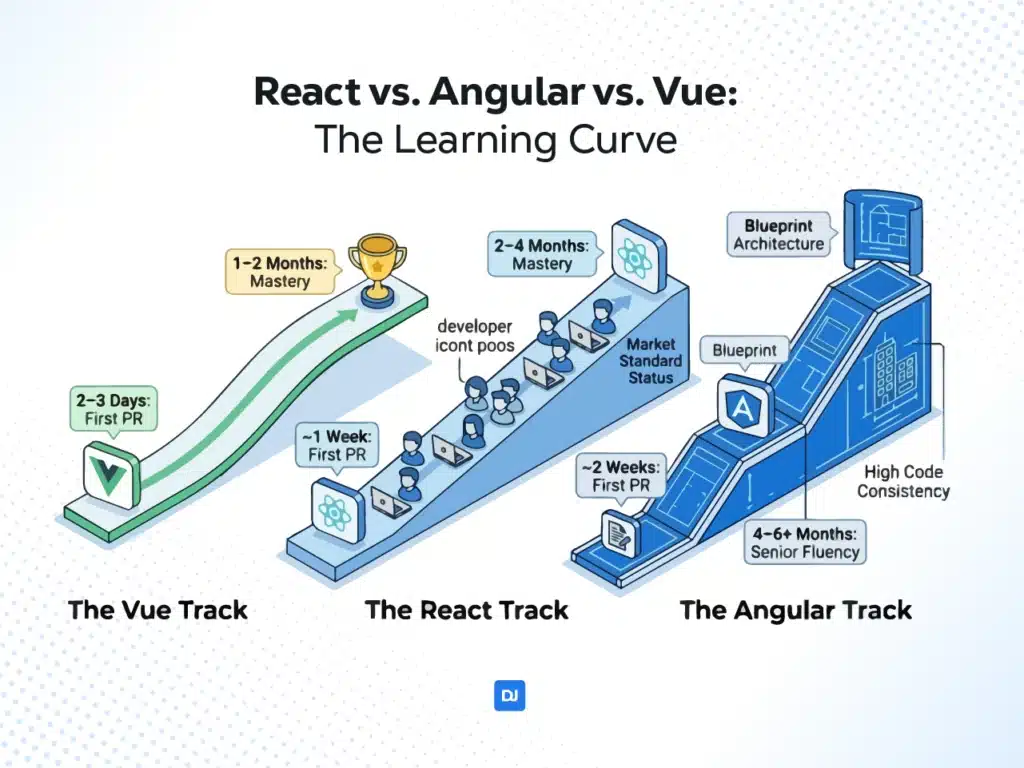
| Metric | Vue (Templates) | React (JSX + RSC) | Angular (TS + Signals) |
| Initial Learning Curve | Low (Gentle) | Moderate | High (Steep) |
| Prerequisite Knowledge | HTML / Basic JS | Advanced JS / Logic | TypeScript / Design Patterns |
| Time to First PR | ~2–3 Days | ~1 Week | ~2 Weeks |
| Time to “Senior” Fluency | 4–6 Months | 8–12 Months | 12+ Months |
| Code Consistency | Moderate | Low (Requires Linters) | High (Built-in) |
1. Vue: 1–2 Months to Mastery
Vue is the gold standard for developer experience (DX). Its Template System is the secret weapon for project leads managing teams with mixed skill levels. The State of Vue.js shows that 93% of developers who have used Vue plan to use it again.
Developers can look at a component and instantly understand its structure. Unlike JSX, it doesn’t require thinking in JavaScript just to render a list.
And with Vapor Mode, Vue has simplified its reactivity. It removes the need to understand the Virtual DOM’s inner workings, as the compiler handles optimizations on its own.
You can hire a junior dev on Monday, and they could usually commit a bug fix by Wednesday.
2. React: 2–4 Months to Mastery
While JSX (JavaScript XML) is easy to start with, the “rules of hooks” and the React Compiler architecture are hard to learn.
React requires developers to be highly proficient in modern ES6+ JavaScript. Since “everything is just a function,” a dev must master map, filter, and ternary operators just to build a basic UI.
The biggest struggle is the Client vs. Server boundary. Developers must learn when to use ‘use client’ and how to handle data fetching in Server Components.
That being said, React has the largest talent pool. However, “knowing React” demands knowing an entire meta-framework like Next.js.
3. Angular: 4–6+ Months to Mastery
Angular 20/21 has undergone a “Renaissance” by moving to a Signals-based, Zoneless architecture. However, it remains a heavyweight champion in terms of complexity. Specifically, it utilizes an object-oriented, decorator-heavy style that can be jarring for developers coming from a pure JavaScript background. Consequently, they will need strong TypeScript skills.
A new Angular dev doesn’t just learn a library; they must also master Dependency Injection, RxJS (which is being phased out but remains present in legacy code), and the Angular CLI’s strict project structure. Admittedly, this makes onboarding slow and expensive, but the ultimate payoff is consistency. For example, in a team of 50 developers, Angular ensures every file looks exactly the same, effectively preventing architectural drift.
Ecosystem and Longevity: Corporate Backing vs Community
React (formerly Meta, now Linux Foundation) and Angular (Google) provide a predictable safety net. In the meantime, Vue proves that a community-first model can rival (and sometimes outpace) corporations.
React is the safest bet for both career and ecosystem longevity. Angular is the choice for those who need stability from a tech giant like Google. And Vue is for teams that want the fastest path to production, backed by a community that doesn’t need a Silicon Valley parent to survive.
| Feature | React (Foundation) | Angular (Google) | Vue (Community) |
| Governance | Neutral (Linux Foundation) | Corporate (Google) | Democratic (Core Team) |
| Primary Funding | Multi-corp (Vercel, Meta, MS) | Single-corp (Google) | Sponsorships & APAC Enterprise |
| Release Cadence | High (Experimental features) | Strict (Every 6 months) | Moderate (Feature-driven) |
| Longevity Risk | Near Zero (Ubiquity) | Low (Internal Google use) | Low (Proven maturity) |
| Best For… | Universal flexibility | High-security Enterprise | Rapid innovation & lightweight apps |
1. React: From Corporate Ownership to Global Infrastructure
As of February 2026, React is no longer owned by Meta. It was transferred to the React Foundation, which is part of the Linux Foundation. Meta remains a strong founding member alongside Amazon, Microsoft, and Vercel.
While Meta handles the core, Vercel ensures that React is a fully-funded library and its ecosystem has enterprise-grade deployment pipelines. No single company can kill it on a whim; it’s the highest-stability choice for 2026.
2. Google (Angular): An Enterprise Golden Path
Google’s relationship with Angular remains direct and opinionated. Angular 20 and 21 have solidified a Zoneless architecture (no need for Zone.js) using Signals. This is a big move by Google to keep the framework competitive for its own internal massive-scale apps (like Gmail and Google Cloud Console).
Google’s backing means a predictable 18-month support lifecycle. Now you know exactly when a version will die (e.g., Angular 19 EOL is May 2026).
Google has used Angular for over 3,000 internal apps. Angular will be maintained with high-security standards (SOC2, HIPAA compliance), making it the best choice for “Regulated Industries” (Banking, Healthcare).
3. Vue: The Community-Driven Powerhouse
Vue remains the outlier, thriving without a single Big Tech parent. Instead, it relies on a diverse network of corporate sponsors (like LWS and various Asian-Pacific giants) and a massive global community.
Vue 3.6 introduced “Vapor Mode” and “Alien Signals.” The community often implements performance features 6–12 months before React or Angular.
Moreover, Vue holds a soft monopoly in the APAC market and parts of Europe, where developers prefer its progressive nature (easy to drop into a small part of a page).
Talent Acquisition: Availability of Skilled Developers
The table below uses Indeed counts as a snapshot (late March 2026). These should be treated as directional, not absolute, because job boards (a) de-duplicate imperfectly, (b) change ranking/indexing, (c) include broader titles (e.g., “Full Stack”) that may still require the framework, and (d) are sensitive to keyword spelling (notably “Vue” vs “Vue.js”).
| Region (Indeed domain) | React “developer” jobs | Angular “developer” jobs | Vue “developer” jobs | Vue “Vue.js” jobs (terminology effect) |
| Australia (au.indeed.com) | 263 | 55 | (not shown with this exact query) | 26 |
| Ireland (ie.indeed.com) | 92 | 30 | 7 | 26 |
React demand is substantially higher in both snapshots; Angular demand is typically second; Vue demand is often present but under-counted unless you search “Vue.js” explicitly (a genuine uncertainty in job-board keywording).
Developer Supply and Senior Availability
The Stack Overflow Developer Survey gives a large-sample view of which web frameworks respondents used in the past year. In 2025 (professional developers), React leads, with Angular and Vue in the high-teens. 2024 shows similar ordering; however, React is still clearly ahead.
| Survey | Population | React | Angular | Vue |
| Stack Overflow 2025 | Professional developers | 46.9% | 19.8% | 18.4% |
| Stack Overflow 2024 | Professional developers | 41.6% | 19.4% | 16.6% |
Integration and Flexibility: Fitting into Your Current Stack
React and Vue are designed to be integrated into a “Best-of-Breed” stack. They are the preferred choice for Micro-frontend and Islands architectures. In the meantime, Angular doesn’t just play with your stack; it becomes your stack’s biggest frontend asset.
| Feature | React 19.2+ | Vue 3.6+ | Angular 21+ |
| Integration Cost | Low (Library first) | Low (Progressive) | High (Platform shift) |
| Third-Party Reliance | High (Need external tools) | Moderate (Official plugins) | Low (Built-in everything) |
| Micro-frontend Fit | Excellent (Module Fed.) | Excellent (Islands) | Good (Shell/Remote pattern) |
| Tooling | Meta-framework dependent | Vite-first / Fast | Angular CLI / Comprehensive |
Which Framework Should You Choose for Your 2026 Project?
There is no objectively “best” framework in 2026; React, Angular, and Vue are all production-ready and capable of powering large applications. Choosing between React, Angular, and Vue in 2026 rests on your team’s composition, project scale, and long-term governance needs. Here is a final decision matrix to help you choose based on your specific scenario.
| If your priority is… | Best Choice | Why? |
| Speed to Market / MVP | Vue 3.5+ | Lowest boilerplate; “Vapor Mode” provides instant performance with minimal setup. |
| Hiring & Talent Pool | React 19.2+ | Largest global ecosystem; virtually every frontend dev knows React or a meta-framework like Next.js. |
| Enterprise Governance | Angular 21+ | Opinionated structure prevents “code rot” in large teams; built-in security and testing are industry-standard. |
| Micro-frontends | React or Vue | Lightweight core makes them easier to wrap and deploy as independent “islands” or modules. |
| Performance (Low-end devices) | Vue (Vapor) | Smallest bundle size (~12KB core) and zero Virtual DOM overhead in Vapor Mode. |
In short
- Go with React if you want the Default choice that fits 90% of use cases and has the best hiring prospects.
- Go with Angular if your team is large (15+ devs) and you want your project to last for years straight.
- Go with Vue if you have a small, fast-moving team that values a clean, high-performance developer experience.
The bottom line
Ultimately, your choice should reflect your hiring strategy. For instance, if you need to find a senior architect tomorrow, React is your best bet. On the other hand, if you need a standardized environment for 50+ developers or a project with strict compliance, Angular is the answer. Alternatively, if you want a fast-moving, happy team with a low barrier to entry, Vue is the winner.
Regardless of your choice, whether you’ve settled on the flexibility of React, the structure of Angular, or the elegance of Vue, you need experts who can turn these tools into a competitive advantage.
DistantJob headhunts world-class senior React developers who master these specific stacks and are ready to integrate into your timezone and culture.
Contact DistantJob Today to find your next Senior React, Angular, or Vue expert in as little as two weeks.
FAQs About React vs. Angular vs. Vue
There is no single “best” framework. First, React is the safest choice for most projects due to its enormous ecosystem and talent pool. Angular is best for large enterprise applications (15+ developers) requiring strict structure and long-term governance. Vue is ideal for small-to-medium teams prioritizing developer experience, fast MVPs, and minimal bundle sizes. All three are production-ready in 2026.
Vue 3.5 leads in initial bundle size (18–22 KB) and time-to-interactive (1.2–1.8s). React 19.2 follows closely with efficient Virtual DOM rendering and automatic batching. Angular 20 has a larger initial bundle (110–130 KB). However, it excels in memory efficiency for long-running enterprise sessions through its Incremental DOM. In practice, implementation quality matters more than framework choice.
Vue has the lowest learning curve. Developers can typically commit their first PR within 2–3 days and reach productive fluency in 1–2 months. React requires 2–4 months due to JSX, hooks, and the Client/Server boundary. Finally, Angular takes 4–6+ months because of TypeScript requirements, Dependency Injection, and its strict architectural conventions.
React dominates the job market with approximately 46.9% of professional developers using it (Stack Overflow 2025). Angular holds second place at 19.8%, with strong enterprise demand. Moreover, Vue sits at 18.4% but is growing, particularly in APAC markets. And React developers also command the highest average salaries ($95,000–$130,000/year in the US).
Yes. Angular has undergone a significant modernization with Signals-based reactivity and zoneless architecture (v20/21). Furthermore, Google uses Angular for 3,000+ internal applications. Thanks to that, the framework remains the top choice for regulated industries (banking, healthcare). All due to its strict TypeScript conventions, built-in security, and predictable 18-month support lifecycle.
Yes. Vue 3 with the Composition API, full TypeScript support, and the Nuxt 3 meta-framework has closed most enterprise gaps. Companies like Alibaba, GitLab, and BMW use Vue in production. However, the Vue talent pool is 40–60% smaller than React’s, which can make hiring for large enterprise teams more challenging.
Yes. Angular requires TypeScript. React has strong TypeScript support through community tooling and is increasingly adopted in production React codebases. Vue 3 offers excellent TypeScript support, especially when using the Composition API. All three are viable for applications in 2026.
Match the framework to your context. Choose React if you need the largest talent pool, plan to build a mobile app with React Native, or need Server Components for content-heavy applications. If you’re building large-scale internal tools with 10+ developers and value prescriptive architecture, Angular is your best bet. Finally, choose Vue if time-to-market is your top priority and your team values developer experience. The framework matters less than the team; a senior Angular team will outperform a junior React team regardless of benchmarks.