

“DJ is phenomenal. They find amazing candidates, make hiring extraordinary devs easy. Think of it as having a top recruiter, HR, and payroll departments in dozens of countries.”


We don’t have a bench of Salesforce developers waiting for a project. We don’t need one. For every role, we run a custom search against your stack, cloud, certifications, time zone, and team. The developer we present is the developer you’d have hired yourself if you had the recruitment infrastructure to find them.
The developer becomes part of your team. Not ours.

Andres
Recruitment Expert
Verified
Salesforce is a wide platform, and "Salesforce developer" can mean six different things depending on what you're building. We recruit across all of them.
The core engineering roles. Apex (server-side), Lightning Web Components (LWC) for modern UI, Visualforce for legacy code paths, SOQL and SOSL for data, and the Salesforce DX toolchain for modern source-driven development. The developers we place are typically Salesforce Certified Platform Developer I or II, often both.
For organisations with complex Salesforce environments, the architect roles cover the high-stakes design decisions: data model, sharing and visibility, integration patterns, multi-org strategy.
Most production Salesforce work is shaped by which cloud it lives in. We recruit specialists for Sales Cloud, Service Cloud, Marketing Cloud, etc
The newest part of the Salesforce stack and the hardest to staff for. Agentforce agents, Einstein prompt and prediction work, and Data Cloud (formerly CDP/Genie) require engineers who have actually shipped these features in production, not just read the documentation. We have placed against all three since they reached general availability.
The integration layer is where many Salesforce projects succeed or fail; the engineers we place at this tier tend to also have non-Salesforce backgrounds (Node, Java, Python) that make them effective on both sides of the wire.
The line between admin and developer has narrowed as declarative tools (Flow Builder, Validation Rules, Permission Sets, Dynamic Forms) have absorbed work that used to require Apex. Modern Salesforce admins are often more valuable than mid-level developers for the right work. We recruit both.
| What it actually means | |
|---|---|
| Direct hire | The developer joins your team as your full-time employee or contractor. No vendor markup, no rented bench, no incentive misalignment. |
| Custom search per role | We don’t fish from a pool of pre-placed engineers. We source against your specific job description, stack, and time-zone requirements. |
| Salesforce-specific vetting | Live technical interviews with senior Salesforce engineers. Apex code reviews. Real-world architectural problems. Not multiple-choice tests. |
| One-time placement fee | No hourly markup that compounds across years. We get paid once when we place the right developer. |
| 90-day replacement guarantee | If the developer doesn’t work out in the first 90 days, we re-run the search at no additional cost. |
| 2 to 4 week typical timeline | First qualified shortlist usually arrives within two weeks of kickoff. |
The Salesforce talent market is unusual. IDC estimates the Salesforce ecosystem will create 11.6 million jobs globally between 2022 and 2028, with 4.7 million directly inside the Salesforce customer base.
The hiring demand far outpaces the available pool of senior, certified, cloud-specialized developers, especially in newer areas like Agentforce and Data Cloud.
Certifications matter more than in most stacks, the depth of cloud specialisation makes “a Salesforce developer” too vague to be useful as a search filter, and the rarest tiers (CTAs at 490 globally, senior Agentforce engineers, Marketing Cloud AMPscript specialists) are too thin for any bench-based model to reliably cover. These conditions make bench marketplaces a poor fit for serious Salesforce hiring.
| Marketplace / pre-vetted bench | Bespoke recruitment (DistantJob) | |
|---|---|---|
| How candidates are sourced | Pre-vetted pool waiting for clients | Custom search per role |
| Match quality | Whoever’s available on the bench | Whoever’s the best fit, anywhere |
| Niche stacks (Commerce B2C, FSL, Agentforce) | Often unavailable | Sourced specifically |
| Time zone control | Limited to bench geography | Sourced to your time zone |
| Engagement model | Hourly markup, ongoing | One-time fee, direct hire |
| Long-term cost | Compounds over time | Front-loaded, then flat |
| Conversion to direct hire | Often restricted by contract | The default outcome |
For most product engineering teams hiring Salesforce talent for long-term roles, bespoke beats bench. The exception is short-term, generic Salesforce work where time-to-start matters more than fit — for that, a staff augmentation provider is the right tool.
Testimonials
“DJ is phenomenal. They find amazing candidates, make hiring extraordinary devs easy. Think of it as having a top recruiter, HR, and payroll departments in dozens of countries.”

“DistantJob took the time to talk about the job description and explore what was important to us. They came back with a great candidate on the first try!”

“I can easily say that I’ve never worked with a more dedicated, patient, and productive developer. DistantJob made the remote engagement painless. Win-win!”

“We have 3 employees from DistantJob right now. Phenomenal. For the dollar value that we are spending, we are far ahead of what we would find locally or offshore.”

“Hiring through DistantJob (…) surpassed my expectations. I had no opinion before, neither for [remote work] or against, but this experience definitely put it on the radar for me.”

“DistantJob is great for helping you find technical folks especially when your local area doesn’t have the right pool of talent for the job.”

“The remote developers presented by DistantJob] delivered a caliber of quality, skill and technical expertise, beyond my best expectations, far exceeding our local team members.”

“Working with DistantJob made everything about recruiting a highly technical employee easier and cost-effective.”

Trailhead badges, Salesforce certifications, project history, GitHub or AppExchange contributions if applicable.
Live conversation to confirm working proficiency. Critical for any role that touches stakeholders or admins on the client side.
Conducted by a senior Salesforce engineer in the same cloud or specialisation. Topics include Apex patterns (Trigger Framework, Service Layer, Selector Pattern), governor limits and bulkification, SOQL optimisation, LWC component design, sharing and visibility, integration patterns, and AppExchange security review concepts where relevant.
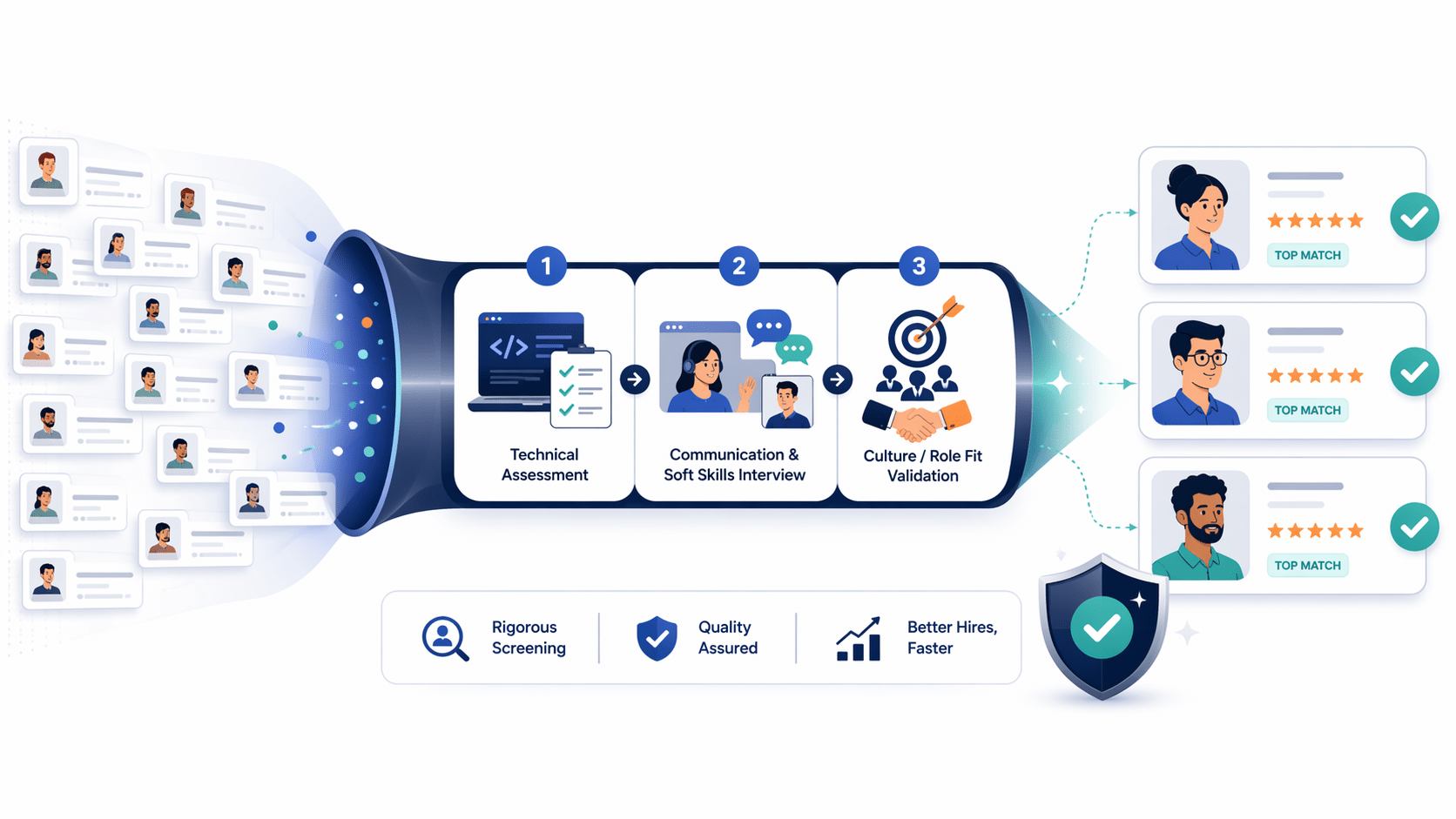
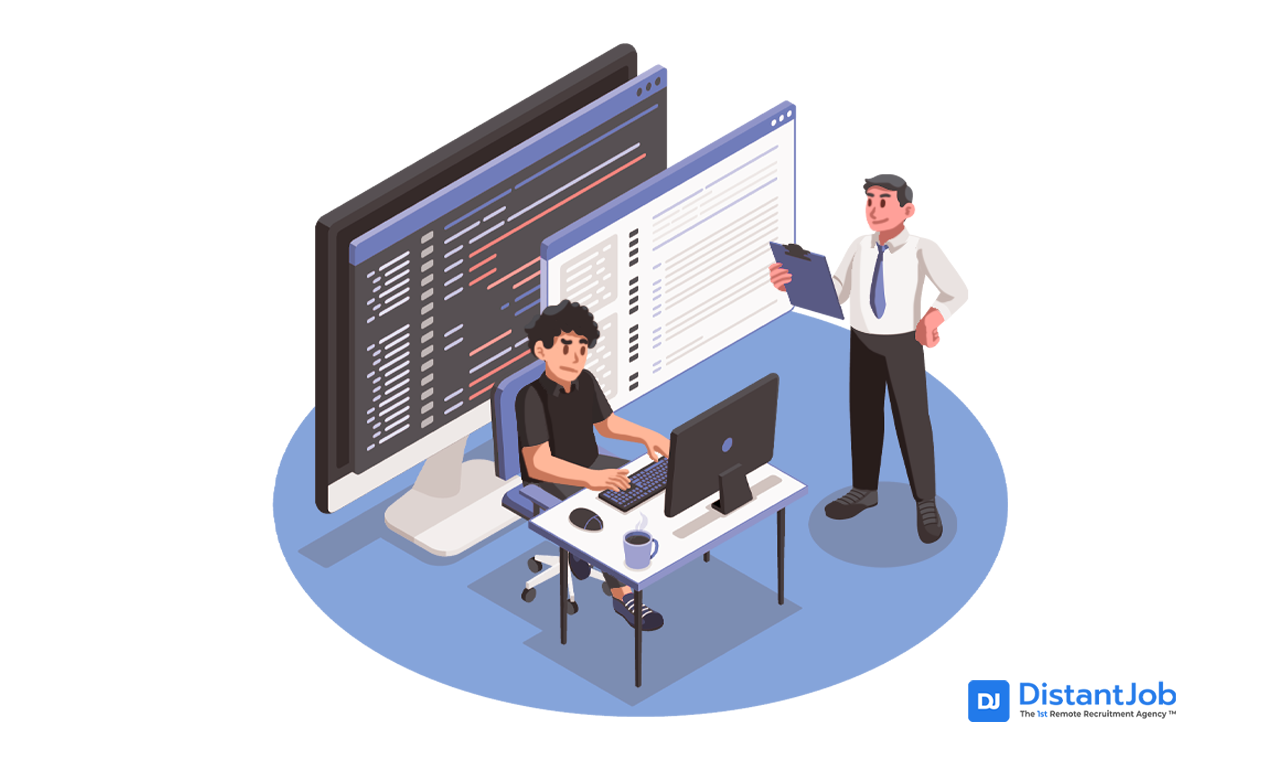
Either a take-home task or a live pair-programming session, scoped to the candidate’s claimed seniority. For platform developers this typically involves Apex and LWC. For architects, a design problem on a sample data model and sharing requirement.
Communication, ownership, working-style fit with the client’s team
We present 2 to 4 candidates we’d hire ourselves. You interview, you decide.
We’ve placed Salesforce developers from 20+ countries. The strongest regional pools for Salesforce work specifically:
| Region | Countries | Strengths |
|---|---|---|
| Latin America | Argentina, Brazil, Mexico, Colombia | Strong English, full US time-zone overlap, active Salesforce community |
| Eastern Europe | Poland, Romania, Ukraine, Portugal | Strong CET overlap for European clients, deep architecture and integration talent |
| India | — | Large talent pool, established Salesforce ecosystem, lower rates |
| United States / Canada | — | Same-country hire preference |
The country recommendation depends entirely on the role. We’ll suggest the best fit for your specific stack, seniority, and team in the first call.
A normal Salesforce developer search runs on this timeline:
We confirm the role, stack, cloud, seniority, certifications, time zone, and any non-negotiables.
We screen against the spec, run initial interviews, build a shortlist.
You receive 2 to 4 candidates with detailed write-ups, certifications, and technical interview notes.
We coordinate scheduling. You decide.
Developer starts.
The developer’s compensation is whatever you and they agree on. Typical 2026 ranges for senior Salesforce developers via global hiring:
| Region | Annual full-time (senior) |
|---|---|
| United States | $124,000 – $210,000 |
| Latin America | $70,000 – $130,000 |
| Eastern Europe | €65,000 – €140,000 |
| India | $35,000 – $80,000 |
The US range reflects Glassdoor’s May 2026 data for Senior Salesforce Developers: $123,901 to $178,226 at the 25th–75th percentile, with the 90th percentile reaching $210,449. Average across the role is $147,552.
Certified Technical Architects, senior Agentforce specialists, and Marketing Cloud Email Specialists with deep AMPscript experience generally sit 20 to 40 percent above these ranges. Platform Developers specifically (the certified specialist tier) average $151,237 with the 90th percentile at $218,922 in the US.
We’ll share the typical range for your specific role on the first call.

“”
Here are the skills to look for in if you want a talented Salesforce developer. This will help you with your job description:
For platform developers:
* Apex experience and at least Platform Developer I certification.
* Lightning Web Components for any modern UI work. Aura only matters as legacy maintenance.
* Solid grasp of governor limits, bulkification, and SOQL optimisation.
* Source-driven development (Salesforce DX, scratch orgs, sfdx CLI). If they’re still using change sets, they’re behind.
* Working knowledge of one CI/CD tool: Copado, Gearset, or AutoRABIT.
For architects:
* Data model design across multiple objects, including custom and standard.
* Sharing and visibility model fluency (org-wide defaults, role hierarchies, sharing rules, manual sharing, Apex sharing).
* Integration pattern selection — synchronous vs asynchronous, event-driven, batch.
* The Salesforce Well-Architected Framework concepts.
* At minimum, Application Architect and System Architect certifications.
For Marketing Cloud:
* AMPscript, SSJS, and SQL within Marketing Cloud are different from regular Salesforce skills. A Sales Cloud developer is usually not a Marketing Cloud developer.
* Email Specialist or Marketing Cloud Developer certification.
For Commerce Cloud:
* B2C and B2B Commerce Cloud are different platforms with different developer profiles. Don’t conflate them in the job description.
For Agentforce / Einstein / Data Cloud:
* Production experience matters more than certification here, because the products are too new for certifications to fully capture real skill. Ask for specific shipped projects.










When you partner with DistantJob for your next hire, you get the highest quality developers who will deliver expert work on time. We headhunt developers globally; that means you can expect candidates within two weeks or less and at a great value.
Increase your development output within the next 30 days without sacrificing quality.